


Is the Future Pre-determined?
By Tom Brown
Fri, 13 Nov 2009
- 11420 reads
22 comments
The assumption of an absolute determinism is the essential foundation of every scientific inquiry.
–Max Planck ( 1958 )
&
As I understand, the question of whether the physical universe is deterministic or not, is profound both in philosophy and religion. The aim in this essay is not to attempt to answer the question. I only present facts as well as observations of my own.
Determinism has fundamental implications amongst others for questions such as whether a person has a “free will” and directly related to this in religion the Christian beliefs in “conversion” as opposed to that of “the elect.” In science and in reality determinism is intimately linked to concepts such as “chance”, “risk”, “coincidence”, “luck”, “cause and effect”.
For practical purposes it decides the question of fate, or then, of destiny.
The narrative is loose and the essay informal I will digress on issues in natural science and explain some ideas in mathematics that are relevant in an indirect way. My intention really is more to entertain and stimulate the imagination.
Trajectories in phase space
One may understand the Universe and the laws for its “time-evolution” as resulting in continuous change and the development of its physical state with time, as either a “dynamical system” or the more general “semi-group”. In contrast to a semi-group a dynamical system asserts that future time as well as past time is inherently infinite, time has no beginning and no end. However seen as a semi-group there must be a start, a time equal to zero. The Big-Bang, or the moment of Creation. Edwin Hubble– Past time is finite, future time is infinite.
To explain what is meant by a “phase space” as a term used in mathematics and in physics, without going into any technical detail and without considerations of individual models, I will attempt to convey the idea in familiar language and within common experience. A “point” in the phase space specifies the whole configuration, the complete physical state of a system. In mechanics for instance it gives the position, mass, velocity and acceleration and all relevant information of each individual particle (e.g. at some moment in time).
The phase space is then the totality, the collection of all possible and all conceivable states (points) for that system. It should not confused with our familiar two-dimensional plane and three-dimensional space. Mathematically the phase space is normally of infinite dimension. It is definitely not a space as we are familiar with this word.
A trajectory is a kind of time-line through the phase space. It is a curve parametrised by the variable time t.
In a way we may think of a point in phase space as a frozen frame in some video film capturing all information as at that instant or “pause”. Whilst the movie plays the picture is flowing. Some further imagination applied from science-fiction stories and films could help! Given some specified fixed initial state x, a “trajectory” or “orbit” is then such a time curve starting at x from history to future.
The nature of time and flow
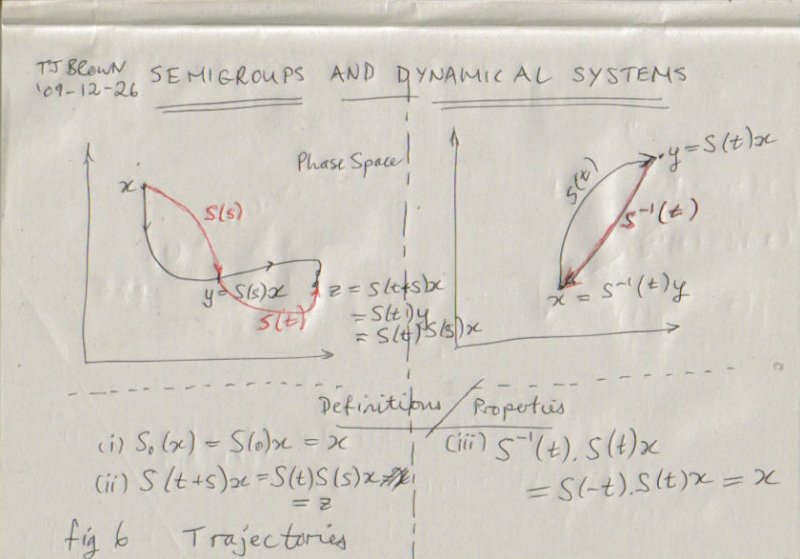
The defining properties of a semi-group are very reasonable if one thinks of time passing by. The most important rule would assert that suppose time starts now, this instant, at this state of reality, at this point in phase space X, and suppose we find ourselves at a point Z in phase space in exactly three hours. Then will be at the very same place, state Z if now also starting at X, and we “along the way” find ourself at a point Y in one hour. When starting again at Y and two more hours pass, we are also at the same destination Z.
This is in effect simply what the semi-group relation says. For interest’s sake, our causality is formulated very simply and concisely in the equation
E(t +s) = E(t) E(s)
In a way,
If we start in Cape Town and drive to Durban and stop, and start again and from there to Pretoria, we end up in the same place as when starting in Cape Town through Durban without stopping and driving straight to Pretoria.
The Illustration 3 could help. The idea is actually very simple. Thinking of daily experience all is self-evident and this is an essential property when experiencing time. This was of course not a new insight at all- the real achievement and actual significance is to be able to define this “causality” in a mathematical statement, an equation of evolution.
~
Say if in addition we can “return” from any given moment in time, in a way “see” backward to any previous time, our system is called invertible and is called a dynamical system. It has this additional property an additional constraint, a kind of “perfect memory.” Tracking history backward, reverse time as it were.
An interesting observation: If the invertability condition is not satisfied so that we have only semi-group causality, then in principle it is possible to arrive at the same state z following a different, distinct, trajectory. It means you don’t know your history. No-one can. As a manner of speaking: I know where I am, but I don’t know how I got here…
In scientific modelling the laws for time-evolution of a system are encapsulated in equations: A system of partial differential equations, PDEs, as well as certain constraints such as boundary values, and an initial state (time zero). Different situations could apply to either and the type of time-evolution approach has far reaching consequences.
A trajectory in phase space is the way reality flows with time governed by the divine laws of nature.
Heracleitus– All is flux, nothing stays still.
Perturbation and sensitivity to data
Many purely deterministic systems easily demonstrate probabilistic properties and exhibit apparent unpredictability, for example as is typically found in chaos theory and in the geometry of fractals, and even so in the most basic elementary instances. One example is the dyadic transformation. It is a very simple iteration process. We start with a given number x between 0 and 1, and double it, 2x, then take the “fractional part” for our next (new!) x, then we have done one step. The process is repeated indefinitely.
To illustrate: If x = x(1) = 0.74 then 2x = 1.48 of which the fractional part is 0.48 so that x(2) = 0.48 and now 2x = 0.96 and the fractional part is x(3) = 0.96 ; x(4) would then be 0.92 We repeat this any number of times and it gives a set of numbers scattered on the interval (0, 1). For interest’s sake if we take x(1) = 0.75 (close to 0.74!) then x(3) = 1.00 and x(4) = 0.00, this to show how incredibly sensitive the numbers are to errors!
The sequence of numbers is spread in a seemingly random fashion on interval. In fact this simple method is exactly how a computer generates its “random numbers”.
Symbolically: x(n+1) = 2x(n) mod 1
This is in fact a deterministic process but since you are working with finite precision on a computer, you are making incremental round-off errors with each iteration, every time. When experimenting on a PC you will find that you lose accuracy rapidly. The “errors” compound quickly. So soon you cannot have any clue where you should be given the given initial x, the first x, your “seed” number. It seems that the number is now random. It is not. The errors increase exponentially even for such an extremely simple example. The limitations are on your side.
The same happens when want to predict the weather. I can predict one day ahead quite well. Another day? A week? No clue. Your guess is as good as mine. Plus in this case you have the sensitivity to data of an initial state, in other words your physical measurements available right now.
Calculation of Solar orbits
Regarding the Solar system and the calculating of the relative positions of planets going far back in history, in time, I am not familiar with the numerical methods nor the modelling used “backwards” in time. But it can only be a hopeless exercise and for those same exact reasons. For a start the differential equations are totally non-linear not even remotely approachable by linear systems and on top of that you are calculating backward in time. It makes “closed form” or “analytical” solutions impossible with any known techniques. Your only recourse is number crunching.
Secondly your data simply has to be hopelessly inadequate. Added to that there are unavoidable intrinsic limitations on numerical precision of the machines. For the reason that even the slightest perturbation compounds very rapidly.
Causes of climate change
These carbon-dioxide emissions and the greenhouse effect in my own mind brings no confidence in the proposed theories of human activity’s influence on climate change- global warming then. The “events” have been throughout the aeons and characterised by greatly varying time scales, some geological, others brief, all varying in severity, some of gradual onset, some of sudden onset. There is indisputable geographical evidence and even recorded history of such fluctuations. There is enough evidence to know that volcanic and solar activity plays a role. However perturbations of the orbit of Earth clearly is the principle cause. These in turn easily can be explained by gravitational effects of the orbits and relative location in space, of the massive planets in particular Saturn, Jupiter and Uranus, the gas giants.
The fact is one cannot know the effect of orientations of planets in the distant past since you cannot know their positions, and therefore it would not be possible to have an accurate idea of the influence today. So one cannot be sure whether pollution or gravitational effects cause global warming. Furthermore most of the physical evidence of human influence presented seems to me a matter of “putting the cart before the horse”. With this I mean that if some or other coincidental observations would now ascribe global warming to atmospheric pollution, then those observations are in fact themselves the result of the climate change.
And even, is it necessarily so that industrial (human) activity by itself does increase the amount of carbon dioxide significantly? Personally I believe for the currently warming climate this is what the cause is, perturbations of the solar orbit of planet Earth and that the burning of fossil fuels contributes very little.
Invertability and recurrence
If added, the simple time “invertability” axiom makes a semi-group a dynamical system and results in unavoidable, surprising, even upsetting consequences.
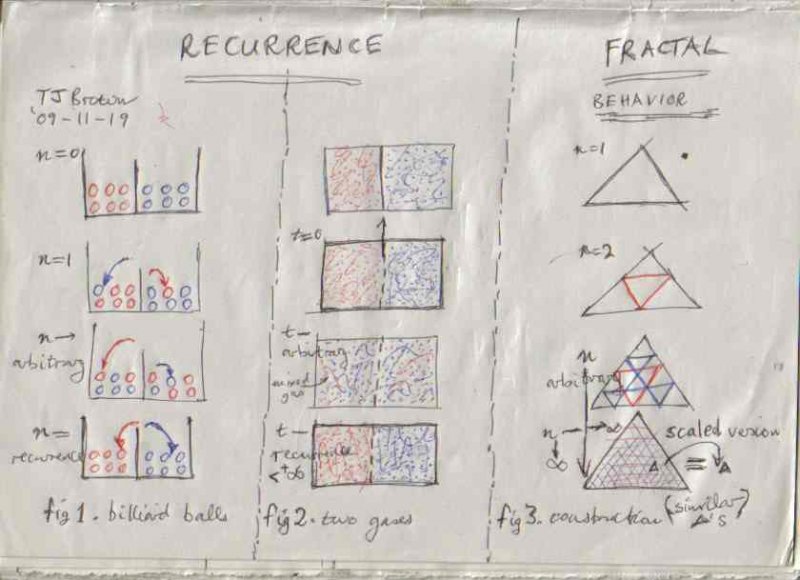
Fig’s 1 & 2 relate to the recurrence theorem for dynamical systems as proved first by Poincarè. His theorem is of a very general nature there are very few restrictions. It has startling consequences, it states that an initial state of the phase space is always revisited, and in finite time. The diagrams should give one some understanding of the concept. One could interpret this amongst others to mean that the whole universe as it is at this instant will at some future time recur, exactly as it is now, and then of course again! Infinitely many times!
In the first diagram two balls are taken at random at every step, one from each box, and they are swopped around. It makes sense that at some time one should eventually revisit the starting point and be in that same position again.
The same should apply to the second example where two gases in separate halves of a tank mix together the instant a partition is removed. In my model the two examples are identical save that in the second the number of “balls” is of many magnitudes higher. However one should realise that the expected return time in even a very small model as this is astronomical, of order of the estimated age of the universe.
Infinite sums and convergence
It will now be briefly demonstrated how this kind of behaviour is found both in mathematics and indeed in physically observed reality, and even everyday life.
The paradox “Achilles and the tortoise” originates from ancient Greece (Zeno). The idea is simple but it definitely is a non-trivial question. A very ordinary event: a door is open and one wants to close it. One must first close it halfway. Then ¾ way, or, half of that which was left. Again, the new halfway mark must be reached and this continues indefinitely. The argument then is that one cannot close the door and this is the paradox.
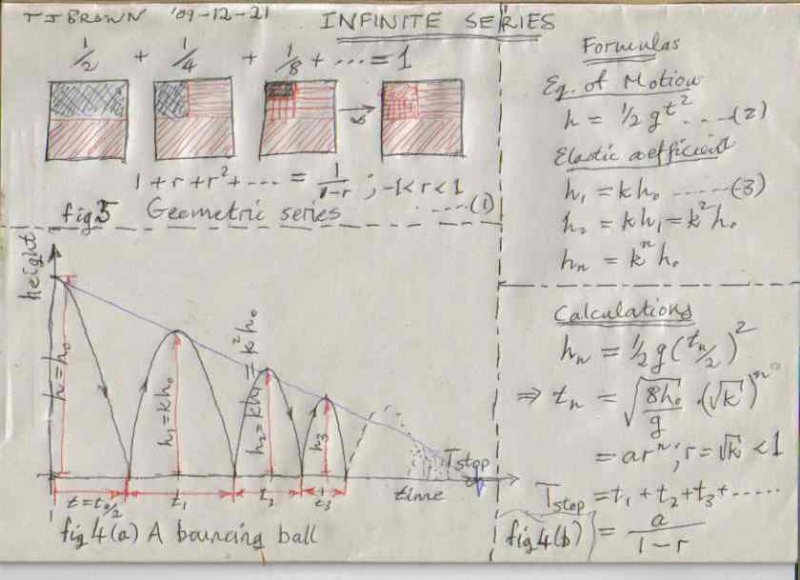
Fig. 4 should make clear the idea of how a sum of infinitely many non-zero and positive numbers can be a finite, fixed number. The square is coloured in half for half at a time and eventually the square is filled up completely coloured in. The diagrams should be self-explanatory.
If it is a unit square, then in adding up the areas we have the infinite series
½ + ¼ + ⅛ … = 1
which is in fact is exactly the same as in my version of Zeno’s paradox! The infinite series has a finite sum and the sum is equal to one.
This is not quite so spectacular. A much more interesting example is that of a ball that bounces, until it comes to rest. The ball is modelled as having a elasticity coefficient of k < 1. It would mean that with each hop kinetic energy is lost, in proportion to k. The formulas needed and my calculations are on the diagrams and the claims may be verified.
Successive times between bounces decreases in a similar geometric fashion so that the infinite sum converges and the stopping time T is finite. Note that there are infinitely many bounces, but the ball does stop.
Self-similarity and fractals
A few very typical properties of fractals are illustrated with the simple geometric Figure 1 now described
As in the illustration the geometric construction is done in steps:
1. We start with a isosceles triangle, each side 1 unit in length.
2. The midpoints of all three the sides are joined for the inscribed isosceles triangle, dividing the triangle into the four smaller triangles each with sides of ½ unit.
3. The procedure is then repeated, on each of these smaller triangles
4. And this procedure is repeated indefinitely, to infinity.
Our sketch is a kind of triangular mesh, it has surprising properties:
For example although the combined areas stays exactly the same and equal to at the start (due to the fact that a line has no area) the sum of the lengths all line segments is infinite, this isn’t hard to confirm.
The really important thing for us is that the triangle is “self-similar” and by that I mean if any little triangle, very tiny tiny is chosen, then the geometric figure obtained is identical to the original construction, it is a scaled version and in every other aspect it is an identical copy. This means that it by itself contains all information that our construction had.
Should we now repeat the same procedure, but each time just leave the centre triangle out (blank) then the construction would indeed be a “real” fractal. It would look like a kind of snowflake. One can make the same construction on regular polygons: a square, a pentagon, hexagon etc.
There are analogies in physical reality for instance holograms. I am told that when a hologram is burnt in a crystal and the crystal is cut into similar pieces the hologram again appears exactly the same in each piece. We may compare this with a glass window. Through my window I see the whole garden. When ¾ of the window is covered, again I can see the whole of the garden by going closer to the window.
Along these lines one could think on the possibility that the entire universe may be represented in every space and then every smaller space, and eventually in each point. One could speculate that each point may contain the totality of all information and knowledge.
~ ~
It is fascinating to imagine how such diverse ideas could be extended and that this all might tie up with the empathy concept. This dual causality is an extension of that of the semi-group and is given simply by
S(t +s) = S(t) E(s)
This is a simple expression but again the real insight is in formulating a dual causality between distinct vector spaces as a mathematical equation.
~ ~
One more thought
In any theory in physics the assumption has to be made that the natural laws stay inherently unchanged and unchanging where-ever one may be. For any and every place in space and time. That is an act of faith.
& Einstein–
I never think of the future. It comes soon enough.
I never think of the future. It comes soon enough.
- Log in to post comments
Comments
Most of the fundamental
Most of the fundamental ideas of science are essentially simple, and may, as a rule, be expressed in a language comprehensible to everyone.
Einstein & Infeld ( 1938 )
I'm part of everyone and these ideas are never simple enough for me to understand...Richard Feydman wrote a number of (non physics) books and he explains the different countries we inhabit very well.
- Log in to post comments
I've taking the time to read
I've taking the time to read your post and comment. QED: that is time wasted.
- Log in to post comments
Einstein was a very clever
Einstein was a very clever bloke
with his friends he wrote a joke
which became a paradox called EPR
that's not uncertain however far
A problem that has now been licked
entangled dice you can predict
as long as you can see one spin
you know the value of its twin
but if you look at it to check
the whole shebang becomes a wreck
but that is not the only crime
they claim it's right half the time :O)
- Log in to post comments
http://www.youtube.com/watch?
- Log in to post comments
Thomas Edison said
Thomas Edison said mathematics is like women he could never understand either &&
- Log in to post comments
"One could interpret this
"One could interpret this amongst others to mean that the whole universe as it is at this instant will at some future time recur, exactly as it is now, and then of course again! Infinitely many times!"
I always felt that this was a weakness in the film K-Pax where Prot makes a similar claim and advises that this makes it very important to get it right the first time… which of course pre-supposes that this is in fact the first iteration - what’s the chances that this is the first if there are infinite repeats?
It’s worth mentioning that Einstein famously said that after the mathematicians had pounced on Relativity that he couldn’t understand it any more.
Which suggests, to me at least, that they didn't understand it in the first place.
As for the tortoise and the hare - that's actually the wrong Zeno problem and is about calculating how long it takes for something moving faster than something else to catch up. Admittedly it does seem to boil down to a similar problem but it doesn't really.
With a infinitely bouncing ball it can never stop can it or by definition it isn't infinite.
I have already tackled the problem on the threads and argue that it boils down to the fact that there is a point at which there is no half left -
in other words, in practical terms when you reach the minimum.
In reality I suspect this is almost impossible as before then the background 'noise' would make the repeat unreliable.
I suppose I should clarify my point that the tortoise and the hare is a different problem even though it does appear to have the same premise. The point is that it is an artificial problem forced by a faulty method of calculating the distance travelled when they meet. The method used where by you calculate the time it takes the hare to reach where the tortoise WAS and then recognising that the tortoise has moved on requires a further calculation as to how long it takes the hare to travel this extra distance forces an infinite series but only because it is an inappropriate method.
It does however display a lovely solution of how to find a series of fractions that sums to unity.
However, if the difference between the speed of the tortoise and the hare is minute it does approximate the other problem.
It also explains why you can’t expect to accelerate a particle to the speed of light using something that itself is limited to travelling at the speed of light - unless you’re willing to wait a very, very long time.
Perhaps interestingly Tom, I found that the Tortoise and the Hare problem was related to the number base you used minus one ie.
9 in decimal, 7 in octal and probably 1 in binary
(might not work in binary though).
- Log in to post comments
Yes the whole subject is
Yes the whole subject is fascinating Tom.
Checking that my ‘system’ does indeed work for binary if we specify that the tortoise has a one yard start and the hare runs twice as fast then they should meet at two yards.
Checking, at 2 yards the tortoise has moved 1 yard (which plus the head start = 2 yards) and the hare twice as far = 2 yards!
For a problem which has the hare ten times faster we use 9 yards.
By the time the tortoise has moved 1 yard the hare has moved 10 yards the same as the tortoise (9 +1).
This works because 1.1 recurring (1.111111111111111 etc) is 1 and 1 ninth in decimal so to multiply by 9 gives 10!
However does it prove that an one ninth does not require an infinite series to be reached?
- Log in to post comments
Not Big Beethoven then
Not Big Beethoven then ;O)
Interestingly it seems that the Philharmonic Society of London originally commissioned the symphony in 1817 but Beethoven had planned to set the poem 'Ode TO Joy' to music as far back as 1793.
For me it will always be 'Take me to the Emerald City'...
Seekers version not Erasure
- Log in to post comments