


Courtesy Calls: The Fire Lane (1)

By SoulFire77
- 1046 reads
Rule 12: A fire lane exists for a reason. So does everything else.
The first thing I noticed about Darrell Burch was his shoes.
Not the Suburban — though the Suburban came into it eventually, in the way most things eventually come into their logical conclusions. The shoes first. New Balances, white, the kind kept white through deliberate effort, which told me something about how Darrell Burch organized his attention. He had left the Suburban in the fire lane outside the Harris Teeter on East Dixie Drive and was walking through the entrance with the purposeful efficiency of a man who has somewhere to be, which men of his type always have, regardless of where they are.
The shoes stayed white through the parking lot. Anyone who has spent time in parking lots understands this to be a small achievement. There are carts to navigate, puddles from the previous night's rain, the general residue of asphalt and spilled beverage and the slow grinding of tires. Darrell Burch moved through all of it without incident. His white shoes arrived at the automatic doors as white as they had left his garage.
He was inside for eleven minutes. I know because I watched the clock on my dashboard and because I had been sitting in the lot for about twenty minutes before he arrived, drinking coffee from a thermos and watching the Saturday morning sort itself out around me. After eleven minutes he came out with two bags, loaded them in the back of the Suburban — the soccer decal in the rear window catching the April sun for a moment, white and blue, before the Suburban pulled out and was gone — and drove away without looking at anyone. Not the woman who had to angle her cart around the Suburban's rear bumper. Not the young man in the yellow vest who watched from twenty feet away with the expression of someone conducting a careful assessment of their employment situation. Not me, parked in a legitimate space forty feet from the fire lane with a clear sightline and nothing competing for my attention.
I went home. Made lunch. Read for a while. Somewhere during the third chapter of a book I was not fully committed to, I decided I would go back the following Saturday.
I have been back in Randolph County for fourteen years. I grew up here, in a house my parents built on the twelve acres I now own — field on three sides and a wood line on the fourth, quiet in the way of places that have been quiet long enough that the quiet has become structural. I enlisted at eighteen, which is what you do in Randolph County when you're good at things that don't have obvious applications to civilian life and not good at waiting for them to appear. I was gone for twenty-two years. I came back at forty, when the work was finished, and moved into the house because it was mine and because I did not have a compelling argument for anywhere else.
My mother had lived in the house until the previous spring. She was seventy-nine and small and she had cleaned other people's houses for forty years without complaint, which is either a virtue or a form of grace, I've never been entirely sure which. She called me Kurt in the way nobody calls me Kurt anymore. She kept a blue glass bird on the windowsill above her kitchen sink — the color of a particular sky in early morning, the kind that looks like it can't decide if it wants to be dark or light — and she watched her programs in the evenings and treated me, when I visited, like a man who needed looking after rather than a man who could end rooms.
After she died I moved the glass bird to my own kitchen. It sits above my sink. I look at it sometimes when I'm doing dishes and my attention has gone slack.
She was the last person who knew me before I became what I became. The absence she left is not grief, which I understand to have stages and language. It is something more like a change in the quality of light.
I noticed, about a year after she was gone, that I had started spending Saturday mornings in parking lots.
This is not as eccentric as it sounds, or maybe it is, but the point is that it had a logic. I had been watching things my entire professional life — positions, routes, patterns, the way people move through space when they believe they're unobserved — and I had come home to a county that had changed, in my absence, in ways both obvious and not, and I found that the parking lots were a reliable cross-section of how. What people did with shared space told you who they thought they were and who they thought everyone else was. You could learn the whole taxonomy of a community from a Saturday morning in a parking lot if you paid attention.
Most people I watched were fine. They parked in spaces, returned their carts, navigated around each other with the low-level courtesy of people who understand that shared space requires shared management. They were not virtuous. They were practical. The negotiation of a parking lot does not require virtue. It requires only the recognition that you are not alone in it.
Darrell Burch had reached a different conclusion.
The second Saturday I saw what the first Saturday had suggested.
He arrived at nine forty-seven, later than the first week. Same Suburban — black, current year, the kind of detailed cleanliness that requires regular professional attention. Different shoes: hiking boots this time, the clean flat-soled kind that advertise terrain they have not encountered. A polo shirt with a golf course logo on the chest. He pulled into the fire lane with the naturalness of someone pulling into his own driveway, hazards on, and went inside.
I noted two things. The lot was at roughly sixty percent capacity. Three spaces were open in the first row, within thirty feet of the entrance — including two standard spaces adjacent to the handicapped zone near the door. He had driven past all three to reach the fire lane.
I also noted the handicapped placard hanging from his rearview mirror. Blue, standard DMV issue. I considered this and set it aside. The placard was not the issue I was working. The fire lane was the issue I was working, and a man who can load bags with ease and walk without modification is a man using a document the way certain men use documents — as permission to exceed what the document actually permits.
He was out in seventeen minutes. More bags than the previous week. He loaded them with the same practiced efficiency, got in, drove away. I watched the Suburban until it turned onto East Dixie and then sat in the lot for a few more minutes, finishing my thermos.
I drove to Holt's Diner on Fayetteville Street, which is where I have coffee on Tuesday and Thursday mornings and, increasingly, on Saturdays when I have something I want to sit with. Holt's has been on Fayetteville since before I was born. The counter seats twelve and the booths seat four each and Pearl Shumate has run the front of it for twenty-two years. Pearl does not ask about my life and I do not offer it. In this mutual restraint we have arrived at something that functions as friendship without requiring either of us to name it. She refilled my coffee twice without asking and slid me a piece of lemon chess pie I hadn't ordered. She does this sometimes, on mornings when she decides I look like I need something. I ate the pie. I thought about the word routine and about the specific difference between a habit that forms below awareness and one that forms despite it.
The third Saturday I arrived early enough to watch the lot fill.
The strip on East Dixie has the particular composition of Asheboro's commercial arteries — a Harris Teeter that anchors the north end, then a dry cleaner, an insurance office, a nail salon, a vape shop with a sign that I have always found grammatically ambitious. The lot fills by ten on Saturdays. By nine forty-five it was running at about seventy percent, the morning already in full exercise, carts in motion, kids, the low-level negotiations of people who need groceries and parking spaces and have learned to manage both without excessive drama.
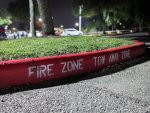
The fire lane runs the full length of the Harris Teeter frontage. Red curb, refreshed annually — you can tell by the evenness of the color. Signage at both ends, white on red, legible from a normal distance. There is nothing ambiguous about it. This is worth noting because ambiguity provides cover and the fire lane provides none. A person who parks in the fire lane has decided to park there, not failed to notice they are.
Darrell Burch arrived at nine fifty-two. Four open spaces in the first row, two of them quite good — the lot had not yet peaked. He approached at regular speed, which dropped slightly as he reached the third space, the best of the four, a first-row spot maybe thirty feet from the entrance. His head turned toward it.
I watched his head turn toward it.
Then he continued to the fire lane.
I have thought about that head turn more than the situation probably warrants. What it confirmed was not new information — I was already operating under the assumption that Darrell Burch understood exactly what he was doing. But assumptions require confirmation, and the head turn confirmed it. The distinction between a man who doesn't see the other spaces and a man who sees them and continues to the fire lane anyway is the distinction between inattentiveness and choice. Inattentiveness you can work with. Choice is a different problem, with a different solution.
He was inside for nine minutes. While I waited I looked at the fire lane — not at the Suburban but at the lane itself, the curb, the approach geometry. I thought about what the lane was for. Not as a regulation, not as an inconvenience to people with a certain kind of convenience problem, but as an operational fact: a clear approach route for a vehicle carrying equipment and people in a hurry to prevent something bad from becoming catastrophic. The lane is not painted and signed and maintained as a suggestion. It is painted and signed and maintained because emergency response vehicles need to reach the front of a building quickly and anything in their path costs time they do not have.
Darrell Burch came out at ten oh one. He loaded his bags. He drove away. I sat in the lot for a few more minutes and thought about what comes next when a man has spent three Saturdays in a fire lane and shown no indication that he will stop.
What comes next is the fourth Saturday.
The fourth Saturday I did not observe Darrell Burch. I ran my criteria.
I have a set of conditions I require before acting on anything, which I developed over two decades in work that required acting on things with serious consequences. They have stayed with me because the logic does not change with the stakes. You do not act on insufficient information. You do not act on what could be ignorance when it might be indifference. You do not act on a single instance.
Public: the fire lane at the Harris Teeter is as public as a space gets. A designated shared resource with operational implications for the entire neighborhood behind the strip. Whatever happens in it happens in plain sight and affects people who have no say in it.
Deliberate: confirmed by the head turn. Darrell Burch understood his options and selected the fire lane.
Repeated: four Saturdays constituted a pattern rather than an instance. More than enough.
Capacity to know better: yes. The man kept his shoes white. He maintained his Suburban in immaculate condition. He participated in youth soccer and displayed it on his rear window. He obtained and displayed a handicapped placard through proper channels. These are not the habits of a man operating below the threshold of social awareness. They are the habits of a man who participates in the social contract when it suits him and exercises a quiet exemption when it doesn't.
The correction needed to fit the logic of the offense. Darrell Burch parked in the fire lane because the fire lane had never cost him anything. The correction was to ensure the fire lane cost him something — not through something I invented but through something the fire lane had already earned and Darrell Burch had so far managed to avoid.
I noted that I had taken four Saturdays rather than the three my criteria technically required. The extra Saturday was something I recognized as testing myself, which is a habit I developed early and have seen no reason to drop. The thing I was testing was whether the impulse I was acting on was what it presented itself as. This is a question worth sitting with before you move, because impulses are good at presenting themselves as something more defensible than what they are. I had sat with it. The answer was satisfactory.
I went home and opened my laptop.
Randolph County parking enforcement records are available through the municipal portal and updated weekly. I spent two evenings with them. I was looking for the officer whose Saturday route covered the East Dixie corridor, and I found him in the third page of the schedule: Garrett Hollifield, eleven years with the office, route running from the municipal lot on Sunset Avenue east through the commercial strips with typical East Dixie arrival between nine forty and ten fifteen, depending on the morning's volume.
That window aligned cleanly with Darrell Burch's arrival pattern.
I also reviewed eight months of fire lane citations on East Dixie Drive. Two total. Both from the same Saturday in October during a concert event that had flooded the nearby streets and prompted an enforcement sweep. In ordinary conditions, the fire lane at the Harris Teeter had not generated a citation in the available record. This is how the fire lane became available parking in Darrell Burch's understanding of the world — not because it was, but because the enforcement window is narrow enough that violations pass without consequence long enough to become habits, and habits long enough become facts about what is permitted.
I also mapped the East Dixie approach geometry. The fire lane runs the length of the store front. The street south of the strip is Southgate Drive, a residential block that feeds into a neighborhood of mid-size houses built in the eighties and nineties. The nearest fire station is on North Cox Street, and the nearest medical response staging is on East Kivett Drive. The approach to Southgate Drive from either location runs along East Dixie, past the strip.
I thought about this for a while. I thought about what a vehicle in the fire lane does to the approach geometry when something on Southgate Drive requires a response.
On a Tuesday morning I called the parking enforcement office. I identified myself as a regular customer of the Harris Teeter and reported a vehicle I had observed blocking the fire lane on multiple Saturday mornings. I gave the make and a partial plate. I provided the approximate time window. I noted concern about emergency vehicle access. The woman on the phone was efficient. She logged the complaint. I thanked her and ended the call.
I had created a record. A timestamped citizen complaint referencing a specific vehicle at a specific location during the window when Garrett Hollifield's route already brought him past the store. The complaint would not dispatch an officer. It would flag the location for attention on his next Saturday patrol, which would proceed regardless — only now with a logged reason to look specifically at the fire lane.
The following Saturday I did not go to the Harris Teeter.
Go to the next part:
https://www.abctales.com/story/soulfire77/courtesy-calls-fire-lane-2
- Log in to post comments
Comments
A worthy pastiche written
A worthy pastiche written with authenticy and distinction.
This is today's Facebook, X/Twitter and Bluesky Pick of the Day.
Congratulations.
- Log in to post comments
I'm not sure it's a pastiche.
I'm not sure it's a pastiche. In spite of resonances, I think it's highly original. Congratulations. Well-deserved.
- Log in to post comments
we get it. He's an asshole.
we get it. He's an asshole. The narrator is the cure. But whether the cure is worse than the dis-ease makes us uneasy.
- Log in to post comments