


Admission (1)
By SoulFire77
- 30 reads
The chain-link shook after he let go. A low rattle, the kind that carried. Cody hung from the top bar for a second with his sneakers scraping the crossbar, then dropped.
His foot hit a root and the shock went through his ankle and up the bone. He sucked air through his teeth and stayed where he landed, one knee in the dirt, both hands flat on the ground. He listened. Not for voices or flashlights — for the quality of the space, the way you listen at a door before you open it to find out what kind of room you're walking into.
Crickets. The generator hum from somewhere past the tree line. And past that, the carnival — muffled, warped by distance, a sound like the inside of a seashell if the seashell was full of people screaming.
The ankle was already loosening. Three seconds of heat and it was fading, the kind that didn't stay. He'd know by the time he stood up. He cataloged it the way he cataloged all pain — by type, by how deep, by whether it would get worse when he moved or just sit there like a stone he could walk around. This one was already behind him.
He stood. Tested his weight. The ankle was fine. The ache in his left hip caught as he straightened, a slower thing, set deeper, the kind that had settled into the bone days ago and wasn't going anywhere. He shifted his weight off it without thinking about it and looked toward the lights.
The fence had torn a small hole in the cuff of his flannel. He pulled the sleeve down over his wrist and started walking.
Backstage was extension cords taped to dead grass with silver duct tape and a generator the size of a washing machine vibrating on a plywood platform. A man sat on an overturned bucket between two trailers, smoking, his face visible only as the orange pulse of the ember. He didn't look up. Cody moved past him the way he moved past all adults in unfamiliar spaces — quickly, quietly, close to the wall of whatever was nearest. Milk crates full of stuffed animals that hadn't been hung as prizes yet, their plastic eyes catching the light.
He could smell diesel and cotton candy and something else, something electrical — a burning sweetness, like a wire getting too hot inside its sleeve.
He slipped between two game booths where the plywood backs didn't quite meet and the midway hit him.
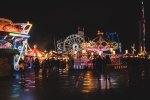
The Scrambler grinding underneath the screaming, and the bass from the Gravitron so loud it was just a vibration in the asphalt under his thin soles, and layered over that a barker chanting something about three throws for a dollar, and a child somewhere shrieking in a register that could have been joy or terror, and the funnel cake grease thick enough to taste at the back of his throat before he even located the stand, the flat char of the corndog griddle and powdered sugar, and the lights — incandescent and neon, not one color but all of them pulsing against the grease-haze until the air itself seemed lit, warm and uneven, the Ferris wheel turning its circle of amber bulbs with three dark gaps where bulbs had burned out, like missing teeth in a smile that didn't know they were gone, and under all of it the green smell of crushed grass being slowly killed under a temporary city.
A clock on the ticket booth at the front entrance read 8:17. The sign beside it: HOURS 6 PM – 10 PM. He had less than two hours. He pulled his left sleeve down over his wrist, tucked his right hand in his pocket to keep the sleeve from riding up, and stepped into the crowd.
The crowd was families, mostly. Fathers carrying daughters on their shoulders. Mothers pushing strollers with one hand and holding corndogs with the other. Cody moved through the gaps between them, filling each one and passing through without altering the current. Nobody looked at him. He was good at that.
He was scanning for food and money. But the smell got to him before the plan did. Funnel cake grease hit something in his stomach that was deeper than hunger, and his mouth filled with spit and he was walking toward the stand before he'd decided to.
He found it at a picnic table near the funnel cake stand. Half a funnel cake on a paper plate, abandoned, the powdered sugar gone gray from sitting. A fly was walking on the edge of the plate. Cody sat down across from nobody and pulled the plate toward him and curled the paper around the cake so it looked bought. He ate. The dough was cold and dense and the grease had soaked through the paper. He ate it anyway, all of it, using his fingers to get the pieces that broke off. When it was done he wiped his hands on his jeans, on the thighs where the denim was already dark, and sat for a moment with the empty plate in front of him like a customer deciding whether to order something else.
Then he got up and went back to work.
Pennies first. Two by the ticket booth, facedown in the grit where the asphalt met the grass. A nickel by the Tilt-A-Whirl, half-embedded in a dried spill of soda that had turned the ground tacky and dark. He had to peel it free. A dime near the portable toilets, where the smell kept people walking fast and looking at their feet — which was exactly why the dime was still there. Cody picked it up and wiped it on his shirt and kept moving.
A boy passed him going the other direction — his age, maybe a year younger, wearing a neon-green wristband and holding a corndog in one hand and a stuffed bear in the other. The boy was saying something to the man beside him, something with the word never in it, and the man said something back that Cody didn't catch. They passed. The crowd filled the space where they'd been.
He found two more pennies near a bench and kept scanning.
When he rose from a crouch beside the ring-toss booth the ache flared in his hip, not his ankle, higher up and deeper, the kind that tightened when he moved wrong. He shifted his weight and it settled back to where he could carry it and he kept walking.
The music from the Gravitron changed to something with a heavy synth line and the neon reflected off something wet on the asphalt — spilled soda, maybe, or melted ice — and the pink and blue light moved on the surface like oil and Cody stopped walking. He was just standing there. The midway pulsed around him, huge and bright and loud, and he was standing in the middle of it not scanning the ground and not checking his sleeve and not heading anywhere, just standing there, eleven years old, in it. Then he was walking again, and the moment was behind him like the ankle, and he did not look back at it.
The dart game was in a row of booths along the east side of the midway. Cody stopped. A boy about his age was throwing, the darts wobbling in the air and hitting the board with a flat, papery smack. The boy's father stood behind him with one hand on the boy's shoulder, the other holding a can of Pepsi. The father said something — aim lower, buddy — and the boy adjusted and threw and a balloon popped and the father's hand squeezed the boy's shoulder once.
Cody watched. Not the prizes. Not the balloons. The throwing. The stepping up, the paying, the being handed three darts by someone who looked at you when he gave them to you. The easy ordinary thing of it. A dollar, three darts, your father's hand on your shoulder telling you where to aim.
The barker noticed him. A man with a sunburn and a canvas apron full of change. His eyes swept Cody the way a register sweeps a barcode — quick, assessing, not personal.
"You want a turn, kid?"
A move-along disguised as an offer. Buy something or keep walking.
Cody gave him a small smile. "No thank you, sir."
He turned and walked away and the barker had already forgotten him. Under the bench beside the booth, caught in the shadow where the plywood base met the ground: a quarter. Cody's hand was on it before the rest of him finished deciding. He rubbed the grit off with his thumb and slid it into his pocket with the others and kept moving.
He was passing the funnel cake stand again when a hand closed on his shoulder from behind.
He stopped. Everything stopped. His feet planted and his eyes went to the ground and his shoulders dropped and his whole body pulled inward and downward and got small and still in a motion so fast and so complete it was like a picture of a boy being replaced by a smaller picture of the same boy. He didn't breathe.
"Watch where you're going, kid." A man's voice, annoyed but already losing interest.
The hand lifted. The man walked past, a large shape in a blue t-shirt, already looking at something else.
Cody blinked. His shoulders came back up. He took a breath and let it out and the whole thing was over in the time it took someone to step around him, and he was walking again, and no one who'd been watching would have seen anything except a kid who got bumped and said nothing, and no one had been watching.
Between two trailers, where the extension cords ran thick along the ground and the light from the midway came through in slats, he emptied his pocket into his palm.
He counted. Two pennies. Two pennies. Nickel. Dime. Two pennies. Two pennies. Dime. Quarter. He added it up. Seventy-six cents. He'd seen the chalkboard by the tent. A dollar fifty. He needed seventy-four more cents.
He put the coins back in his pocket and went out again.
The midway was thinner now. A ride at the far end had stopped, its lights still on but its chairs empty and swinging. The PA crackled something about the carnival closing at ten. The Ferris wheel still turned, but slower, and the screaming had thinned to occasional shrieks that sounded less like joy now and more like the sound itself was getting tired.
He found a dime in the grass near the cotton candy cart. A nickel in a shadow. Two pennies in the trough of a booth where people rested their elbows. Another dime in a crack where the asphalt had split — he had to dig it out with his fingernail, the metal edge biting the soft skin under the nail, and he got it.
He went back to the space between the trailers and counted again. His hands were steady. He laid the coins out in rows — pennies, nickels, dimes, the quarter — and added. A dollar fifty-three. Three cents over.
He could keep the money. Buy something to eat tomorrow with a dollar fifty-three. A can of ravioli from the gas station. A pack of crackers. His stomach, still working on the cold funnel cake, made a suggestion.
He put the coins back in his pocket and headed for the far end of the midway, where the lights got thin and the music faded and the ground turned from asphalt back to grass.
The tent was older than anything around it. The banner across the top was hand-painted in colors that had been bright once — reds and yellows and a deep blue — faded now to the palette of a photograph left in the sun. WEIRD WONDERS OF THE WORLD, in letters designed to look like they were dripping. Below the banner, a chalkboard on an easel: ADMISSION $1.50.
The ticket-taker sat on a folding metal chair beside the tent flap. A woman, older, with a cardigan pulled around her shoulders despite the heat. She was reading a paperback, holding it close to her face in the weak light from a bulb strung on an extension cord. She didn't look up as Cody approached.
He reached into his pocket and took out the coins. He placed them on the card table beside her. Not dumped — placed. The quarter first. Then the dimes. Then the nickels. Then the pennies, each one put down with the care of a child who knows what each one cost. The woman looked at the coins. Looked at him — briefly, without interest, the way you look at a clock you've checked a hundred times — and swept the coins into a cigar box under the table.
She held the tent flap aside with the hand that still held the paperback. Her thumb kept her place.
Cody walked in. The temperature dropped. Not cold — damp. A coolness that smelled like formaldehyde and old canvas and dust and the absence of moving air. A boombox sat on a folding chair just inside the entrance, playing a synthesizer tape of what was supposed to be spooky music. The tape hiss was louder than the melody. The play button was held down with a strip of masking tape that had yellowed and curled at the edges.
The tent was a corridor. Canvas walls on both sides, exhibits on tables and pedestals, the path running straight toward the far end where the light dimmed and the canvas narrowed and the sounds from the midway became just a vibration in your feet.
He walked.
The first exhibits were in jars. Blue-gelled bulbs behind the tables cast a cold, aquatic light that made everything look like it was underwater. A two-headed piglet floated in amber fluid gone almost to brown, the heads slightly different sizes, one with its mouth open as if it had been trying to say something when they sealed the jar. A card in front of it, hand-lettered in black marker: TWO-HEADED PIGLET — BORN IN ARKANSAS, 1961. The piglet turned slowly in its fluid as Cody's footsteps vibrated the table, suspended, held in place, going nowhere.
He moved on...
(To Be Continued)
- Log in to post comments