


The Bungalow-5

By Ivan the OK-ish
- 101 reads
Continued from Chapter 4: The Bungalow-4 | ABCtales
Hawke sat in an aisle seat. Normally, he preferred the window, so he could look out at the tracks, the signals, the concrete cable troughs speeding past, but not today.
Several passengers got out of the carriage at East Croydon; quite a few more got on. It was the busiest station on the line. Hawke looked up and down. Nobody that looked obviously like a detective or plain clothed policeman, but then they tried not to be too obvious these days, clumping around in size ten boots, he supposed.
The young woman opposite, in an orange sleeveless vest and a pinched little rosebud mouth, was on her phone: “And I said to her, I’m not going to do the evening shift, I’d already done Wednesday and if that cow thinks …” Could be a cop, he supposed. Equally, could be a woman bitching about her work hours.
Four guys in the bay opposite, two in suits, two in jeans and trainers. Each to a man peering at his mobile.
Hawke felt conspicuous in his massive maroon jacket. Budgie had been right; he was roasting. He slipped it off and folded it carefully, putting it onto his knees. He couldn’t resist checking to see that the capacious inside pocket was still zipped up.
The train was spinning through Sydenham at 70mph; the speed calmed his nerves a little. Unlikely that old Beemer would be able to keep up in South London traffic, even if it did have flashing blue lights hidden behind its radiator grill. Brockley…New Cross Gate…now they were swinging through the junction with the lines from Kent, the Millwall football ground on the left. A disconsolate groundsman pushed a wheeled machine along the edge of the pitch.
The old Metal Box factory on the right of the tracks. The train almost came to a halt at the place it always did, just opposite the Downside Boys’ Club in its big brick and tin shed. The motors whined again and the train slid into platform five at London Bridge.
Hawke looked at his phone; Nine fifty-nine; departure not due until ten-O-one. The four guys opposite got off, so did the woman with the pinched mouth. He stayed put in his aisle seat and checked his phone again.
The door hustle alarm began its ‘beep-beep-beep-beep-beep’. Hawke remained in his seat for a split second, then leapt from his seat, out onto the platform, just as the doors closed behind him.
He peered through the train windows as it glid out of the platform; no obvious signs of agitation inside, no one else had stirred from their seat. Then he went over to a bench and sat down, putting his big maroon jacket folded on the bench besides him.
He let a couple of northbound Thameslinks arrive and depart, then rose from his seat and got into the 10.28 to Luton. As it squealed and ground around the right-hand curve Hawke plodded through the open-pan carriages until he reached Coach number eight of eight as the display proclaimed.
He hurried out of the east exit of the station and along the riverside. There weren’t too many tourists around this early in the morning. He passed the Tate Modern; he’d never been in the place, though Hawke had a suspicion that he’d disapprove. Dead animals floating in formaldehyde, wasn’t it? Then the Globe theatre. Hawke didn’t have any opinion on Shakespeare.
He turned sharp left down and halted at the entrance to Bankside jetty, outside the ticket office. He took the ticket he’d printed out at home and showed it to the Thames Clipper lady. Still a good five or six minutes before the Barking service, no sign of the boat yet. He looked up and down the riverside. No one seemed to be loitering.
A foreign school party appeared, as if from nowhere, kids with matching yellow and black backpacks, in charge of a short, stout woman teacher. The teacher made enquiries of the ticket lady in heavily accented English about the group fare to Westminster. The kids chattered among themselves in what could have been Spanish, maybe Portuguese, he wasn’t sure. They blocked the entrance to the jetty, oblivious, as only groups of tourists could. A lady with a small child was trying to get past the throng. Bloody foreigners. Bloody tourists. Hawke tut-tutted on her behalf, exhaled through his teeth, though she didn’t seem to mind, unduly, eventually steering her small charge through the crowd. Hawke followed them down onto the jetty.
The Hurricane Clipper, one of the newer and bigger boats appeared from under Blackfriars Bridge, dead on time at 10.49. Hawke sat on the backmost seat on the open air deck, right above the water, between the twin exhaust vents. He looked upwards. The crew, up in their raised cabin, had no sight of this part of the boat, hidden by the roof of the rear saloon. Except…except, there were a couple of CCTV cameras, one pointing diagonally to the Port corner of the boat, the other positioned in the other direction; probably to help manoeuvre the boat into the jetties, not to keep an eye on passengers. Hawke positioned himself on the bench seat, in between them.
He glanced towards the passenger saloon. An Asian guy, about thirty, moustachioed, in shorts leaned against the rear bulkhead, arms folded gazing out over the back of the boat towards the water. Possibly…
There was another guy, about three yards to his left. Young, dark glasses, pointy face, made more prominent by a goatee. He stared straight past Hawke, towards the water, almost deliberately avoiding eye-contact. Foreign-looking, Mediterranean. If Hawke had been a betting man, he’d put money on this one, not the Asian. Looked slightly too intelligent to be a cop, though. A Black family occupied the bench seat in front; a man, a woman, a slightly older man and two kids, girl and boy, about five or six, excited at the trip on the water. Wouldn’t put it past the Met to use a family group for a surveillance job, but they’d have to have worked mighty fast to put that little lot together in the time they’d had.
A woman to his left, standing, gripping a support pool in black-and-white printed tights and a black vest top. Long, frizzy hair. Tatts on her upper right arm, and her lower left, that was all he could see from where he was sitting. Mid-thirties, perhaps. Attractive. Hmm – possible...
Hawke forced himself to relax a little. He watched the deck crew at work. A tall, bearded guy in shorts a white shirt with naval epaulettes and a stocky, woman, also, in the dark top of the Thames Clipper uniform. Both tossed looped coils of rope expertly around bollards as the boat pulled into each jetty. The guy tried an ambitious throw with the boat still ten feet away from the shore, and missed. The woman laughed. She’d be a good girl to go round Cape Horn in a force ten with, Hawke thought. Her solid, round calves reminded him of Hales, not that he could imagine Hales tossing ropes and heaving gangplanks around.
After Wapping, a tannoy announcement that Hawke didn’t quite catch but something about full speed ahead. The Hurricane Clipper’s engines roared, the exhaust vents spewed cooling water and diesel fumes simultaneously. The street scene on the river bank looked as if it was a film that had been put into fast-forward.
Canary Wharf, then Greenwich, where half the passengers got off, then Canary Wharf from the other side as the boat rounded the loop around the Isle of Dogs. Pointy-face, the Black family, Mr Asian-in-shorts and Ms Black-and-White tights had all disappeared by now.
The deck crews swapped over at Greenwich. An Asiatic-looking pair, a man and a woman. Related, maybe. The woman looked tough, even stockier legs than her colleague. A good person to have on your side if you got into a fight with pirates in the Malacca Straits. That is, if she wasn’t one of the pirates herself…
The Greenwich Peninsula receded and now the tourist veneer was suddenly stripped away, as if a curtain had been pulled back – warehouses, stacks of containers, waste transfer stations, a Sainsbury’s distribution centre shiny dully in gunmetal silver-grey. The WL Uglich was getting ready to leave the Tate + Lyle wharf at Silvertown. The two Woolwich ferries, loaded with cars and trucks turning and pirouetting in the Hurricane Clipper’s wake.
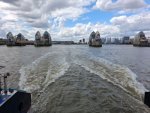
And now the battered silver helmets of the Thames flood barrier rose up ahead. There was the faintest of breezes. Hawke got up out of his seat and turned around, leaning over the guardrail. He slipped his big maroon jacket on, then groped inside and unzipped the big pocket. Carefully he took the two jiffy bags out, holding them in his right hand on the other side of the rail but keeping them hidden by his jacket. The Hurricane Clipper gave a final roar of its engines, then turned across the channel towards Barking pier. Hawke relinquished his hold on the two envelopes. They dropped, together, and hit the water with a sharp plop between the two mighty exhausts, leaving only the tiniest flecks of foam on the grey blue surface of the Thames.
As the Hurricane Clipper tied up, the WL Uglich throbbed past, churning up the water, brown streaking the grey-blue, bound for Ust Luga.
He didn’t get off at Barking but stayed on board. Just like the old days, with Marjorie.
Hawke gazed out at the twin wakes as the vessel sped back towards London, the banks of the river distant smudges on each horizon. They passed back through the flood barrier, the silver bulk getting steadily smaller and smaller. This was the place, sitting in the bright spring sunshine, almost the exact same position on the boat, that Marjorie had said: “Hawky, I’ve got something to tell you…”
That was, what, two and a half years ago? God…
The meal they’d had that evening in the White Hart in Chipstead had been strangely normal, almost cheerful. Except at one point, Marjorie had said: “Well, I guess I’ll never cycle the Karakoram Highway now, will I? But you’ll do it, won’t you, Hawky? And I’ll be up there, like your little guardian angel, every yard of the way…”
But he’d made sure they did one thing on her bucket list, the taster flying lesson out of Biggin Hill in a Cessna. The flying school people were supposed to hand out leaflets at the end, encouraging punters to book a full course of lessons. But they didn’t; they could tell, just by looking at Marjorie, that there wouldn’t be a ‘next time’. The pilot was so choked he could hardly say goodbye. That had been a lovely June day too.
Continued in Chapter 6: The Bungalow-6 | ABCtales
- Log in to post comments