


Rat Trap: November 1978

By Cerasus Poetry
- 195 reads
By the time Alan clocked off from the Plessey site on Sutton Road, the sky was already a black and starless maw. The kind of hungry darkness that threatened to swallow the meagre radiance of the streetlamps and contrasted with the frost on the pavement, which shone like ground glass. He walked with his collar turned up and his hands shoved deep in the pockets of his donkey jacket. The wind blew straight up from the estuary, keen enough to make his eyes water.
Southchurch Road was busy in the wrong sort of way. The buses were running late again. A few women stood at the stop outside the Co-op, burdened down with shopping bags and keeping their heads low against the stiff breeze. A group of men stamped their feet as they argued about the Ford strike. Someone said the drivers might walk out next week. Someone else said they already had. Alan didn’t stop to join the queue. He was fed up hearing about it.
He cut across Warrior Square, where the grass was stiff and glistening and the benches stood empty. The sea was audible long before it was visible. A low, mechanical roar that seemed to come from everywhere at once as it echoed between the buildings. He walked down toward the High Street; past the Wimpy with its steamed-up windows; past the betting shop where another group of men stood smoking under its awning; past the record shop with Dr Feelgood posters curling at the edges in its unlit window.
The Golden Hind arcade was an island of flickering light in the dark ocean of evening. The glare of its fluorescent sign promised an artificial warmth. He didn’t mean to go in, but some impulse drove him to push open the glass doors.
Inside, the air stank of cigarette smoke, warm plastic and the coppery tang of coins. The machines blinked and chimed. A few kids clustered around a Space Invaders cabinet, shouting at the screen. The attendant sat behind the counter reading yesterday’s Daily Mirror and muttering to himself about rubbish piling up on the streets.
Alan drifted toward the fruit machines. He didn’t have money to waste on them, but he liked their cheery tunes, they way they flashed their lights and hummed as if they were thinking, the warm breath they exhaled from their coin trays.
A young woman approached and stood beside him. “You’re late,” she said.
He turned and recognised Marianne. He’d seen her around before: at the arcades, at the bus stops, at the Kursaal Tavern on Friday nights. She worked at the hospital laundry, folding sheets in a room that smelled of steam and bleach. She wore a long brown coat with a missing button and kept her hair pinned back in a way that was meant to look accidental.
Alan nodded. “Shift overran.”
“Mine too.”
She patted the side of the fruit machine. It seemed to respond to her touch with a new pattern of lights and a deeper hum that was almost a purr.
“You going home?” she asked.
“Eventually.”
“But not yet?”
“Nope.”
She nodded, as if that made perfect sense.
The arcade doors swung open automatically. A spectral gust of cold air was all that entered. The overhead lights dimmed for a moment. Marianne looked towards the exit, then back at Alan.
“Come on,” she said, tugging his sleeve.
He didn’t ask where. He just followed.
The seafront was almost deserted. The illuminations were still being displayed, but they looked tired. Bulbs were missing and their colours faded. Mechanical displays jerked out of sync. A neon fish thrashed on the end of an invisible hook. A clown’s arm twitched in slow motion. The hum of electricity rose in counterpoint to the wind.
Marianne stopped under a string of randomly flashing bulbs. “It’s like they’re dying,” she said.
“They’ve been dying for years.”
She smiled. “You’re cheerful.”
He shrugged.
They walked east along Marine Parade. The wind whipped spray across the promenade, carrying the mingled smells of salt and diesel. The sea loomed black and loud. The gulls screamed overhead, circling like they were waiting to pounce.
They passed a shuttered ice-cream kiosk, a boarded-up café and a row of empty benches. The faint aroma of vinegar drifted from a closed chip shop. The pavement was dusted with frost. The lights from the arcade behind them faded like they were being smothered by the night.
The Kursaal loomed ahead: huge, dark and decaying. Its once-bright façade was faded and its windows were cracked. The fairground was mostly shut for the season, the rides standing still and skeletal. A single bulb buzzed above the entrance, casting a sickly glow on the pavement.
Marianne stopped. “I used to come here when I was little.”
Alan said nothing.
She touched the cold metal railing. “Feels different now.”
“Everything does.”
She looked at him. “You’re not much for conversation.”
“Nope.”
“That’s alright.”
They walked on. The underpass beneath the road was ahead: a concrete tunnel that smelled of rust and urine. The kind of place kids dared each other to run through. The lighting inside was dim and intermittent. Something squealed in the gloom.
Marianne paused at the entrance. “Ratman lives down there.”
Alan didn’t react. “So they say.”
“You ever seen him?”
“Nope.”
“Me neither.”
She stepped inside. He followed close behind.
The tunnel echoed with their footsteps. The wind outside became a distant howl. The fluorescent lights struggled to be strong enough to cast their shadows. A rat scurried across the floor, then disappeared into a crack in the wall.
Marianne said, “My brother says a bloke died down here. Years ago.”
Alan nodded. “I heard that.”
“They say he still walks it.”
“They say a lot of things.”
She looked at him. “You scared?”
“Nope.”
“You should be.”
He didn’t answer.
They reached the other side of the underpass. The wind slapped them again, sharp and cold, straight in their faces. Marianne pulled her coat tight. Alan shoved his hands deeper into his pockets.
Pier Hill rose ahead, its slope steep and exposed, channelling the wind like a funnel. The lights across the pier entrance danced aimlessly. The sea roared somewhere below them, black and endless.
Marianne said, “Let’s go.”
Alan hesitated. “It’s freezing.”
“So?”
She started up the hill. After a moment, he continued to follow.
The attendant’s booth was empty and the turnstiles were unlocked. A handwritten sign hung at a crooked angle: PIER TRAIN RUNNING INTERMITTENTLY.
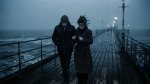
They slipped through the pedestrian entrance. The pier itself stretched out into the darkness, a long and thin bridge across to nowhere, its boards slick with frost. The wind whistled through the beams. The lights hummed their own tune. The sea smashed against the pilings below.
They walked for a good twenty minutes. The cold penetrated their coats. The wind slashed across their faces. Lamp lights provided a diffuse glow as the town shrank behind them and the darkness ahead grew.
Halfway along, Marianne stopped.
“Listen.”
Alan listened. He heard the wind, the water and the distant murmur of traffic. He heard the creak of the pier, the groan of its old planks and the faint rattle of something threatening to break loose.
Marianne said, “Feels like the end of the world.”
“Or the beginning.”
She looked at him. “You’re strange.”
He shrugged.
They walked on. The café at the end of the pier glowed dimly, condensation streaking its windows. Inside, an elderly man sat alone, stirring his mug of tea. A radio played quietly in the background: news about strikes, inflation and general unrest.
Marianne bought two teas. They sat at a table by the window, watching the restless churning of the black waves.
Alan said, “Why’d you want to come out here?”
She blew on her tea. “It’s quiet.”
“It’s cold.”
“That too.”
She looked at him. “You don’t like quiet?”
“It’s fine.”
“You don’t like much, do you?”
He didn’t answer.
Marianne said, “My mum thinks I’m at my friend’s.”
Alan nodded.
“She worries,” Marianne said. “Thinks I’ll get into trouble.”
“Will you?”
“Probably.”
She smiled, but it didn’t reach her eyes.
They drank their tea. The wind rattled the windows. The elderly man stood and left, moving slowly and leaning on the railing outside as if afraid of being swept out to sea.
Marianne said, “You ever feel like you’re stuck between things?”
Alan looked out at the water. “Sometimes.”
“Like you’re not going anywhere, but you’re not staying put either.”
He nodded.
She reached across the table and touched his hand. Her fingers were cold, but his were colder.
“Come on,” she said.
They strolled back along the pier. The lights pointed their way in a dotted line towards the shore. The boards creaked beneath their feet. The sea swirled below.
At the halfway point, Marianne stopped again.
“Alan.”
He turned.
She stepped closer. “Don’t think too much about it.”
“I’m not.”
“Good.”
She kissed him. Her lips were cold, but his were colder.
The wind howled around them. The sea crashed against the pilings. The lights flickered as if they were about to be extinguished.
Marianne said, “This doesn’t mean anything.”
“I know.”
“But it’s something.”
He nodded.
They walked the rest of the way in silence. The town’s outline began to appear as a faint glow ahead of them. Pubs, arcades, illuminations and late running buses. People hurrying and gulls screaming.
At the exit onto the street, Marianne stopped.
“You going home?”
“Eventually.”
She nodded. “Me too.”
She walked away, her coat flapping in the wind, her hair streaming loose from its pins and her breath rising in white plumes.
Alan watched her abrupt departure. He didn’t know what it meant. He didn’t know if he’d see her again. He didn’t know if it mattered.
But he felt... something... Not hope, not longing, not the prospect of escape. Just the cold. The wind. The humdrum town. The memory of her lips, cold and real. The echo of the underpass, where something had squealed in the dark.
He walked back along Marine Parade, where the illuminations were gradually being switched off. The dome of the Kursaal loomed. The arcade was being shuttered. The sea continued to roar. The wind sliced across his face.
He didn’t go into the pub. He didn’t go home. He didn’t go anywhere in particular. He just walked.
- Log in to post comments
Comments
Close encounter of the rat
Close encounter of the rat trap kind. Great story.
- Log in to post comments