


Fade

By Ivan the OK-ish
- 790 reads
FADE
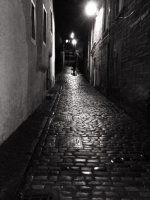
The light is fading on a February evening in an old industrial city in north-west Europe. The woman’s footsteps ring out as she hurries along the side street, cobbles glistening, then left into Avenue Maurier, right into Rue Étroite. Down in the valley, the roar of water as it rushes over the weir, mingling with the roar of steam leaking out of a pipe that crosses the dark water on an archway. Car headlights rush urgently along the trunk road that runs parallel to the river: white, yellow, white, yellow, yellow, white...
The clang-screech of a tram, the fizz of electricity somewhere across the other side of the valley.
More footsteps behind, heavier, more measured; left into Avenue Maurier, right into Rue Étroite.
There is a bite in the air. Tomorrow there will be snow.
The woman carries on down Rue Étroite, then left, right, into Rue d’Église, two rows of houses either side of the narrow street, marching up the side of the valley. Now it is fully dark. Neon, faintly, behind the grime of the window of a corner-shop; Jupiler; Kronenbourg; Gitanes. A single streetlight, crooked on its concrete post, at the corner.
She jabs a key into the lock of the little terraced house, tries to turn it. With a muttered ‘Putain!’ she gropes in her dark brown leatherette handbag for the key to the mortice lock below. Her room-mate, Céline, after weeks of pleading, has finally double-locked the front door. Today of all days.
The footsteps behind draw closer. The woman in her light beige overcoat swivels round. A cry of relief, and recognition: She drops her hands, palms outwards, by her sides. “Henri!”
One day later.
“CHARLOTTE! NON! NON! NON!” More of an animal bellow than a cry. The body of a young woman has been discovered in a derelict house off Avenue Maurier. She’ll need to be formally identified, the policeman tells Mme Faurier, but there can be a little doubt. A beige coat; a dark brown handbag. Mme Faurier’s husband, Georges, sits on the sagging settee in the tiny front parlour of the little house in Jarzy, on the other side of the river, gnarled red steelworker’s palms flat on the cushion either side. He stares ahead at the wall; he says nothing.
Three days later. Most of the snow has melted, a few ribbons of grey slush at the side. The young female police officer in a beige coat walked briskly down Avenue Maurier, right into Rue Étroit, the black unmarked Renault police sedan with the magistrate, the commissaire de police and the police photographer following slowly behind. At Rue d’Église a small crowd of neighbours and onlookers gathered behind the string of rope stretched across the far end of the street. The woman stops; jabs her key in the door, then fumbles in her bag. Now a man, in a dark overcoat, head downturned, hidden by the wide brim of his hat, gains the corner. He breaks into a half-run, now he is behind her. An arm round her neck; she folds, collapsed on the pavement. He half drags her, half carries her back along Rue d’Église, her high heeled black pumps scraping and dragging in the dirt of the street. They disappear from sight round the corner. The magistrate nods to the commissaire; the timing fits perfectly with the anonymous call to La Tribune. The Police traced the call, of course. A public phone outside the Greveux station, out in the suburbs.
‘Why didn’t he drag her inside the house? She had the keys in her hand. Why take her all that way to Maurier?’ mutters the magistrate, as much to himself as to the commissaire who shrugs: ‘Perhaps he couldn’t be certain the place was empty, that the room-mate wouldn’t be there… Les tueurs comme ça sont…rarement rationnels.’
Nobody along Église, Étroite, Maurier had seen anything between 5.30 and 5.45pm on Monday evening. An old lady on Église thought she might have heard a scraping, a scuffling at about that time. Didn’t think anything of it. A rat, perhaps. There were enough of them in that part of town, climbing in and out of the trashcans.
Five years later. Mme Faurier sets her brown nylon shopping bag down on the pavement in front of the door of the little house on Rue Église, unlocks first the yale lock, then the mortice lock, picks up the heavy bag of groceries and heaves it inside. With a sigh, she heaves it up the narrow staircase with its red-brown carpet and yellow-and-blue floral-patterned wallpaper. The landlord had offered to replace the carpet, to redecorate. She’d vehemently refused.
She’d taken over the lease of the place when the landlord put it back on the market, after the detectives had finished their work. She'd moved there from Jarzy. Céline of course had moved out; Mme Faurier had the place to herself, both rooms plus the kitchenette, and the tiny front sitting room with its two tone green carpet that didn’t quite cover the floorboards.
She put the groceries onto the cupboard shelves in the light blue cupboards of the kitchenette, haricots, tomates, maïs; her daughter had adored maize. Butter in the tiny fridge that sat on top of the kitchen table, the parents’ moving-in present to Charlotte.
Charlotte had moved into the little flat in Rue d’Église to be nearer to the lycée where she’d got her first job, teaching English. She’d only taken a three-month lease, to the end of first term, to see how things went. With Céline sharing the rent, it was quite affordable. It would probably only be for a little while, she said.
Shopping sorted, Mme Faurier went into the narrow bedroom, only a metre or so wider than the single bed with its dark blue eiderdown. She sat on it, kicked off her brown flat-soled shoes and then lay back, closed her eyes., for a few minutes. Then she reached across to her handbag on the floor, and pulled out the light blue airmail letter with the Moroccan postmark and re-read the letter from Georges. His uncle’s farm was doing OK; Georges was enjoying the work. They hadn’t been together for nearly nine years now.
There was no rancour; Mme Faurier recognised that Georges’ desire to get away from Europe was, in its way, just as strong as her own compulsion to be in Rue d’Église. The cows were doing well, the pois chiches crop less so; it had been a wet summer, wet for Morocco, at any rate. Redemption, solace of a sort for Georges.
Ten years on, mid-November. Detective Vauberin scrapes a chair across the shiny, dark brown lino and sits opposite the man, elbows on the small table, chin resting in his cupped palms. Their faces are hardly 50 centimetres apart. “We can make this easy. Or we can do it the hard way, if you want. Describe you movements, your activities between the hours of 4pm and 6pm on that evening.”
“Which evening?” says the man, a thickset guy, tough looking, about 45.
“Merde! You know perfectly well which evening. The evening of the murder of Charlotte Faurier!”
The man raises has chunky, stubby hands, palms outstretched. He shrugs. “You’re asking me to recall a random evening ten years ago. It’s impossible…”
“We pulled you in for questioning the very next day. Surely that would have fixed something in your mind? Even someone with your hectic social life.” He fixes the man with a glance, a ghost of a-smile. He fits the stereotype; no friends, a loner.
The man leans back, stares up at the off-white ceiling where the last of the day’s light from the window dances and trembles. A muffled metallic thump, then a factory hooter howls across the valley; probably the Ameroux steelworks. “I think…I think…I finished work at about four, maybe five. Then I headed home. Maybe I went for a quick drink with some of the lads from work at the Café Moulin, over in La Bavanne…”
“You know we have a new witness who can place you in Rue d’Église at 4.15pm, the time of the murder?” That was stretching a point. The old biddy in the corner shop had said, a decade after the event, that she thought she might have seen a guy vaguely matching the man’s description some time after four that evening. It wasn’t much, it would never stand up in court. Vauberin imagines her taking the witness stand; perhaps the guy knew all that. Come to think of it, the guy wasn’t much of a suspect, either. A bit strange, at least so said his workmates at Les Ateliers Choumeaux - the big steel finishing plant that stood astride the river gorge above the town; a loner; bit of history of aggro in his younger years. Still, the police chief had been keen to confront him; thought it might unsettle him, if it was him. He could be right. It would be a retirement present for the chief.
Fifteen years on, a quarter century after the murder. The light is fading on a February evening. A woman’s footsteps ring out as she hurries along the glistening cobbles, left into the Avenue Maurier, right into Rue Étroite. The water roars over the weir, but the steam from the pipe that over the river has gone; the grey insulating cladding is peeling away. Car headlights rush along the road, mostly white, perhaps one in twenty is yellow...
The film cuts to Mme Faurier, older, hair completely white but still tied in a tight bun. Charlotte was so happy to have landed a job at the Lycée Gérald, just the start she needed. She carries on talking while the film morphs into fuzzy black-and-white footage of a young teacher gathering up her books, shrugging on a beige overcoat and hurrying out of the gates of the Lycée Gerald. They’d taken down the hoardings, spruced the place up with a coat of white paint and repaired the broken windows; it was due to be torn down to make way for a new apartment block. Mme Faurier’s voice fades out, the commentator cuts in: ‘Did anyone talk to Charlotte that night? Did she say that she was meeting someone, a man perhaps?’
Back to the dark, cobbled, glistening street: more footsteps, clumping heavily; along Maurier, right into Rue Étroite. Ahead, the woman carries on down Rue Étroite, hurrying now, panicked, into Rue d’Église; neon lights gleam from the window of the corner-shop; its windows have been unboarded and the glass replaced. The camera discreetly avoids the tall new streetlight on its grey steel column.
She desperately jabs a key into the lock of the house, then gropes in her handbag for a second key. The footsteps behind draw closer. The woman in her light beige overcoat swivels round and cries out, a half-gasp, a half-scream. The camera cuts.
Retired Detective Vauberin. He’s still a big guy, fit, unbowed by his 65 years, just a little greyer around the temples. Sitting in his front parlour, the curtains drawn, he looks uncomfortable, doesn’t like the interviewer thrusting the mike towards his face; he’s more used to asking the questions, not answering them. Nowadays, the senior police bods all go on media training courses; not in his day.
The grande reconstitution was the new commissaire’s baby. It was the sort of thing that young, thrusting police chiefs were keen on. Engaging with the public, put the town and its police force and, above all, its young, thrusting commissaire de police on the map, on prime TV. The weekly crime-busting real crime programme featured lots of re-enactments, of course – they’d copied the idea from the BBC – but this was the first time one had been done for a historic crime. Jog a few memories, get people to trawl through their recollections of a February night a quarter of a century ago, maybe even prick a few consciences if anyone was holding something back; that was the idea of putting the grieving elderly mother on camera. They would have had the grieving father too, but it was five years too late for that, of course.
Forty years on from the murder. The estate agent paces in front of the door of the house in Rue d’Église. The front doorstep has been repainted, bright white; so has the triangle of brickwork underneath it. Either side of it, the two shuttered windows stare out blankly across the street.
The estate agent is nervous. The young couple who asked to see the property don’t seem to know about its history. Perhaps they hadn’t seen the TV programme, 15 years ago, didn’t know about the murder; maybe they were from the other side of the border. Of course, with all this darned Internet malarkey, they could easily find out, if they started searching. He’d need to clinch the sale before they thought of doing that, or started talking to the neighbours. It had taken years to put the place on the market; there’d been complications with the old lady’s will, and with her husband’s relatives in Morocco. The estate agent glances along the street to the corner. A smart new apartment block. The area is on the way up, he’d say.
Across the gorge, the sunlight bounces of the silver-grey structures of the new science park. ‘Go and see if there are any jobs going there,’ people urge their neighbours, their sons and daughters. ‘Or try the airport; they’re expanding there. They’re looking for people.’
There’s talk of turning the old steelworks and the finishing plant into an écoquartier.
Sixty years on. The light is fading on a February evening in the old city in North-west Europe. A woman’s rapid footsteps ring out rapidly as her black pumps clatter over the cobbles. Left into the Avenue Maurier, right into Rue Étroite. Down in the valley, the roar of water as it rushes over the weir; the pipe and its archway are long gone. White car headlights rush urgently along the trunk road, down in the valley. An old woman is dozing in the armchair in her front room. The clack-clack-clack! of the woman’s heels awakes her. At that moment in time, she is the only person thinking of the murder of Charlotte Faurier.
- Log in to post comments