


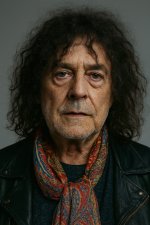
FRQNTZ EXCLUSIVE: Interview with Mark Feld - 40 Years After Live Aid
By Lille Dante
- 467 reads
Prelude: The Man Who Didn’t Die
Marc Bolan, forever the elfin prince of glam, did not perish in that fateful car crash of September 1977. Instead, fate twisted differently: David Bowie was the one lost that year, leaving Bolan to carry the torch of glam’s mythic lineage. By 1985, Bolan had weathered the late ’70s with a string of experimental records - melding funk, proto-electronica and his trademark cosmic boogie - and was poised for a renaissance.
The Road to Wembley: Live Aid 1985
When Queen withdrew from Live Aid due to Freddie Mercury’s sudden illness, organizers scrambled. Bolan was invited to step in. With only weeks to prepare, he assembled a band of then-unknowns who would later define British music in the late ’80s and ’90s:
- Drums: Phil Selway (later of Radiohead)
- Percussion: Steve White (soon to join The Style Council)
- Rhythm Guitar: Johnny Marr (pre-Smiths fame exploding globally)
- Bass: Guy Pratt (later with Pink Floyd)
- Keyboards: Neneh Cherry (before her solo breakthrough, experimenting with synths and funk)
- Saxophone: Courtney Pine (then a rising jazz prodigy)
The lineup was eclectic, raw, and prophetic - an ensemble that hinted at the future of British sound.
The Setlist: Myth and Electricity
- Children of the Revolution - opening salvo, a glam anthem recharged for the global stage.
- Tainted Love - sung by Gloria Jones, reclaiming her song from Soft Cell’s inauthentic synth-pop version.
- Medley of Hits 20th Century Boy, Telegram Sam, Metal Guru, Electric Phoenix and a fiery jam on Get It On, during which Mick Ronson joined Bolan on stage for a guitar duel.
- Tribute to Bowie - a heartfelt cover of The Prettiest Star, reframed as elegy.
- Hot Love - closing with a mass singalong, Wembley transformed into a glittering ritual.
Conducted in July 2025, on the anniversary of Live Aid’s seismic broadcast; Mark Feld, now 78, speaks from his London studio, surrounded by glitter relics, modular synths and a shrine to cosmic kitsch.
FRQNTZ: Mark, let’s begin with your career up to 1985. How do you see that arc now?
MARK FELD: I was always chasing the shimmer. The ’70s were about glam’s explosion, but after ’77, I had to mutate. Funk, disco, even early hip-hop rhythms - I wanted to fold them into my boogie. By ’85, I was restless, hungry. Live Aid wasn’t just a gig; it was a resurrection.
FRQNTZ: It’s been 40 years since Live Aid. You famously stepped in for Queen when Freddie fell ill. What do you remember about that day?
MARK FELD: It was chaos, darling. Beautiful chaos. I got the call two days before: “Freddie’s out, we need magic.” That’s destiny’s irony. I had this ragtag band of kids assembled from the ether - Johnny Marr, Phil Selway, Neneh Cherry - none of them famous yet. We were raw, electric. We didn’t rehearse. We just vibrated. Gloria sang Tainted Love like it was prophecy. And when Ronno walked on, it was like Bowie’s ghost was with us. Covering The Prettiest Star was my way of saying: ‘David, you’re still here’.
FRQNTZ: Your set became legendary - especially the opening track, “Children of the Revolution”, re-imagined as post-industrial gospel. Did you feel you were rewriting your legacy?
MARK FELD: Absolutely. Live Aid cracked open the door again. Suddenly, I wasn’t just a relic of glam - I was part of the future. It showed that glam could evolve, that it wasn’t stuck in glitter and platform boots. That performance was less rock star, more shamanic broadcast. It gave permission for hybrid sounds, for myth and funk to coexist. And socially, it reminded people that music could be ritual, not just entertainment. I wasn’t singing to fans - I was transmitting to future mythologies.
FRQNTZ: How do you see your impact now, in this post-truth, post-genre landscape?
MARK FELD: I’m a sigil, not a man. My legacy isn’t in vinyl - it’s in the way kids remix glam with glitch, how they wear sequins to protest rallies, how my lyrics get sampled in AI-generated lullabies. I’m not nostalgic. I’m recursive.
FRQNTZ: There’s a theory that your Live Aid set marked the birth of “mythic pop”: music that doesn’t just entertain but rewires cultural memory. Thoughts?
MARK FELD: I love that. Mythic pop is exactly what I was doing. I wasn’t performing songs - I was casting spells. That set was a ritual: glitter as resistance, distortion as truth, melody as memory hack.
FRQNTZ: If you could send one message to the artists of today, what would it be?
MARK FELD: Don’t chase relevance. Become a frequency. Let your art shimmer, glitch and haunt. And never forget: the future is just yesterday in drag.
Contemporary Voices (1980s–1990s)
- Mick Ronson (1985, backstage at Live Aid): “Marc was always the revolution in miniature - glitter on the outside, fire on the inside.”
- Johnny Marr (reflecting in the 1990s): “Playing rhythm for Bolan at Wembley was like plugging into a myth. It wasn’t just chords, it was prophecy.”
- Neneh Cherry (early 1990s interview): “Marc gave me space to experiment. He treated funk and glam like they were cousins at the same cosmic party.”
- Courtney Pine (1986): “That sax solo wasn’t mine - it was the spirit of Bowie blowing through me.”
Career 1985–2025: The Feld Years
After Live Aid, Bolan began releasing albums under his birth name, Mark Feld, reclaiming identity and grounding myth in flesh. His trajectory included:
- Late ’80s: Collaborations with Prince, Grace Jones, and Talking Heads.
- 1990s: Feld embraced Britpop’s energy, mentoring younger acts like Blur and Suede.
- 2000s: Experimental records with electronic producers, merging glam with trip-hop and drum & bass.
- 2010s: A return to stripped-down acoustic mysticism, touring with Courtney Pine and Neneh Cherry.
- 2020s: FRQNTZ hails him for not twisting and changing to fit in with the times, but for striving to bend the times to accommodate his new recordings and mutations.
Modern Voices (2000s–2020s)
- Thom Yorke (Radiohead, 2005): “Phil Selway told me about drumming for Bolan at Live Aid. That’s the kind of myth you inherit, not invent.”
- St. Vincent (2014): “Marc Bolan taught us that distortion could be divine. He was the first to glamorize chaos.”
- Grimes (2020): “Bolan was proto-hyperpop. He blurred the line between sincerity and spectacle, which is basically the internet now.”
- Damon Albarn (Blur, 2010): “Mark Feld was the godfather of reinvention. Britpop owes him more than it admits.”
Legacy: The Eternal Revolution
Marc Feld: My legacy? I think it’s about permission. Permission to mutate, to refuse the coffin of genre. Glam was never about glitter - it was about myth, about becoming larger than life. Live Aid proved that myth can survive, even when history tries to write you out. And reclaiming Feld was about grounding that myth in reality. I’m not just Marc Bolan, the elf prince - I’m Mark Feld, a man who lived, loved and kept singing.
Closing Note
FRQNTZ: Forty years after Live Aid, Mark Feld remains a living contradiction: mythic yet human, flamboyant yet grounded, forever revolutionizing the revolution. His Live Aid intervention, once seen as a glam-rock footnote, now reads as a rupture - a moment when pop became prophecy. His legacy isn’t just musical; it’s mythopoetic. In the age of synthetic memory and sonic propaganda, Bolan / Feld remains a beacon of glittering distortion.
- Log in to post comments