


Addition (2)

By SoulFire77
- 28 reads
The second showing was Audrey's idea. On a Tuesday Philip came home from work and Audrey was sitting on the couch with her laptop and a legal pad and she had the look she got when she'd been doing math — the focus of a woman who teaches art to twelve-year-olds and does math as combat, each number a position to be taken or surrendered.
"I called about the house," she said.
"Which house."
"Philip."
"Okay."
"Saturday at ten. I found four hundred in the Christmas fund we didn't use and if we move the car payment to the second half of the month it opens a window in April, and I'm not saying we can afford it, I'm saying we can go back and look at it with real numbers instead of receipt numbers. I want to look at it like it might be ours."
He sat down next to her. The legal pad had two columns — one labeled YES and one labeled BUT — and the YES column was longer and the BUT column was more honest and the distance between them was the distance that had always been between Philip and Audrey, the distance between a person who measures twice and a person who decides once, and the decision is a weather system that rearranges the furniture.
"Okay," he said.
"You don't have to sound resigned."
"I'm not resigned. I want to go back."
"Why?"
The room. The folder on his laptop that he had opened twice since Thursday. The floorplan in the kitchen drawer he kept taking out and refolding. These were the reasons and these were not reasons he could give to Audrey without giving her the folder.
"The garage," he said. "I want to measure it."
Wednesday, on his lunch break, in the parking lot behind the county annex, he called the number from the back of the floorplan.
It rang four times. Someone picked up. No voice, no breathing. But the line was open — he could hear the openness, the acoustic of hard floors and bare walls, the sound a room makes when there is nothing in it to absorb sound. Somewhere in it, once, wood shifted against wood — a chair taking weight, or giving it up.
He listened for eleven seconds. He hung up. Then he opened the call log and deleted the call, and it was the first thing he had ever hidden from Audrey that had a timestamp.
Saturday. Vetch Lane. The siding still the yellow that white becomes. The shutters still the green of a decision completed. Two other cars in the driveway — a Subaru with a child's seat visible through the back window and a truck older than Philip's, the bed carrying a toolbox and a folded tarp. The February light fell on the roof and the roof accepted it without comment.
Mrs. Linden opened the door. Same blouse. Same smile. Or several of the same blouse — a decision made once that did not need making again. She shook their hands. Philip's first, then Audrey's, the beat on Audrey's hand again — the held half-second that was warmth or measurement.
"Welcome back," she said.
The living room. The carpet. The acorn on the pull chain. A couple — younger, late twenties, the woman pregnant in a way that was early enough to be a secret and late enough to be a shape — stood at the window discussing light. The house had people in it, touching surfaces, opening cabinets, performing the inventory of someone else's life to see if the dimensions fit their own.
Philip went to the hallway.
The door between the linen closet and the bathroom was not there.
The wall was continuous. Off-white, unbroken, the baseboard running in a straight line from the linen closet past where the door had been to the bathroom frame. He put his hand on the wall. Drywall. Paint. The texture of a wall that has been a wall for twenty years. He pressed. Solid. He ran his hand along the surface, looking for a seam, a patch, a place where the paint was newer or the texture was finer. There was nothing. The wall was a wall.
He stood in the hallway and he put both hands on the wall and the wall was warm. Not warm the way drywall gets in a heated house. Warm the way the knob had been warm. He held his palms flat and waited. Nothing.
"Philip." Audrey was in the kitchen doorway. "Come look at this."
He followed her through the kitchen, past the counter. The galley kitchen ended at a wall — the exterior wall, the one that backed against the side yard. Set into this wall, between the end of the counter and the back door, was a door. Six-panel. Same paint, same hardware, same brass knob. It had not been here last week. Last week this wall had held a calendar, a light switch, and sixteen inches of blank space. Now it held a door.
"Look," Audrey said. She opened it.
The room.
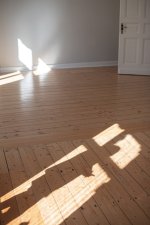
The hardwood was the same — honey oak, the boards fitted closely. The window faced south now, not east. The room was the same dimensions, and Philip's knees registered the drop of the threshold — the same inch, the same correction, the body remembering a surface it had met once before. The lavender was there. The density underneath it. The white of the walls.
The room was not empty.
A chair stood in the center of the floor. Spindle-backed, wooden, the kind of chair you find in a farmhouse kitchen or on a porch that has been enclosed — simple construction, no cushion, the seat slightly concave from use, the wood lighter there, shaped by the weight of someone who had sat in it long enough that the chair remembered them. The spindles threw thin shadows across the hardwood, sharp and regular, not quite matching the angle of the light from the window. Philip stood in the doorway. The chair sat in the center of the room, and the center was exact.
"This is nice," Audrey said. She wasn't looking at him. She was looking at the room — at the walls, at the floor, at the window, at the chair. She was looking the way she looked at rooms in museums, at the houses of friends with more money or better taste. She was measuring something — not square footage, something else, with a tape that didn't read in feet.
Her arms were at her sides. Then they weren't. She raised them — not all the way, not a stretch, but outward, slightly, the way a person does when they are checking the width of a doorway. Her fingertips reached the walls on either side. Both hands, at the same moment, at exactly the same extension. The room was the width of Audrey's arm span. She didn't seem to notice she was doing it.
"We could use this," she said. She dropped her arms. "Philip, this could be—"
She stopped.
"Could be what?"
"A room," she said. "For things." She turned from the window and walked past the chair and her hand trailed across the top of the spindle-back the way her hand trailed across the top of a student's chair when she was walking between desks — automatic, proprietary, the touch of a person who owns the space they are moving through. "The light is good."
"Audrey, this room wasn't here last week."
"What do you mean?"
"Last week this was a wall. A calendar and a light switch. This door wasn't here."
She looked at him. It was the look she gave him when he said the router was in the wrong subnet or the HVAC register was unbalanced — the things he noticed and she did not, because her attention was built for color and shape and his for the gap between what was drawn and what was built. She looked at him with patience and with the specific incomprehension of a person standing in a room that is obviously a room.
"It's a nice room," she said. "Let's keep looking."
They walked the rest of the house. The bedrooms were the same. The bathroom was the same. The living room, the carpet, the acorn. Philip followed Audrey and Mrs. Linden and he listened to Mrs. Linden describe the water heater and the crawlspace and the age of the roof and he nodded and he thought about the room that had moved, that had gained a chair and a south window, that Audrey could enter and touch and measure with her arms and could not see as wrong.
In the living room the pregnant woman was standing at the mantel. The mantel held three photographs in frames — the kind of photographs a staging company places in a house to make the house look like someone lives there. A beach scene, a mountain scene, and a photograph of the house itself taken from the street.
Philip stopped. He looked at the photograph of the house. It showed the front elevation — siding, shutters, porch, front door. And four windows. The living room window, the two bedroom windows visible from the street, and a fourth window between the second bedroom and the edge of the house. A window where the exterior wall was blank. A window that looked in on a room that did not exist from the outside and existed, undeniably, from the inside.
He picked up the photograph. The image was slightly faded, the way photographs fade when they've been in sunlight for longer than a season. The fourth window in the photograph had a curtain — white, simple, drawn half-open. Behind the curtain, the room. Behind the room, a shape that might have been the chair or might have been a shadow or might have been neither.
The pregnant woman was looking at him. A hand rested absently on the shelf of her belly, the way a hand rests on a surface that has recently changed shape. She looked at the photograph. She looked at the house through the living room window. She counted the windows — her lips moved, her eyes tracked left to right across the elevation. She looked at Philip. Philip looked at her. The distance between the photograph and the house was one window, and the one window was the room, and neither of them said anything. She held his gaze for a long moment. Then her husband called from the kitchen and she turned away, her hand still on her belly, and Philip set the photograph back.
Mrs. Linden appeared at his elbow. "Questions?"
"The photograph."
"Yes?"
"There are four windows."
Mrs. Linden looked at the photograph. She looked at it with the same attending blankness she had given the door in the hallway, the same cataloging surface, the same smile beginning at the corners of her mouth and spreading outward until it covered her face the way weather covers a field.
"Lovely house," she said.
They sat in the car. Audrey had the legal pad. She was writing in the YES column. Philip held the steering wheel and did not start the engine.
"The room off the kitchen," he said.
"What about it?"
"What did you see in there?"
"A room. Wood floors. Nice light. Why?"
"The chair."
"What chair?"
Philip looked at her. Audrey looked back. Her pen was on the pad on her knee and she was asking what chair, in the room she had walked through and touched and measured with her arms. Her hand had trailed across the spindle-back. He had watched her do it.
"There was a chair in the center of the room," he said.
"I don't remember a chair."
"You touched it. You ran your hand across the top of it."
She frowned. Not the frown of someone who is lying or someone who is caught — the frown of someone who is reaching for a memory that should be there and finding the space where the memory should be and the space is smooth.
"I remember the room," she said. "The floors. The window. It was nice. I don't remember a chair."
Philip started the engine. The idle settled into the rhythm of a car that is eleven years old and has been started twenty thousand times. He pulled out of the driveway. In the rearview mirror the house on Vetch Lane shrank. Three windows from the street. The front door, closed. Mrs. Linden's car in the driveway, the only car remaining.
They drove. The highway. The strip malls. The canopy of the dead Texaco station, the shadow Philip drove through in half a second. Audrey wrote numbers on the legal pad and the numbers were the numbers and none of the numbers accounted for the room.
At home he checked the dryer vent. He went to his office. He opened the laptop. He opened the folder. Forty-three photographs of rooms. He scrolled through them slowly, the way you walk through a house you're considering — the desks, the chairs, the light in each room a different quality of the same thing.
The forty-fourth photograph was already there.
He had not saved it. It sat at the end of the row, a thumbnail like the others, and when he clicked on it the image filled the screen: the room on Vetch Lane, taken from the doorway, the hardwood visible, the south window, the chair in the center. The light falling across the chair the way it had fallen while he stood there and Audrey walked past the chair and touched it and did not remember. The photograph was taken from the angle Philip had been standing at. The photograph was taken at the time Philip had been standing there. The photograph was of the room looking back at the doorway, and in the doorway there was no one.
He closed the laptop. He sat in the dark of his office and the carpet under his feet was carpet and the room on Vetch Lane was eleven miles away.
He went to bed. Audrey was asleep. The bedroom was the bedroom. He lay down and the mattress accepted his weight with the familiar give of a mattress that knew him. He closed his eyes. He opened them. The bedroom smelled like lavender.
Not the lavender of a candle. Not a sachet. The lavender of a living plant in a room eleven miles away, blooming in February, in a house with three windows or four, in a room that moved, in a room that contained a chair that his wife had touched and forgotten and that he could see when he closed his eyes — the spindle-back, the concave seat, the shadows on the floor, the shape that might have been sitting in it when the photograph was taken, turned toward the window, waiting for the light.
To be continued...
The "Familiar" Series:
- Log in to post comments