


Fewer Each Time (2)

By SoulFire77
- 112 reads
When the woman turned the stroller and went off along the square, the children walking beside her, Odell went back to the office.
He sat down in front of the monitor and turned it on, and the box came up in the middle of the screen and asked him for the password. He did not type anything. He took the keyboard in both hands and turned it over, the way he would have turned over a wind-up toy that had quit on a customer, and on the bottom, on a strip of masking tape, in the boy's square capitals, it said WITCHGOESRIGHT. Under that, smaller, the boy had written DON'T TELL ODELL.
He looked at it for a while. Then he turned the keyboard right side up and typed the password in, and the screen divided into four.
The four squares were live and gray. The front walk and the curb under the streetlight, empty. The counter, lit by the one lamp, with the words across the glass. Aisle two, running back from the camera over the register to the train table at the far end. The back hallway, the stockroom door shut, and the office door standing open with a slice of light coming out of it and the edge of his own shoulder in the light.
It took him some time to find where the machine kept yesterday. When he found it there was a calendar, and he pressed on the Friday, and the four squares jumped and became the same four places with the overhead lights on and a number running in the corner of each.
At 18:58 the boy walked into the counter square and turned the sign on the door.
He was in his work shirt with the sleeves pushed up. He counted the drawer the way Odell had shown him, licking his thumb on the bills, and closed it, and then he went to the front window and got to work. The exterior camera caught the window from outside. Odell watched the boy stack the hay bales, kneel and fuss with the scarecrow, open the crate of pumpkins and look into it and leave it.
At 19:12 the boy lifted the plaster witch from the right side of the window and carried her across in his arms like a sack of feed and set her down on the left. He turned her broom toward the street. Then he stood back from her with his hands in his back pockets.
Odell stopped the playback. He sat with his hand on the mouse. His other hand had gone to his shirt pocket and was pressing the button there through the cloth. After a time he let it run.
At 19:40 three small figures came up the walk into the exterior square. A woman stopped at the curb under the streetlight with a stroller, the hood turned toward the shop. The boy came out of the hallway square into the counter square, picked up the bowl from the end of the counter, and opened the door. He crouched to them with the bowl held low. His mouth was moving. Odell could not hear him, and did not need to; the boy had never once handed anything to anybody without talking. The three children stood with their bags held open and did not move. The boy dropped the taffy into their bags by the handful. They turned and went back down the walk to the woman, and the boy stood in the door and watched them go, and then he took a piece out of the bowl for himself and unwrapped it and put it in his mouth and went back to the window.
Odell dragged the bar along the bottom of the screen. The boy jerked about the window at a run, and the light outside went from blue to black.
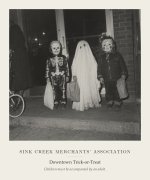
At 20:25 two figures came up the walk. The ghost and the face. The woman was at the curb.
The boy went to the door with the bowl. He crouched. His mouth moved.
In the aisle square, something moved.
Odell had been watching the door. He looked over. In aisle two, halfway between the camera and the train table, a small figure in black stood between the shelves with its back to the camera, and the white bones printed on it showed up plain under the overhead lights. It was perhaps ten feet behind the boy. It did not move while the boy talked to the two at the door. Its arms hung at its sides. Then it walked away from the camera down the aisle, not hurrying, toward the train table, and at the end of the aisle it went out of the frame to the left and was not there anymore.
The boy shut the door. He set the bowl on the counter. He came around the end of the counter and started back toward the hall, and at the head of aisle two he stopped.
The number in the corner said 20:31. The boy stood at the front of the shop looking down the aisles to the back, and he stood there a long time, and he did not touch anything. Odell had stood that same way at three o'clock that afternoon, from the other end.
Odell went back to 20:25 and watched the skeleton walk down the aisle again. He watched it four times. The fourth time he stopped it with the figure at the very edge of the frame, one foot lifted, and he leaned close to the screen and looked at the foot. Then he looked at the live square in the corner of the monitor, where his own aisle two ran back gray and empty to the train table, and the cabinet door under the table was shut on its folded cardboard the way he had shut it that morning.
The playback clock in the corner of the stopped picture said 20:25:40. The live clock in the small square said 20:24.
He looked from one to the other. He watched the live clock until it turned.
The bell went.
He did not take the bowl.
He walked up the hall and through the shop to the front, and the buzzer went on sounding through the floor until he was halfway up the aisle and then it quit. He came around the end of the counter and stopped a yard from the door.
Two children were standing on the step. The ghost and the papier-mâché face.
At the curb, under the light, the woman stood with the stroller. The hood was turned toward the shop.
They had their bags open in front of them. They did not lift them. They did not look past him. The face had the elastic around the back of its head and the crack down through the white of its forehead, and the eyeholes in the face were dark all the way back. The ghost's two eyeholes were cut uneven, the one higher than the other.
There was a wind on the square. He could see it in the bare oak in front of the bank, the small branches going, and a paper cup rolling along the gutter past the stroller wheels. The hem of the ghost's sheet lay on the step and did not stir.
Odell put his hand in his pocket and took hold of the key and held it. He did not take it out. He stood where he was, and they stood where they were, with the glass between, and he did not know how long. Long enough for the furnace to come on under the floor. Long enough for his hand to start to hurt around the key.
The face turned first, and then the ghost, and they went down the step and along the walk and stood with the woman around the stroller. None of them looked into it. None of them looked back at him.
Odell turned around and looked down aisle two.
He went down on his knees at the train table and pulled the folded cardboard out of the cabinet door and opened it. The engines in their boxes on the bottom shelf. The track above. The bag of little painted people on top, the station master and the woman with the umbrella and the boy with his hand up, waving at a train. He put his hand in behind them, all the way to the back panel, and moved it along the back panel from one side to the other. Dust. A twist tie. He took his hand out.
He shut the cabinet. He had folded the cardboard and wedged the door with it before he looked down and saw what his hands had done.
He got up and went to aisle three and stood in front of the stuffed-animal wall.
He had built it back that morning from the gap outward, the back row and the middle and the front, and it stood the way it had stood all fall, deep and soft and dusty at the top. He took down the brown horse, because it was on top. He held it against his chest with one arm and reached in with the other and took hold of a bear in the second row by its ear.
From inside the wall, low down and toward the back, close to his knees, something crackled.
It was the sound a child makes shifting on the vinyl seat of a car. Once. Then nothing.
Odell stood with the bear by its ear and the horse against his chest. He did not breathe for a while, and then he did. There was no other sound from the wall. Out on the square the paper cup went on rolling.
He put the bear back where it had been, in the second row, and turned its face out. He reached up and set the brown horse on top, square to the shelf, the way it had always sat. Then he backed out of aisle three without turning around, and only when he could see the counter did he turn.
Lorna Furr answered before the first ring finished.
"I was just fixing to call you," she said. There was no television behind her now. "He's not at Tyler's. Tyler's mother says he never came over. She says they didn't have any plans. I've called his phone I don't know how many times."
Odell stood at the counter with his free hand flat on the glass, on the I.
"He closed for me last night," he said.
"I know he did."
"When I came in this morning," he said, "the shelves were down. Most of the stock was on the floor. He'd written something on the counter."
She did not say anything.
"He wrote I quit," Odell said. "In marker. On the glass."
"Wade did."
"I thought he'd had a bad night. I thought he'd call me." He looked at the bowl. "I should have told you this morning."
"Mr. Tesh." Her voice had gone very even. "Where is he?"
"I've got the cameras up," he said. "He's here last night. He's here till late. He goes in the back."
"And then what?"
"I haven't watched the rest of it."
He heard her breathe. He heard a door, and keys, and a screen door slap shut, and then her footsteps on something hollow, porch boards, and then gravel.
"I'm coming down there," she said. "I'm calling the sheriff on the way. You stay right there where you are. Don't you leave."
"No, ma'am," Odell said. "I'll watch for you."
When she was gone he stood with the phone in his hand. Then he went around the counter and got his coat off the hook by the register and put it on, one arm and then the other, and buttoned it to the neck.
He looked down the aisles once. The train table at the end of aisle two. The cabinet door, shut. The dark at the very back where the hall went off to the stockroom and the office, and the slice of light still coming out of the office door.
He turned the key in the lock and opened the door, and the cold came in, and he stepped out onto the walk and let the door swing shut behind him.
Next Part:
Fewer Each Time (3) | ABCtales
- Log in to post comments
Comments
great sense of suspence and
great sense of suspence and something, not sure what, which adds to the mystery.
- Log in to post comments