


Hard Time Killing Floor - Part Three: The First Figure

By SoulFire77
- 203 reads
In the summer of 1964, three young men drove south from Washington, D.C., in a Volkswagen, looking for a man who might have been dead.
John Fahey was twenty-five, a graduate student in folklore who collected pre-war blues 78s the way some men collected stamps — with a taxonomist's precision and a convert's need. He had found Bukka White the previous summer by mailing a postcard to Aberdeen, Mississippi, addressed to Bukka White, Old Blues Singer. It had been forwarded twice and answered. Skip James would not be as easy.
The trail led to Bentonia, where no one had heard from him in years, and then to Tunica County, where a contact reported that a man matching his description had been admitted to the hospital. Fahey and his companions — Henry Vestine, a guitarist who would later play lead for Canned Heat, and Bill Barth, a fellow collector — drove to the hospital and walked in.
They found him in a ward bed. He was sixty-two. He had not recorded in thirty-three years. He had been a preacher, a timber cutter, a tractor driver. He had married a woman named Mabel in an Alabama mining camp and lived with her in northwest Mississippi for more than a decade. He was not well.
They asked him if he was Skip James. He said he was.
They asked him if he would play.
What he played, sitting up in the bed, was not entirely what they had expected from the man who had recorded Devil Got My Woman in Grafton, Wisconsin, in 1931. His voice had thinned. His hands were slower. But the tuning was the same — the Bentonia D-minor that had not been heard on a commercial recording in thirty-three years — and his right hand still did the percussive thing on the upbeat that nobody had been able to explain from the records alone.
They brought him to the Newport Folk Festival that July. He sat in a folding chair on the workshop stage — not the main stage, where the crowds were larger, but the smaller one where the scholars and the serious collectors gathered. He played four songs to an audience of perhaps two hundred, most of whom had never heard the Bentonia sound outside of a scratched Paramount 78. None of them had driven as far as Fahey to hear it. All of them would remember the afternoon.
She almost did not go.
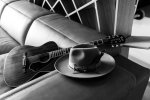
She had been wearing the hat in the flat for six days. She had been practising in it. She had been listening to records in it. She had slept in it twice without meaning to. By Wednesday at half five the hat was on her head and the SG was in its case by the door and she was sitting at the kitchen table with her coat unbuttoned, looking at nothing, thinking about ringing Pete and telling him she was ill.
She did not ring Pete. She buttoned her coat. She picked up the SG and walked to the Hopbine through Battersea in the dark, and the half-mile walk in February cold with the hat on her head was the most awake she had felt in three years. The streetlamps on Lavender Hill cast the same light they always cast. The fishmonger's was closed. The pavement was the same pavement. She was not the same person who had walked it last Wednesday without the hat and she could not have said how she knew this, except that her feet hit the ground differently, as though the ground had been expecting them.
Pete saw her walk in wearing the hat. He looked at it. He said nothing.
The Combo played the first set — the Memphis stuff, the Furry Lewis, the slow blues that paid the bills. She played it the way she had played it every Wednesday for two months. Except that her left hand was doing what she told it to do without being asked, and her right hand was doing something she had not planned — the percussive figure on the upbeat she had been trying for two years and which she had got, alone, in the flat, on a Thursday night with the gramophone — and she was getting it here, in the Hopbine, in front of Pete and the regulars and the barman.
The second set she played Devil Got My Woman. In the Bentonia voicing. The open D-minor she had tuned the SG to in the flat on the night of the testing and had not tuned it back from since.
Pete was at the bar. He did not move for the entire second set. He was holding his pint the way he always held it, thumb on the rim. He did not drink. He did not talk to the barman. He stood and watched her play and he looked at her the way you look at someone who has come back from somewhere you cannot go.
The set ended. The lights came up.
Two of the Wednesday regulars were still at their tables. They had not finished their drinks. They were not talking to each other. The applause, when it came, was a half-second late, as though the room had forgotten it was supposed to clap and then remembered.
Pete bought her a pint. He set it on the bar beside her. He did not ask if she was alright. He did not ask anything. He walked to the other end of the room and began packing his guitar in its case.
She drank the pint alone. The hat was still on her head.
She walked home through Battersea with the SG in its case and the hat on. The streets were empty. The fishmonger's was dark. She climbed the stairs and put the kettle on and sat at the kitchen table and thought about the way Pete had looked at her after the second set and about the two regulars who had not left and about the half-second delay in the applause and about none of it, because she was still inside the playing the way you are still inside a dream for the first few minutes after waking.
The Marquee was four nights later, on a Saturday.
She played in the flat every day between. The tinnitus she had first noticed on the night of the testing — the high thin note that was present whether the hat was on or off — had not gone. It was a companion now, faint, there when she woke and when she slept and when she practised. She did not mention it to Pete. She did not mention it to anyone.
Pete had booked the slot three weeks ago — a support set, forty minutes before the headliner, eight o'clock — and he had been pleased about it, because the Marquee was the Marquee and a support slot there was better than a residency anywhere else. He had not known, three weeks ago, what the Combo would sound like by the time they played it.
The room was bigger than the Hopbine. Wardour Street crowd, not the Battersea regulars. She wore the hat. She played the first set without thinking about the hat or the crowd or the room. She played it the way her hands wanted to play it. The SG sounded different in the larger room — the open D-minor gave the guitar a resonance that the Hopbine's low ceilings had compressed, and in the Marquee's taller space the Bentonia voicings opened and filled the air above the audience like something released from a smaller container.
Between the first and second song she looked up from the fretboard and toward the back of the room.
A man was standing against the back wall. He was wearing a brown corduroy jacket. He had no drink. He was not talking to anyone. He was standing with his hands at his sides, watching the stage.
She looked down at the fretboard. She played the second song. She looked up again. He was in the same place. He had not moved. He was watching the stage with the patience of someone who has been waiting for an event that has not yet begun.
Between sets she went to the bar. Davey Kirk was there — glass eye, pint, the posture of a man who had been leaning on bars since before she was born. He had played with Korner once, years ago, and still talked about it. He caught her looking at the back of the room.
"Don't look at the back when you play, love," he said. He was not smiling. His glass eye caught the stage light and held it. "Nothing back there for you."
She did not ask what he meant. She had known Davey for two years. He had been on the circuit since the late fifties, had played with Korner and Graham Bond and the men who had been playing blues in London before anyone in London was playing blues. He had never given her advice. He was a man who drank his pint and played his set and went home. The fact that he was saying something now was its own kind of information.
She went back for the second set. She played Devil Got My Woman again, the same Bentonia voicing, the same percussive figure. Halfway through the song she closed her eyes. The Marquee crowd was quiet in a way the Hopbine crowd had not been — not polite quiet, not bored quiet, but the quiet of a room that has stopped doing everything except listening. She could hear the amplifier hum. She could hear someone's coat shifting against the back of a chair. She could hear her own hands on the strings and, under all of it, the faint sound she had first heard on the gramophone at one-thirty in the morning seven days ago.
She looked at the back of the room.
The man in the brown jacket was still there. He had not bought a drink. He had not spoken to anyone. He had not sat down. The set had been forty minutes and he had stood for all of it.
The set ended. The lights changed for the headliner's crew to begin their setup. The audience moved and talked and went to the bar. She looked at the back of the room.
He was still there. He was not leaving with the others. He was standing against the wall with his hands at his sides and he was looking at the stage where she had been.
Pete was packing up behind her. Davey Kirk had left. The barman was pulling pints. The room was full of people doing what people do when a set ends, and the man in the brown jacket was doing none of it. He was standing still in a room that was moving around him.
She could walk to the back of the room.
She could walk out the front door and go home.
She stood at the edge of the stage with the SG in her hand and the hat on her head and she looked at the man at the back of the room and he did not look away.
Vote in the comments:
A. Walk to the back of the room.
B. Walk out the front door and go home.
- Log in to post comments
Comments
I'll have an A please Soul.
I'll have an A please Soul.
- Log in to post comments