


Keep On (1)

By SoulFire77
- 40 reads
The water came out of the kitchen tap cold and stayed cold.
Martin Shoup let it run while he counted to sixty, the way he always did, then shut it off and stood with his hand on the faucet. The dishes waited in the sink. A plate, and the pan he had fried the potatoes in. He could leave them until morning. He had left worse.
The calendar hung beside the refrigerator, a feed-store calendar with a different tractor every month. In the Thursday square someone had written DORIS 7:15 in blue ink, and that someone was him, and he had written it in every Thursday square since March. Doris Albaugh lived down the road past the bend, and three days a week a machine cleaned her blood for her because her kidneys had quit. Her nephew drove her Tuesdays and Saturdays. Martin had Thursdays.
His phone lay face down on the counter beside the bread box, plugged into the wall. He looked at it and left it there. Nothing in the basement had ever needed a phone.
He took the long lighter from the drawer by the stove, the kind with the trigger and the neck you use on a grill, and put it in his shirt pocket. In the hall, the photograph on the little table at the head of the basement stairs had leaned again. It leaned whenever the furnace came on. He set it straight with one finger. Bernie on a dock in a sun hat, squinting, holding up a fish too small to keep. He didn't look at it longer than it took to straighten it. He never did.
The basement door stuck at the top, the way it had stuck for twenty years, and he put his shoulder to it.
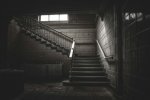
The switch at the head of the stairs lit a single bulb at the bottom. Twelve steps, open-backed, painted gray by somebody before his time and worn to bare wood in the middle of each tread. A handrail on the left only, pipe, cold to the hand in every season.
He had owned this house twenty years in April. He had come down these stairs, he figured once, something over three thousand times. The furnace filter, the breaker box, the jars Bernie used to put up when there had been a Bernie to put them up, the Christmas boxes, the water heater. Mostly the water heater. It was an old gas unit, forty gallons, older than he would have liked, and every few months the pilot went out for no reason anybody could tell him, and he came down and lit it again.
He lit it standing. One hand flat on the top of the tank, the other reaching down with the lighter to the little window near the floor. He had never needed to get lower than that.
He was on the fourth step from the bottom when his slipper went out from under him.
The slipper was the old leather one with the heel crushed flat, and the heel caught the lip of the tread and folded, and his foot went forward and his weight did not. He grabbed for the rail with the wrong hand. The rail was on the other side.
He came down the last four steps on his back and his left leg went somewhere his body didn't follow. He heard it. A short sound, like a green branch. Then the edge of the bottom step found his ribs on the right side and the concrete found the rest of him.
For a while he lay and looked at the bulb.
It hung on its cord from a joist, bare, sixty watts, and it had a dead moth stuck to it that he had been meaning to wipe off since summer. He watched it. His mouth was open and nothing was going in or out of it. Then something came in, a little, and it hurt along the right side in a long bright line, and he breathed shallower after that.
"Well," he said, out loud, to the moth.
He tried to sit up and learned about the ribs. He tried again, slower, on his elbows, and got his back against the bottom step, and looked down at his left foot.
It was turned a way he did not look at twice.
He looked up instead, at the underside of his own kitchen floor. He knew where the counter was from here, and the phone face down on it beside the bread box. About fourteen feet. Up.
"Hello," he said, louder. His face went hot, and he said it again anyway, louder still. The basement took it. There were two window wells on the road side, small and filthy, and the road was a quarter mile off past the yard and the hedge, and Doris's house was past the bend. Nobody walked that road. Nobody had walked that road on purpose in years.
He turned himself, a few inches at a time, until he was facing the stairs. He put his hands on the second step and lifted his weight and sat himself on the first. Then the second. The leg came behind him like something tied to his belt. On the third step the ribs closed down on him all at once and his arms let go, and he went down onto the concrete on his side, and lay there with his cheek on the floor and his eyes shut until he could open them.
He didn't try the stairs again.
He worked it out the way he would have worked out a bill.
Sunday night now. Three days to get through, and then Thursday. At seven-fifteen Doris would be on her porch in the brown coat with the bag of magazines she never read, and at seven-twenty she would look down the road, and at seven-thirty she would go in and call him. The phone would buzz on the counter. It would buzz until it quit. Then she would call the nephew, and the nephew would come grumbling, and she would get where she was going, and that would be the end of it. She might call again Friday to give him a piece of her mind. She might not.
Nobody would come to the house.
He counted it again on his fingers to see if it came out different. It didn't.
The furnace kicked on. He heard the blower and then, overhead, faintly, something small tick against wood. The frame on the hall table, leaning. He lay and listened to it lean.
The window wells went from gray to black. He knew the time by the furnace, which ran twenty minutes in the hour after ten, and by the refrigerator upstairs, which shuddered when it quit. He was cold. The concrete took the warmth out of whatever part of him lay on it, so he moved, a little, and the leg told him about it, and he stopped moving.
He slept, or something like it, and woke with his tongue stuck to the roof of his mouth.
He thought about the dishes in the sink. The water in the pan. He thought about it longer than a man ought to think about the water in a dirty pan.
Upstairs, at ten after six, his alarm went off. He had set it for ten after six every weekday for eleven years and had never once needed it. It went the full two minutes. He lay on the floor of his basement and listened to his own alarm through the boards until it stopped, and then the house was quiet in a way he had not noticed it could be.
The window wells turned gray again. Monday.
The thirst was worse than the leg by noon. He could tell noon because the light in the left window well came straight down, the way it did when he was out in the yard and the sun stood over the chimney.
He lay on his back and went through the basement in his head, looking for water. The jars on the shelves were empty and had been for nine years. The utility sink was across the room under the far window, and he could not reach its tap from the floor, not with the leg, not with the ribs. The floor drain was dry.
Then he thought of the heater.
The pilot was out. That was why he'd come down. The tap upstairs ran cold because the burner had stopped, but the tank itself was still full. Forty gallons. And at the bottom of every water heater, at about the height of a man's ankle, there was a drain valve. He had never once opened his. He knew it was there because he had seen it every time he lit the pilot, a little brass spigot with a plastic knob, sitting in the shadow at the foot of the tank.
The heater stood in the far corner on a concrete pad, maybe twenty-five feet away.
He rolled onto his stomach. That was the worst of it, the roll, the ribs, and when it was done he lay with his forehead on the concrete for a while. Then he put his forearms out in front of him and pulled.
It went in pieces. A foot. Rest. A foot. The left leg dragged, and every time the toe of the slipper caught on something the whole leg reminded him what was wrong with it, so he stopped and worked the slipper off with his other foot and left it lying on the floor behind him. He went past the furnace. He went past the boxes marked XMAS in Bernie's hand. He crossed the floor drain and the grate printed itself into his forearm. Somewhere in there he stopped counting feet and counted pulls, and then he stopped counting.
The water heater got bigger. Then it was in front of him, the green paint, the yellow tag from the gas company, the scorch marks around the little window where the pilot should have been burning.
Behind it, on the wall, hung the pegboard.
It had come with the house. Somebody before him had painted the outlines of tools on it in black, a hammer and a coping saw, a level, a square, and every outline empty. He had meant to take it down that first spring. He had meant to put his own tools on it. He had done neither, and after a while it was simply the wall behind the water heater, the way a coat you never wear becomes part of the closet.
He turned onto his side and found the drain valve with his fingers.
The knob had not been turned in twenty years and did not want to be. He worked it with his thumb, then both hands, pressing his good shoulder against the base of the tank for leverage. It gave a quarter turn all at once and water came out against his wrist. Rust first, brown, then clear. Cold. It ran down his arm and onto the floor and he put his mouth under it.
It tasted of the tank. Iron and something flat. He drank until he coughed, and the cough did what it did to the ribs, and he drank again anyway. Then he turned the knob back and lay where he was, on his side on the wet concrete with his cheek on the floor, and breathed.
His eye was an inch above the floor. From there, the world was all underneath.
He saw the bottom of the furnace and a nickel that had rolled under it some winter. He saw the pad the water heater stood on, and the narrow space between the pad and the wall, where the light from the bulb didn't reach. He saw the bottom edge of the pegboard.
It stopped short of the floor. Two inches short, maybe a little more.
Standing, he had never seen the bottom of it. Standing, it was a wall with a pegboard on it. From down here, under the edge of the board where the wall should have met the concrete, there was a strip of wood. Flat, darker than the floor, a hand's width deep. Worn lower in the middle than at the ends.
He looked at it for a long time.
Then he got the long lighter out of his shirt pocket. The neck was bent where he'd landed on it. He pulled the trigger twice before it caught. He reached it as far as he could into the gap behind the heater, low, the flame lying sideways and blue at the root, and held it there until the metal grew hot in his fingers.
At the left end of the strip of wood, where it met the wall, the flame found an iron hinge. Someone had painted it the same gray as the wall, a long time ago. The paint over the knuckle was split in a clean straight line.
To Be Continued...
- Log in to post comments