


Ridgeline - Part Ten: Forward Anyway

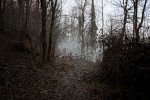
By SoulFire77
- 303 reads
A scent on the trail.
New. The nose drops to the gravel and the compound assembles — human, male, the sweat-salt of a body that has been walking for hours, the synthetic-chemical signature of a fabric the nose has encountered before on other humans in other places. Underneath the sweat: hand sanitizer, the alcohol-sharp compound that clings to skin long after the liquid has evaporated. Trail shoes on stone. The rubber-and-dirt signature of footfalls, fresh, the scent still warm on the gravel. Minutes old. The footfalls go in one direction — ahead, the same direction the thrum pulls, the same direction the baby-sound has been pulling all night.
The body stops. The legs go still. The intact ear rotates forward, then right, then back — scanning the dark for sound to match the scent. Nothing visible. Nothing audible. Just the scent on the gravel, layered and dense. The nose works the compound in long pulls, separating the layers the way the nose separates every compound — human on top, chemicals underneath, and below that, below the sanitizer and the synthetic fabric and the exertion-salt, something else.
Blood.
The pack-blood. The woman's blood. The compound the nose has been tracking all night — the iron-salt, the specific cellular signature that matches the woman on the trail, the woman near whom the thrum eased, the woman whose proximity the body circled for ninety minutes in the failing light. The blood is on this human. On the hands. On the fabric. The scent-concentration says contact — not proximity, not ambient. This human touched the blood or the blood touched this human and the compound is fresh enough to carry in the night air.
The thrum fires. Not the faint pulse from the last hours — a full activation, the sternum vibrating at the frequency that matches the baby-sound, because the pack-blood is here and the pack-blood means the warm-one and the warm-one means the small-thing and the body has been following this compound through the dark for the entire night and now it's on a moving human and the human is ahead on the trail and the trail goes toward the baby-sound.
The body moves forward.
And the hackles rise.
Not the full ridge from the bear encounter. A partial lift — the hair along the spine standing from shoulder to mid-back, the body's threat-response activating alongside the thrum's forward-pull. The nose has found something else in the compound, below the pack-blood, below the sanitizer, threaded through the sweat-salt: a scent the body catalogs as bad-outcome. Not a specific chemical. A compound-signature that the body's threat-detection system flags without the nose being able to isolate the component. The same category as the bear-musk hours ago — large thing, attend — but different in quality. This is human-threat. The compound carries the markers that the body associates with the event that produced the pack-blood in the first place: the violence on the trail, the woman's blood on the gravel, the small-thing's cry changing pitch. The scent of the event is on this human and the body's system reads the scent and the hackles stay up.
The thrum says forward. The hackles say wrong.
The body goes forward.
The human is ahead on the trail. The body can hear the footsteps — steady, deliberate, the pace of a person covering ground with a destination. Not a drift. A walk with purpose. And another sound underneath the footsteps, a faint rhythmic whisper, nylon or fabric against fabric with each step. The body follows. The three-and-pause rhythm from the last hours adjusts — faster now, the legs pulling more from the reserves, the rear leg dragging but the drag shorter, the body leaning into the pace because the thrum is firing hard and the pack-blood scent is ahead and the baby-sound is ahead and the body follows both.
A light. The human ahead carries a light — a narrow beam, steady, sweeping the trail in slow arcs. The beam catches the gravel and the gravel flares white and the laurel leaves flash where the beam crosses them. The body flinches at the first sweep — the light on the dead side, arriving without warning, the retinas contracting — and then the light sweeps past and the dark returns and the body moves forward. The light moves ahead. The body follows the light.
The trail curves left. The gravel changes underfoot — from packed to loose, the rain having washed the surface into ridges the pads catch on. The human ahead navigates the curve and the light sweeps the inside of the bend and the body follows the curve twenty yards behind, the rear leg slipping on the wet loose stone, the claws scraping, the body catching and continuing. The hackles stay up. The threat-compound stays in the air. Every inhale carries the pack-blood and the bad-outcome together and the body can't separate what the compound has joined and the two signals run through the same breath and fire the same nose and produce opposite responses in the same body at the same time.
Twenty yards back. The distance holds. The body doesn't close it — the hackles won't allow closer proximity, the threat-response maintaining a buffer between the body and the human the way the buffer held at ten feet when the body first encountered the woman on the trail. The thrum pulls forward. The hackles push back. The distance is the resolution — twenty yards, not closer, not farther, the body suspended between the two systems that refuse to agree.
The trail is easier here. The gravel packed, the grade level, the surface draining the rain that fell earlier. The pads find traction. The rear leg still drags but the drag finds a rhythm inside the three-and-pause and the rhythm carries the body forward at a pace that keeps the light ahead and the scent-trail fresh.
The light sweeps. The gravel flares. The dark returns. The pattern repeats — light, dark, light, dark — and the body follows the pattern the way the body follows the thrum, not from choosing but from the pull, the pack-blood ahead and the light marking where the pack-blood goes. The rear leg sets the limit, the three-and-pause sets the speed. The human's pace falls inside the body's range. The human's breathing carries back through the dark — steady, unhurried, the rhythm matching the footsteps, the inhale and exhale at intervals that don't change. The breathing of a body that isn't searching. The breathing of a body that is going somewhere it has already been.
The nose tracks the compound continuously. The pack-blood the strongest note — warm, iron-rich, the specific signature the body has been following since it left the woman's side. Underneath the pack-blood, the threat-compound persists. The hackles persist. The body is carrying two incompatible signals through the dark and neither signal weakens and neither signal overrides and the body moves forward with both.
The rear leg catches on a root. The body stumbles — the front legs bracing, the ribs flaring, the flank sending a sheet of pain from shoulder to hip. The three-and-pause breaks. The body stands still on the trail while the light ahead continues, the distance widening to thirty yards. The thrum intensifies — the source pulling further away, the chest-vibration tightening. The legs move. Faster than the rhythm allows. The rear leg drags without pausing and the flank flares and the body closes the distance back to twenty and the hackles stay up the entire time, the spine-hair standing while the legs drive forward, the body operating two contradictory programs on the same hardware.
The light stops.
The human ahead has stopped walking. The beam holds still — aimed at the ground, or at the brush, the cone of light visible through the understory as a white column in the dark. The body stops. Twenty yards back. The hackles at half-ridge. The nose pulling the compound in long draws. The human is motionless. The light is motionless. The silence between the body and the human fills with the drip of rain from saturated canopy and the distant chorus of frogs from the creek and nothing else.
Ten seconds. Fifteen. The human stands on the trail with the light aimed at something the body can't see and the body stands twenty yards back with the hackles up and the rear leg shaking and the ribs catching and the thrum vibrating at the frequency of the baby-sound that both the body and the human are moving toward. The human's breathing carries through the stillness — the same steady rhythm as before, unchanged by the stopping, the lungs working at the pace of a body that is not alarmed and not hurrying and not lost.
The human moves again. The light sweeps. The footsteps resume. The body follows.
The baby-sound. Closer now. The frequency clearer through the intact ear — the murmur that has been the thrum's tether all night, the sound that pulled the body through the woods and the creek and the bear and the rain and the three-and-pause and the ground-that-pulled. The murmur is louder than it's been since the body left the woman's side. The thrum eases with each step toward the sound. The chest-vibration softening, the tightness loosening, the affect that deepened with distance now reversing.
The woman's scent arrives. Not from the human ahead — from the air itself, a separate channel. The trail-scent carrying the compound from a source further ahead: the woman, bleeding, alive, the pack-scent concentrated in one location. And the baby-scent layered on top — formula and skin and the salt of a body that has been crying. And the Lysol that was on the woman's hands that morning when the body first encountered her on the trail and circled three times before sitting down. The compound is a signature the nose assembled hours ago and now the signature is in the air from two sources at once — on the human ahead and in the air ahead — and both sources pulling the body forward and the thrum easing with each step.
Close. The source is close. The thrum easing. The baby-sound louder. The scent thickening with every yard the body covers.
The body follows. The hackles stay up. The rear leg drags. The ribs catch on every other step. The flank seeps where the three-and-pause broke the clot and the blood runs down the leg and onto the gravel in drops the body doesn't register because the drops are a condition and the condition has been present for hours.
The trail straightens. The gravel widens. The light ahead is brighter here or the body's eyes have adjusted or the clouds have thinned because the beam is sharper and the shadows it casts are harder and the body can see, for the first time, the shape of the human ahead — medium, the shoulders forward, the gait purposeful, something in the right hand that isn't the light. The eyes lose the object between light-sweeps. The nose provides what the eyes can't: nylon, synthetic cord, new, the chemical signature of something purchased and not yet worn by handling. The nose files it. The hackles stay up.
The baby-sound is close. Very close. The murmur coming from somewhere just ahead of the human with the light, ahead and to the left of the trail, the sound the body has been following all night and the sound is almost there and the thrum is almost easing all the way and the body moves through the dark at the pace the broken legs allow, one step and another, the rear leg dragging on the gravel, the flank seeping, the ribs catching, the hackles up.
The thrum says forward. The hackles say wrong. The body moves through the dark toward the baby-sound with the light ahead and the pack-blood ahead and the threat-compound on the human it follows and the hackles raised the entire way, every step, the hair along the spine standing, the body carrying the warning it can't act on because the thrum is louder and the pack-blood is stronger and the baby-sound is closer with every step.
Forward. The hackles up. The body moving. Both signals firing. Neither winning.
Forward anyway.
Go to the next part: https://www.abctales.com/story/soulfire77/ridgeline-part-eleven-arithmetic
- Log in to post comments
Comments
layered suspense. I'm dying
layered suspense. I'm dying to know if friend or foe?
- Log in to post comments