


Heel - § 2: The Removal

By SoulFire77
- 229 reads
The dog was at the screen door before she was up, faced out at the street, and the rag rug under him was cold where it should have been warm with the night of him. He had been there a long while. She did not have to cross the kitchen to know which way he was turned. He was turned across.
She put the percolator on and stood at the window with her arms folded into her housecoat and looked at what he was looking at.
Arlene's front door stood open. The heavy door behind the screen, swung back into the dark of the hall, open on a moving day, on a morning of hands full going in and out. A car was at the curb in front of it that she did not know, a clean dark sedan with nothing written on it, sitting low and quiet at the curb, parked by a man who had never in his life had to hurry. No one was on the porch. The milk was still in Arlene's box by the step, the two bottles sweating, nobody come for them, and that was the thing Lorraine's eye kept going back to, the milk left out, when there was a whole car and a whole open door to look at instead.
She had her coffee at the counter standing up. The percolator knocked and settled. On the radio, low, a man read the temperatures for the day and a woman after him sang about a soap, the same eight notes she sang every morning of the world, bright and certain, and Lorraine ran the dishrag around a cup that was already clean.
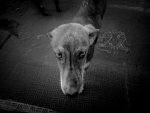
The dog had not moved. His ears were up and his weight was forward and his eyes were on the open door across the street, and his tail was still. She came and stood by him and put her hand down on his head out of habit, and the head was warm and the eyes did not come off the house, and she took her hand back. Whatever was over there, he had it before she did. He always had a thing before she did. She told herself it was the car. Dogs did not care for a strange car on the street, that was all, a strange car and the door left open and the day gone funny, and a good dog would stand at the glass over a thing like that and want to see it put right. She told herself that, and she believed the front half of it.
Denny came down at half past, nine years old and creased from his pillow, his shirt for school not yet on him, carrying it. He climbed half onto the windowsill, and she had her hand on his shoulder before she had decided to put it there.
"Is that Petey's house," he said. "What's the car."
"Eat your cereal," she said.
"The door's open."
"They're airing it out. Eat."
He looked a second longer, a boy's whole-street look that trusts none of it to stay, and then the radio woman started up about the soap again and the smell of the toast got him and he came down off the sill and went to the table, and the dog stayed at the glass, faced across, and Lorraine buttered the toast and did not look out anymore because she had her son to feed.
It was a fine morning. That was the part she would not be able to put down afterward, that it was as fine a morning as the street had ever made, the light coming clean and yellow down the block and the sprinklers going on a timer somewhere and the maples just starting to turn at the tips. Across the street two men came out of Arlene's open door carrying nothing, and stood on the porch a moment in their hats, and went back in. They were not movers. Movers carried things. These men went in and came out with their hands empty and their faces easy, and the second time they came out Arlene was between them.
She was in her good dress, the blue one, the one she wore to anything that mattered, and she had her pocketbook held in front of her in both hands, the one thing she had been told she might bring, and she was talking to the men, smiling up at them, her head going, and from across the street with the glass between them Lorraine could not hear it but she knew the shape of Arlene talking, the big easy roll of her, and she knew Arlene was being charming at them, working them, as Arlene worked everybody, the grocer and the meter man charmed down to size in their turn, and Lorraine stood at her own window with her dishrag and watched her friend be charming at the two men who had come to take her and understood, in her stomach before anywhere else, that it was not going to work this time. That there was nothing under the charm to stand on. That the men were being kind to her. It was the kindness you give a thing already decided.
Petey came out behind them. Arlene's boy, eight, in his church clothes on a Tuesday, and he did not understand it any more than Denny would have, and he went down the steps ahead of his mother toward the dark car looking back at the house, looking up the street, and his look came across and found their window, found Denny's place at the table that he could not see into for the glare, and Lorraine felt Denny start up out of his chair behind her and she said his name once, flat, and he sat back down.
Then Arlene looked across.
She had her hand up to the roof of the car, ducking the small practiced crouch they have you make, and she stopped with her hand up there and turned her head and looked straight across the street and into Lorraine's window, into Lorraine, the two of them not forty feet apart with a strip of bright clean morning between them, and Arlene did not smile. The charm went off her like a coat coming off. She just looked, and her face had the one question on it, the only question, the same one her eyes had put across the kitchen table all those nights, and she held it across the street and into the window and waited, with her hand on the roof of the car and a man standing patient at her elbow, for Lorraine to do the thing a person does. To come down the steps. To cross. To stand on the curb in her housecoat in front of the whole watching street and call her friend by her name out loud where it could be heard.
Lorraine lifted her hand and waved.
It was the wave you give across a yard. Bright, easy, fingers spread, a little wag of it at the wrist, the wave for a neighbor backing the car out, the wave that says fine morning, see you, the wave she had taken off of Mrs. Dunlap and off of every woman on the block without ever once choosing to, and it came up out of her smooth and quick and finished. She gave Arlene that. Across the last forty feet there would ever be between them, with her friend's whole face open and asking and her friend's boy looking back from the curb, Lorraine gave her the neighbor wave, the one that costs nothing, the one that means I have seen you and there is nothing here, and then she turned from the window to the stove as though something on it wanted her.
When she made herself look again the car was pulling out, careful, signaling, and Arlene's face was a pale shape in the back glass not turned her way anymore, and the men's hats were dark in the front, and Petey's head did not show, too small to show, down in the seat. The car went up the block to where the street ran out at the trees, where past the trees the gray stood up and the sky did not go on, and it did not turn around because there was nowhere up there to turn around to, and then it was around the bend by the Dunlaps' and gone, and the milk was still in Arlene's box, and the door still stood open on the dark hall, airing.
Denny had not eaten. He was looking at her.
"Where'd Petey go," he said. "Where'd they take them."
She wrung the rag out and laid it over the faucet to dry, square, the corners matched. She heard her own voice come, and it was warm, and it was certain, and it was somebody else's, as it had been at the window with her hand going. "Miss Arlene's gone to stay with her sister," she said. "Out where her people are. Petey too. It came up sudden, with family it does." She set it in front of her boy like his breakfast and watched him take it.
He took it. She watched the trust come down over the trouble in his face and smooth it, water finding its level, and he picked his spoon back up. "Will she write," he said.
"I expect she'll write."
"Can I write Petey."
"We'll see about an address," she said, and there it was, the small drop, the cellar-stairs lurch in her, the foot going down in the dark and finding the floor a half a step closer than it should be, a thing she felt for half a breath and then did not feel, because she had a wash to get out and a boy to walk to school. She came back up out of it and shut the door on it.
Before the wash she went to telephone her mother, for no reason she could have put a name to except to send her voice into a line and have something come back, and she lifted the receiver and the party line was not free. Two women were on it already, women she knew by their voices and could not have sworn to by name, and one was telling the other that Arlene had gone out to her sister's, sudden, that it was family and family was like that, and the other said wasn't it always, and they had the very words Lorraine had given Denny ten minutes before, in the same order, passed back and forth between them easy as a recipe, though no one had been across to ask and no one had been told. She set the receiver back in its cradle without a sound. She stood with her hand on it. Then she took her hand off it.
She did the wash. She ran the dungarees through the wringer and her hands were steady at the crank, and she carried the basket out and pinned the line full, the sheets and Denny's shirts and her own things, and the sun was high and good and the block came alive around her as a block does of a morning, Mrs. Dunlap out with her keys, a mower somewhere, the two men's clean dark car already nothing, already a thing that had not happened, and when she had the last of it pinned she stood with the empty basket on her hip and looked across the street at the house standing open, and a woman she did not know was up on Arlene's porch now with a broom, sweeping out the hall, getting it ready, humming, and Lorraine lifted her hand and waved at her too, bright, easy, fine morning, and went in.
The dog came off the glass at last and came to her heel where he belonged, and the screen clapped twice behind the two of them, and across the street the broom went on, and the door stood open on the rooms going bare, and somewhere down the block the radio woman sang the same eight bright notes about the soap, and got them, every one, exactly right.
- Log in to post comments
Comments
This is fascinating me.
This is fascinating me. Where it's going. Where it's been.
- Log in to post comments