


Autumn Release
By Makis
- 591 reads
She was suddenly overcome by a desperate urge to be on her own, away from the formality, the fuss and, above all, the sympathy. She had been watching people mourn a man she had spent forty-five years surviving. It had followed her all afternoon like a shadow; in the lowered voices, the carefully chosen words, the solemn faces of people who had known her for years and yet, somehow, had never really known her at all. She leaned forward and touched the driver gently on the shoulder.
'Would you mind stopping somewhere, please? Anywhere that’s convenient.'
She caught his eyes in the rear-view mirror and the look of concern that had occupied his face, but she smiled reassuringly. 'It’s quite all right, driver. There's no need for concern.'
The black limousine whispered to a halt alongside the kerb and the driver anxiously left his comfortable domain and hurried around the car to open her door. She slid across the sumptuous leather seat with as much dignity as she could muster and, gathering her coat around her, gracefully stepped out into the cold October afternoon.
For a moment she stood beside the open door, feeling the wind touch her face. It was the first honest thing that had happened to her all day and with a reassuring touch to the sleeve of his sombre dark coat, she thanked the driver and told him he could now return to his base. He hesitated, perhaps expecting further instruction, but there were none. She gave him a small smile, closed the door herself and set off along the pavement with a calm determination.
She watched the limousine pass her, its dark polished sides reflecting the bare branches of the trees and the pale October sky. Inside it were the things she had been expected to carry home with her: the flowers, the cards, the carefully printed Order of Service and Eulogy, all the conventional remnants of a life which, until that very morning, had seemed destined to define her forever.
Forty-five years of unhappiness travelled away in that car and she stood watching until it disappeared around the corner. Then, almost without knowing why, she smiled; something she had not done for a very long time. There was no triumph in it. No bitterness. It was simply the smile of someone who had finally put something down that she had been carrying for far too long.
She adjusted her scarf and set off in the direction of the park. It wasn't far, but she walked slowly, allowing herself to notice things she'd always been too preoccupied to notice. A dog pulling impatiently at its lead. The distant wail of a siren. A child laughing somewhere across the street. The smell of wood smoke. Ordinary things. Beautiful things. Things she had stopped noticing.
The park had always been her sanctuary. She had come here as a young woman, long before she had understood how desperately she would one day need it. Whenever the walls of home seemed to close in around her, she had found reasons to walk here. Sometimes she had sat for an hour beneath the trees. Sometimes she had walked until her feet hurt. Sometimes she had simply watched the seasons change. Here she had been able to breathe.
The park had offered her a temporary reprieve from the expectations, the endless small humiliations and the carefully maintained silence. Here there had been no need to pretend that ugliness was beauty, that cruelty was kindness, or that endurance was the same as happiness. Here, in the company of trees and water and birds, she could recharge herself with normality before returning once more to numbness. This was where everything seemed to exist according to a simpler law. Things grew and flourished and then withered, and there was no apology for any of it.
She entered through the familiar wrought-iron gates and immediately, an excitable reception party of multi-coloured leaves scurried around her feet. Copper, gold, russet and brown, they chased one another across the path in the fresh October breeze, gathering in clusters before being scattered again. She smiled at them and walked on.
The trees were almost bare now, their branches etched darkly against a washed-out sky. Yet there was nothing sad about them. They had simply reached the end of their season and were surrendering what they no longer needed. She envied them. For years she had believed that losing things was a tragedy, but today, for the first time, she wondered if perhaps it could also be an act of natural release.
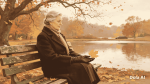
She reached her favourite seat beside the pond and it was exactly as she remembered it: old, slightly crooked, with peeling green paint and a view across the water to the great oak at the far side. She lowered herself stiffly onto it and rested her gloved hands on her lap.
For a while she did nothing but listen as the wind moved softly through the branches. Somewhere overhead a rook called and then fell silent. The surface of the pond trembled beneath a passing breeze, breaking the reflection of the sky into fractured fragments. She closed her eyes as the cold air touched her cheeks and just absorbed the season. Autumn wasn't about dying. That was what she had always been told, but sitting there she realised how wrong it was. Autumn was a transformation; a season of letting go, of releasing what had served its purpose in preparation for what came next. The trees didn't cling desperately to their leaves, they let them fall willingly, and now she could do the same.
She thought of the years behind her. Forty-five years of swallowing words, disguising feelings, making excuses, keeping the peace and preserving appearances. Forty-five years in which she had gradually become a stranger to herself. She had wondered so often what she might have been if her life had taken a different path. Now she realised that the question no longer mattered. The future was now entirely hers, one in which she would make the choices.
A single yellow leaf detached itself from a high branch and spiralled gently towards the ground. It landed beside her shoe with barely a sound and, with some effort, she reached down and picked it up. Its veins were delicate and intricate, like the map of a country she had never visited. She removed her gloves and laid its brittle form in the palm of her hand and smiled. Now in the autumn of her own years, she would follow the natural rhythms surrounding her, rhythms untouched by the expectations of others. She would learn, perhaps for the first time, what it meant simply to belong to herself.
Behind her, the town continued with its everyday business. The traffic rolled past and people hurried about their busy lives, wrapped against the season. For the first time in forty-five years, she had nowhere she was required to be. She slipped the leaf carefully into her coat pocket as the afternoon light began to fade, but today she had no fear of the approaching darkness. There would be winter, of course, there always was, but after winter came spring and she had every intention of being there to enjoy it.
- Log in to post comments
Comments
that makes lots of sense. It
that makes lots of sense. It's like that old joke about spriitualist telling a punter they have somebody that wants to speak to them. And the cry is 'On no, I thought I was rid of him. Tell him to stay whever the hell he is'.
- Log in to post comments
Sad reality
When I was the sort of person who went out each day to earn a crust, many of my clients were very ill, or elderly, or both, and consequently, down the years I saw a great many of them die. That wasn’t a shock to me, but something I found strange was that their closest relatives (usually husbands or wives) didn’t seem to grieve but instead expressed a sense of relief similar to what you've described. Sometimes they'd explain why. I learnt from them that it’s wrong to always assume that just because two people have been together a long time, they have been happy.
One elderly couple I knew had been married seventy years. Their family and everyone who knew them had wanted to celebrate the remarkable anniversary, so when I visited their house soon after the event, I couldn't help but comment on the great number of cards and flowers that filled their house. The woman heard my words of congratulation, looked at me, and, without changing the expression on her face, she said, “I can’t remember breaking ten mirrors.”
Your story reflects a sad reality of life, and your title fits your story perfectly.
Turlough
- Log in to post comments
I found this very affecting,
I found this very affecting, Makis. The sense of place, and the descriptions, are wonderful, and there are many individual touches which bring the character alive. I particularly liked the image of her sliding across the leather seat while trying to maintain some dignity - very human and relatable! The quiet acceptance of what life had brought her over all the years, and the final, equally quiet (and dignified) relief at the end of all that, bringing with it the chance of 'belonging to herself', are delicately and unforgettably drawn. Fine writing.
- Log in to post comments
Pick of the Day
This is our wonderful social media Pick of the Day! Congratulations!
- Log in to post comments
Golden Cage
It's my sister's golden wedding anniversary next year, and she has been miserable for all but the first couple of years.
She was going to leave him when my niece went to school. Then she was going to leave him when my niece left school. Then she was going to leave him when my niece left university. Eventually she stopped talking about leaving altogether. She has her own money, which many women in that situation don't, my niece is long grown up and left home, but my sister just doesn't have the self-confidence to go. She's been with him since she was 18, a child, and has never had to navigate life on her own.
Only my niece and myself know how bad things really are.
Your story expresses all of this so well, Makis. The masks that people wear, the assumptions that other people make.
- Log in to post comments