


The Painter at the Crucifixion

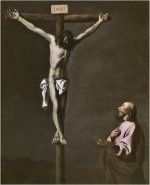
By Mark Say
- 1088 reads
The Painter stayed away from crucifixions. He had passed by a couple over the years – hard to avoid when the Government judged it was time to crack down on crime or dissent – and felt a mixture of revulsion and pity for the wretches sentenced to become a public spectacle of slow, painful death. He had heard that the new Preacher had been singled out for execution, along with a couple of local thieves, and decided to stay home, away from the crowd, and keep his mind on his new depiction of the Holy Mountain. That was a better way to spend the day.
It was mid morning when he heard the knock on the door and opened it to two men, both tall with thick beards and hard eyes, conveying something between distress and determination. One stepped forward, clutching a hand to his chest.
“We hear you are highly skilled with a brush.”
“Some people have said so.”
“Good. We need you, straight away.”
“I have a task for the day.”
“And we have money to offer.”
He opened the palm of his hand to reveal five gold coins.
“You can have it now if you come with us. Another ten when you finish the job.”
The Painter hesitated, suspecting there would be a dark twist in whatever they wanted..
“How long will this take?”
“You have to see something now, then you have a few days. I’ve heard you can work from memory very well.”
“Where do you want me go?”
“Just come with us.”
The painter felt an unease, but he took the coins.
“We don’t have much time,” the man said.
“I just need some basic tools, for an initial sketch.”
He gathered his sack, slate, dark powder, a reed brush, a small papyrus scroll and a jug of water, and slipped the coins into his hiding place. He acknowledged an unknown anxiety, but also that he had rent and creditors to pay. Then he followed the men out of the building and down the hill. Soon they were on the edge of a crowd and he realised they were taking him to the place he had wanted to avoid. He stopped. Both men took a couple more steps then turned to look at him.
“Are you squeamish about these things?”
He nodded.
“I don’t understand why people regard the suffering as entertainment.”
“That’s not everyone. Some regard it as bearing witness. That’s why we need you.”
“There are plenty here to do so.”
“But no others with your skills.”
He realised that meant they wanted him to paint the scene. The thought made him queasy, and for a moment he considered handing back the coins, but then remembered they were in his home. Then he felt a hand over his wrist.
“Come on. You won’t have much time.”
They led him through the crowd to the clearing in front of the scene. Three wooden crosses had been erected. Two held dishevelled men in tunics, their bodies slumped and faces drained in cynical acceptance of their fate. The one in the centre displayed a slim man, naked except for a loin cloth, hands and feet nailed to the cross, apparently more upright with eyes gazing at something in the distance. He must have been the Preacher. The Painter noticed that a handful of soldiers stood at the edge of the clearing, more interested in sharing a bag of bread and fruit than the ground around the crosses. Most of the crowd held back, but a handful of men and women had moved close to the foot of the central cross, looked up and cupped their hands towards the Preacher. He turned to one of the men who had brought him.
“Are you his followers?”
“Disciples.”
“Is it safe for you to be here?”
“It should be. The Government prefers to limit how many people it executes.”
The man looked towards the soldiers, then gave the painter a gentle shove.
“Move closer, so you can see him more closely, while there’s time.”
The Painter moved, glancing towards the soldiers again and noticing how some of the crowd were watching him. Their faces suggested he was taking a risk. He moved within a few feet of the cross, placed the water jug on the ground, looked up at the victim and noticed there was blood on his face, trickling from a circle of thorns that had been pressed into his forehead. The Government was doing this to make a point. The man’s eyes drooped towards the painter, noticing the slate in his hand, and spoke quietly.
“They’ve brought you.”
“Yes. They want me to paint you.”
“I do.”
“Why? You must be in great pain. I don’t understand.”
The man dropped his face lower. It conveyed agony, but also traces of a smile.
“For my legacy.”
“Your legacy?”
The Painter was confused
“This is how I should be remembered.”
“But why?”
“Because otherwise I would be forgotten.”
For a moment that painter was frozen, unable to comprehend the purpose and scared of the brutality of the moment. Then one of the men took his arm and spoke, this time with a desperate plea.
“Please. Quickly. The soldiers will notice. Look at him closely, then step back and do what you can.”
The Painter stared at the man on the cross, taking in the thinness of his body and how it had been stretched to flatten the stomach, exaggerate the ribs and draw out the muscle in the arms, with hands had curled around the nails their palms. The head had slumped but the eyes remained alert and the face seemed set on a purpose he could not understand. He felt a nudge on his arm.
“Hurry!”
He placed some powder on the slate, dipped the reed brush in water and mixed it in, then unrolled the papyrus beside it and quickly sketched the lines of the scenes. He soon had outlines the body and the cross, but paused to stare again at the man’s face. He couldn’t fathom what was behind the expression, but felt it was that of a man confronting something other than his death. He made one small mark, then another, and paused again.
“Come on!”
He managed the line of the nose, one dark eyebrow, then felt a tug.
“That’s enough!”
He glanced at the Disciple, then the other way to see that one of the soldiers had begun to approach. He dropped the materials into his sack and they backed away. The soldier followed a few steps, looked at them with suspicion, but then stopped. He looked back to his colleagues, then at the Preacher, and by the time he had turned again the Disciples and the Painter had moved into the crowd.
Over the following days the Painter spent most of the daylight hours in front of a much larger sheet of papyrus, with a larger collection of powders for different colours and a choice of reed brushes. He painted the details of which he had a clear memory – the lines of the body, nails in the flesh, the dark wood of the cross – then thought about the loin cloth hanging from the Preacher’s hips. It had been wrapped around, but he kept thinking there was something else to convey, and eventually painted it so the fabric been pulled apart to leave a strip of naked flesh beneath the cord. That was it, a picture of vulnerability and humiliation. Then he thought about the face, the expression that he couldn’t quite read, and struggled to find an image. Over a day he managed just the line of the nose and the brow that he had from his sketch, then realising that the Disciple would soon want to claim the work he surrounded them with dark hair and beard that were longer and thicker than he remembered. Then he added shadows to convey light from the left of the scene, and buried half of the face on the darker side.
He waited until the next morning, looked at his work, assured himself it was technically good but felt anxious that there was something missing in the face. He hadn’t caught the detail in the expression. It caused him to worry that the men who paid him would be dissatisfied.
Then they came. At first their faces were full of a stony intent, but within seconds they had transformed into smiles.
“You’ve done well.”
“Exactly.”
The Painter remembered what the Preacher had said.
“You think this will serve his legacy?”
“Perfectly.”
One of the men removed ten gold coins from his purse.
“You’ve earned this well.”
The Painter felt a surge of relief, and mild excitement that he had so much money in his hand.
He said he would prepare the picture for them to take away. One of the Disciples asked if he could admire it a little longer, while the other went to the door and stepped outside. The Painter was anxious that as associates of the Preacher they might attract some unwelcome attention and hoped they would move on quickly. Then he was aware of another man entering the room and turned to see the Preacher. All he could do was watch as he moved slowly towards the picture, walking like a man who had been physically abused, then stared. For a while there was nothing in his expression, but then came a gentle nod and a faint smile appeared through his beard.
“Very good,” the Preacher said. “That will impress people.”
Then he turned to the Painter and offered his hand. The Painter took it, noticing the wound in the centre of the palm, and felt a mild squeeze. His mind tumbled into an explanation.
“You were cut down before you died,” he said. “I’ve heard of that happening in the past.”
The Preacher smiled but didn’t reply. One of the Disciples spoke.
“He died.”
The Painter looked at the man, then the Preacher, then the other man, then back to the Preacher.
“You couldn’t have died. You’re here, alive. I just felt the warmth of your flesh on my hand.”
The Preacher held his smile and spoke softly.
“Yes, I’m alive, and soon I will be gone”
“I don’t understand.”
The Preacher stepped away towards the door, accompanied by one of the Disciples. The other remained and asked that the papyrus be prepared for taking away. The Painter rolled it up carefully, bound it in twine then placed it into a large sack. He held it at his side, looking at the Disciple and struggling to understand.
“You say he died.”
“He died.”
“And now he is alive.”
There was a moment of silence. Then the Disciple replied.
“That’s his legacy. A story that will inspire people.”
“His legacy. That’s the word he spoke to me while he was on the cross.”
“Yes, your creation will help us to strengthen his legacy.”
The Disciple reached down and took the sack, placed it over his shoulder, then took the Painter’s hand with a firm grasp.
“You can be proud.”
The Painter couldn’t find words, and watched as the Disciple went to the door and left. He stood in silent bemusement for a while, struggling to understand the possible implications of this legacy and his contribution. Then he went to the door and looked outside, shading his eyes against a ferocious sun then looking down the hill to a point where a road turned away from the city. He could see the Preacher, both Disciples, a handful of other men and two women gather around two donkeys. The Preacher was mounted onto one of the donkeys and they all began to walk away. It was a time of day when many people would hide from the sun and allow their bodies to rest, but the group moved steadily, as if with a strong intent, following the road to disappear around the side of the hill. He felt overwhelmed, not knowing if he had been involved in an act of deception, madness or glory.
Image: The Crucified Christ with a Painter, Francisco de Zurbaran, Museo Nacional del Prado, authorised for use by non profit publications
- Log in to post comments
Comments
Wonderful writing, and thanks
Wonderful writing, and thanks for the recommendation - I'm in London on Wednesday so might go if there's time
- Log in to post comments
Thank you.
It is interesting that we are told that Christ came at the appointed time. And in providence it was a time when travel had been made easier by a good road system so that the news could be spread, but not when phones had been invendted, nor cameras and no-one thought to paint. Which underlines the limit of an art depiction, imaginary or real to convey exatly what he was suffering (the punishment of others' sins, so not just physical) and also that his teaxhing and actions are more important to really know him than exactly what his physical appearance was. Rhiannon
- Log in to post comments
Congratulations, this is our Pick of the day 13th July 2026
This is very fine writing, and for that reason it is today's pick of the day.
Well done. Please share on your social media, fellow ABCTalers.
- Log in to post comments
Congratulations on pick of
Congratulations on pick of the day. I really enjoyed reading this. I couldn't imagine why they would get an artist for his legacy, (coming back from the dead probably being enough) but then I looked at the painting and I thought, it's been painted ever since, written about, talked about and dramatised. It's a thought provoking painting and a thought provoking story.
- Log in to post comments
it's amazing how many gawkers
it's amazing how many gawkers there where then. Not so amazing we have the same crowd now.
- Log in to post comments