


Addition (1)

By SoulFire77
- 286 reads
The house on Vetch Lane was eleven thousand dollars more than they could afford. Audrey had done the math twice on the back of a grocery receipt while Philip drove, and both times the number came back the same — the gap between what the bank had approved and what the listing asked, a distance measured in months of overtime, or the sale of his truck, or a conversation about the retirement account they had not had, and they were pulling into the driveway.
"We're just looking," Audrey said.
"I know."
"We can't afford this house."
"I know."
"I want to see what almost looks like from the inside."
The house was ranch-style. Three bedrooms, one bath, a galley kitchen visible through the window over the sink. The yard was flat and square, mowed recently by someone who didn't live there. The siding was the yellow that houses turn when white gives up, and the shutters were the green that someone chooses when they are choosing a shutter color and want to be done choosing. There was nothing wrong with it, and nothing about it you would describe to someone unless they asked.
Mrs. Linden met them at the door. Late fifties, silver hair to the jawline, a blouse the color of cream. She shook their hands — Philip's first, then Audrey's, holding Audrey's a beat longer, warmth or assessment. Her smile was professional and total. It did not reach a specific part of her face more than any other part. It was distributed.
"The Haigs," she said. "Come in."
The front door opened into a living room with carpet the color it becomes when it has outlived the family that chose it. The walls were off-white. The ceiling fan had four blades and a pull chain and the chain had a small wooden acorn on the end that clicked against the housing when the fan was on. The fan was not on. Philip looked at the acorn and the acorn looked back with the patience of an object that has been hanging in the same spot for fifteen years.
"Three bedrooms," Mrs. Linden said. "One bath, recently updated. The kitchen was redone in 2019 — new counters, new fixtures. Garage is a single but deep. Good bones."
She walked them through. Living room to hallway, hallway to bedrooms — the master with its window facing the backyard, the second bedroom smaller, the third smaller still, the walls showing ghost-rectangles where frames had hung. The bathroom with the toilet that ran for three seconds after flushing. The kitchen with its counters that were new enough to still look like a decision someone had made. Philip followed and noted what he noted: the outlets, the baseboards, the seam where the old flooring met the new. He worked IT for the county — network infrastructure, mostly, the job of verifying that what was built matched what was drawn. He looked at buildings the way he looked at diagrams.
They were in the hallway, between the second and third bedrooms, when he saw the door.
It was on the left side, set into the wall between the linen closet and the bathroom. A six-panel door, same as every other door in the house — same paint, same hardware, same brass knob. It was not remarkable. It was a door in a hallway in a house, and the only reason Philip stopped was that the floorplan in the listing had shown a linen closet here, and the linen closet was here, and this door was also here, next to it, in a space where the wall should have continued for another four feet before the bathroom.
He put his hand on the knob. The knob was warm.
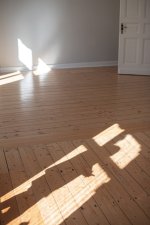
The door opened inward. The room was roughly ten by twelve — he knew this the way he knew room dimensions, by standing in the doorway and letting his body measure. The floor was hardwood. Not the carpet that covered every other surface in the house — hardwood, a warm honey oak, the boards fitted so closely the seams were barely visible. The walls were white, the kind of white that is the result of someone caring about white. A single window faced east, and the light of two-thirty came through it filtered through nothing — no curtain, no blind, no film of dust. The light entered the room as though the room had been expecting it.
The room was empty. The room smelled like lavender. Not lavender the way a candle smells like lavender — lavender the way a field smells, the plant, alive, blooming, the oil still in the stem. And underneath the lavender, a density. The air in the room was heavier than the air in the hallway, and the weight was warm, and the warmth sat in his chest the way altitude sits in the chest.
He stepped inside. The floor was lower than the hallway by an inch, maybe less. His knees registered the drop before his eyes did — the small correction of weight meeting a surface that was not where the body expected it. He stood in the room and the room held him. The light crossed the hardwood in a slow arc, and it was the most beautiful room in the house.
"Philip?"
Audrey was at the end of the hallway with Mrs. Linden. They were looking at him. He was standing in a doorway they could see, holding a knob they could see, and Audrey's face had the expression she wore when Philip stopped in the middle of a hardware store to read the back of a box.
"What's in there?" Audrey said.
"This room." He stepped back into the hallway. "What is this?"
Mrs. Linden walked toward him. She looked at the door. She looked at it the way she had looked at the bathroom fixtures and the kitchen counters — with the mild, cataloging attention of a person who has shown this house before and is performing the act of seeing it again.
"That's the linen closet," she said.
"The linen closet is here." He touched the door next to it. Two doors, side by side, with eighteen inches of wall between them. "This is something else. It's a room."
Mrs. Linden smiled. The smile was the same smile she'd given them at the front door — complete, professional, distributed across her face without favoring any feature. "The linen closet," she said again, and her voice was kind and her voice was final, and Philip opened his mouth and closed it.
Audrey came to the doorway. She leaned past Philip and looked inside.
"Good-size closet," she said.
"It's not a closet. It's a room. There's a window."
"There's a window in the closet?"
"It's hardwood in there. Look at the floor."
Audrey looked. She looked the way she looked at things that Philip pointed out that she hadn't noticed — with the particular effort of a person who trusts her husband's attention to detail even when she cannot see what he sees. She looked for five seconds, maybe six.
"It's a nice closet," she said. "Good light."
Philip looked at the floor. Hardwood. He looked at Audrey. She was already turning back to Mrs. Linden to ask about the garage. He looked at the room. The light from the east window was moving across the oak, and the beauty was the kind that makes you stand still, and he stood still.
"Mr. Haig?" Mrs. Linden was at the end of the hallway. "The garage?"
He closed the door. The latch caught with a sound that was softer than the other doors, as though the mechanism had been oiled more recently or more often.
They drove home. Audrey recalculated on the back of the receipt. Philip drove and didn't talk. The road was forty-five minutes of state highway and strip malls and the light failing in the particular way it fails in February — not setting, withdrawing, the sky going from white to gray to the gray that means the day has decided to stop.
"It's a good house," Audrey said.
"It is."
"It's eleven thousand dollars more than we can afford."
"I know."
"I liked the kitchen."
"The counters are new."
"I liked the master. The window."
Philip nodded. He was thinking about the room. The room off the hallway with the hardwood and the east window and the lavender and the floor that dropped by an inch and the light that entered as though it had been expected. He was thinking about the room the way you think about a sentence you've read that you can't stop rereading — not the meaning of it but the shape, the weight, the way it sits in the mouth.
"The third bedroom is too small," Audrey said. "You couldn't put a desk and a bed."
"You could if the bed was against the window wall."
"Then you'd block the window."
"It's north-facing. You're not losing much."
"You're losing the window, Philip."
He didn't answer. They were on Route 8, the stretch past the old Texaco station where the pumps had been pulled out but the canopy remained, and the canopy threw a shadow that you drove through in half a second, and every time Philip drove through it he thought about the day they'd driven this road to the hospital for the first one. The pregnancy that lasted nine weeks. The canopy shadow. Audrey's hand on the dashboard. The sound of the turn signal in a car they didn't own anymore.
They didn't talk about it. They hadn't talked about it in six years, which was not the same as it not being present.
"The math doesn't work," Audrey said.
"No."
"I'm sorry I wanted to see it."
"Don't be sorry."
She folded the receipt and put it in her purse. The numbers faced inward. Philip drove. The headlights found the road and the road was the road and the house on Vetch Lane was behind them and the room was in front of him, in the place where he kept the things he didn't show Audrey.
At home he sat at the kitchen table while Audrey made soup. Their kitchen was adequate. The counters were the counters they'd moved in with and would move out with. The light above the stove had a short in it that made the bulb flicker on cold nights, and tonight was a cold night, and the bulb flickered, and Philip watched it flicker and thought about the light in the room on Vetch Lane that did not flicker. That fell on hardwood instead of linoleum.
After dinner he told Audrey he was going to check the dryer vent. He went to the spare bedroom that was his office — the router, the filing cabinet, the desk from a yard sale in 2016. He opened his laptop. He opened the folder.
The folder was called RENO and it was inside a folder called HOME and it was inside a folder called DOCUMENTS and it was the most hidden thing on his computer, which was not very hidden, but the path was boring enough that no one would click through it. The folder contained photographs. Forty-three of them, collected over four years from real-estate listings, design magazines, architectural websites. Rooms. Each one a room with a desk or a chair or both, a room with a window, a room where one person could sit and the wall was behind them and the door was closed and the world was on the other side of the door and the world could stay there.
He scrolled through them. The rooms in the folder had a quality he did not have a word for — not beauty, not comfort, not solitude exactly, but the specific intersection of those things that makes a person stop in a doorway and stand still. The room on Vetch Lane had that quality. Not a room like the rooms in the folder. The room in the folder. The dimensions, the light, the floor. The window facing east was the window he'd looked at forty-three times on a screen and once in person and both times the looking was recognition, not discovery.
He closed the folder. He closed the laptop. He sat in the office that was not the room and the carpet under his feet was carpet and the ceiling was seven feet eight inches and the room on Vetch Lane was eleven miles away and the lavender was in his chest as though the drive home had not dislodged it.
Audrey knocked on the doorframe. "Dryer vent okay?"
"Fine. Just dusty."
She leaned against the frame. "I keep thinking about that house."
"Me too."
"The kitchen, mostly."
"Yeah."
"What do you keep thinking about?"
"The garage," he said. "Deep single. You don't see that much."
"She said good bones."
"Good bones."
Audrey stood in the doorframe and he sat in the office chair and they were two people in a rented apartment thinking about a house they couldn't afford. The lavender was still in his chest. He didn't mention it.
The floorplan arrived Thursday. A manila envelope in the mailbox, no return address, the paper inside folded in thirds. Philip opened it at the kitchen table while Audrey was at school.
Three bedrooms, one bath, galley kitchen, single garage. All of it accounted for, drawn to scale, the dimensions in a small neat hand that might have been Mrs. Linden's or might have been the hand of whoever draws floorplans for houses on Vetch Lane.
Four bedrooms.
The room was on the floorplan. Between the linen closet and the bathroom, where he'd stood, where his knees had registered the drop, where the lavender had entered his chest. It was drawn with the same line weight as every other room. It had a window on the east wall. It was labeled, in the same small neat hand: Bedroom 4.
He held the floorplan under the kitchen light. He turned it over. On the back, in pencil, lighter than the ink, someone had written a number. Not a room measurement. A phone number. Ten digits. He recognized the area code.
He put the floorplan on the table. He looked at it. The four rooms. The room that Audrey had seen as a closet and Mrs. Linden had called a closet and the floorplan called a bedroom. The room that smelled like a living plant in a house where nothing was alive except the people walking through it.
He refolded the floorplan and put it back in the envelope and put the envelope in the kitchen drawer where they kept the plastic bread tags, the dead batteries, and the hex wrench from a desk they'd thrown out in 2019.
He left it there. Two houses. The one they lived in and the one that had a room in it, waiting, with the patience of something that could wait.
Next Part:
- Log in to post comments