


The Fat Ones

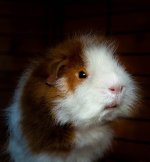
By SoulFire77
- 396 reads
An excerpt from my (stalled) novel-in-progress The Tallow Man — told entirely from the perspective of a herd of wild Andean guinea pigs (Cavia tschudii) fleeing environmental contamination and a folkloric predator through the mountains of Peru. In this scene, the herd's leader — a scarred female — approaches a village at the edge of the cloud forest, drawn by a smell on the wind.
They smelled the kin before they smelled the smoke.
The Scarred One stopped where the dry grass ended and the cleared ground began. Behind her the herd flattened against the earth without command. The Watcher's ears were forward and trembling. The Bold One's body had already begun to turn away. The Gray-Muzzle held still, old face lifted into the wind, reading what came.
The wind carried kin-smell.
Her body knew kin-smell. It was the smell of warmth pressed to warmth in the night-hollow. The smell of milk. The smell of a body she had slept against when she was small. Safe-smell. Sleep-smell. Home. It did not belong here, in this air that also carried woodsmoke and human-leavings and the cooked-meat smell of things that had once been alive.
The Bold One's body said go.
The Gray-Muzzle's body said nothing.
The Scarred One did not move. One part of her was crouched in the grass with the herd. Another part of her was already moving forward, drawn by the kin-smell the way a body is drawn toward the place where it slept as a pup.
She went forward.
The cleared ground was packed earth, swept clean of grass. A low stone wall ran along one edge, broken and rebuilt many times. Beyond the wall: a small wooden structure, dark-walled, smoke rising from a hole in the roof. Behind it, a sagging fence of woven sticks. Behind the fence, a stack of split wood as tall as a human, smelling of resin and old rain.
The Scarred One crossed the packed earth in three movements. Stop. Listen. Move. Stop. Listen. Move. The kin-smell grew stronger with each pause. Mixed in it now: a smell she did not know but her body recognized — the smell of many bodies close together that did not run.
She reached the stack of split wood. The smell was inside the wooden structure. She could go no further by ground.
She climbed.
The split wood shifted under her feet. A piece slid free and clattered against the next, and she froze against the rough side of the structure, body pressed flat, breath suspended. No sound came from inside. No footfall. No human voice.
She climbed again.
Near the top of the stack a knot had fallen from one of the boards, leaving a hole the width of two whiskers. The smell came through it. The light came through it. She put her eye to the hole.
She did not understand at first what she was looking at.
There were pens. Three of them. Low, square, made of split sticks bound with wire. Each pen the size of a sleeping-hollow. Each pen held bodies.
Kin.
Four in the first pen. Five in the second. Three in the third, with a fourth pressed against the wire on its side, breathing the long slow breath of a body that has eaten too much.
They were fat.
She had never seen kin so fat. The fat moved when they moved, gathered at the haunches, hung beneath the belly. Their fur was clean and soft, the kind of fur a mother licks to keep clean, but no mother had licked this fur. It had grown this way. It had been kept this way.
She watched them eat.
A wooden bowl in each pen. Greens. Chopped soft. The kin lowered their faces into the bowls without lifting them, without scanning, without the small constant flick of the head that watches sky and shadow and edge. They chewed. They swallowed. They lowered their faces again.
One of them — the smallest, in the second pen — lifted its head.
Its eyes were soft. Wet-soft, dark-soft, the eyes of something that had never run. They moved across the wall of the structure. They passed the knot-hole. They passed her. They did not stop. They did not narrow. They found the bowl again, and the small head lowered, and the chewing continued.
The Scarred One did not move.
She had been seen and not-seen. She had been there and not-there. The eye that passed across her was the eye of a body that no longer knew what to look at because nothing it looked at could hurt it.
Her own body knew the wrongness of this before she did. Her flank twitched. Her whiskers folded back against her face. Run-now, her body said. This is the smell of run-now.
She did not run.
A door opened.
She heard the wood scrape against earth before she saw anything. Then a human came around the side of the wooden structure into the pen-place — an old human, bent at the shoulder, hair the color of pale grass. The skin of the hands lined like old bark. The clothes plain, dark, worn into the shape of the body inside them.
The human carried a bundle of greens.
The Scarred One pressed harder against the boards. Her body wanted to be smaller than it was. The human did not look up. The human looked at the pens.
The human spoke.
"Vamos, mis gordos. Coman bien."
The sound was soft. The sound was the sound a mother makes to a pup who has woken in the night and needs returning to sleep. The Scarred One did not know what the sounds meant but her body knew the tone — gentle, tending, the voice that means I am here, you are safe.
The kin in the pens lifted their faces toward the voice.
They knew the voice.
The human knelt beside the first pen. Reached over the wire. Set the greens into the bowl with both hands, careful, smoothing the leaves flat the way a body smooths a sleeping-place. The kin gathered around the bowl. The human watched them eat for a long moment without speaking. Then the human's hand went into the pen.
The hand moved among the bodies. It touched one back. Touched another. Stroked. The kin did not flinch. The kin pressed toward the hand the way a pup presses toward milk.
The hand chose.
It closed around the smallest body in the pen — the fattest, the softest, the one whose belly hung lowest. It lifted the body out. The body did not kick. The body did not twist. The body's small legs hung loose from the hand the way a thing hangs that has forgotten it is meant to run.
The human stood.
The human said something else. Quieter. The Scarred One caught one sound that might have been the sound her own herd made for good. Or for come. Or for nothing she had a body for. The human carried the body around the side of the structure toward the door. The door scraped closed.
For a moment there was only the wind.
Then the iron sound. A pot lifted. A pot set down on something hard. Water moving. The crackle of fire being fed.
She did not hear the small body again. She did not need to.
The kin in the pens continued to eat.
One of them — the closest to where the chosen one had been — lifted its head briefly. A half-flick. The ghost of the old gesture that watches edge and shadow. Then it lowered its head and ate. The others did not lift their heads at all. Their bodies did not know what had happened. Their bodies did not know that one less body sat among them.
Or their bodies knew and did not have anywhere to put the knowing.
The smoke from the roof-hole grew thicker. The smell that came with the smoke was the smell of cooked meat and the smell of something else — a sweet, heavy smell. Fat melting into fire. The Scarred One had smelled this before. On the wind. On the long journey. Drifting from human-places, places they had skirted at distance: the smell of bodies being made into food.
She had not known, until now, whose bodies.
She came down from the stack of split wood.
She moved slowly, the way a body moves when something inside it has been re-arranged. Her legs worked. Her body knew where the herd waited at the edge of the dry grass. Her body carried her there.
The Gray-Muzzle was watching for her. The Watcher's ears were still forward. The Bold One's body had stopped saying go and was instead saying what. The herd pressed close around her when she returned. The warmth of their flanks against her flanks was the same warmth that had been in the pens, the same warmth she had slept against all her life.
She did not have a way to tell them.
The Gray-Muzzle put his old face against her neck for a moment. He had been alive long enough to read the smell of where she had been. He did not need sound. No guinea pig has ever needed sound. The body says what it knows by being the body it is, and her body — pressed tight, shivering small, every muscle remembering the pen — said what she had seen.
The Gray-Muzzle turned away from the human-place.
The herd turned with him.
They moved away from the cleared ground in the half-dark. Through the dry grass and into the brush at the far edge, and then up into the rocks where the wind no longer carried the smell of smoke. They moved a long way. Farther than they needed to. Until the Scarred One's own body could no longer find the kin-smell in the air.
She stopped when she could not smell it.
The herd stopped with her.
She lay down between two stones, in the cold, and pressed her flank against the Watcher's flank, and felt the herd's warmth gather. Safe-smell. Sleep-smell. Home. The same smell. The same warmth.
She did not sleep.
Behind her eyes was the pen. Behind her eyes was the soft body in the human's hand. Behind her eyes was the eye that had passed across her and not seen her — not because the eye was blind, but because the body the eye belonged to no longer knew that anything could come from beyond the wire.
The image moved with her into the dark.
It stayed when night ended. It stayed when morning came. It went where she went.
- Log in to post comments
Comments
the fat one is fat for a
the fat one is fat for a human purpose. Reminds me a bit of one of those films were humans were fattened up for the same purpose. Doug McLure might even have been in it.
- Log in to post comments