


The Kept Ledger (1)

By SoulFire77
- 390 reads
The couple was going to fight over the quilt. Gayle saw it the minute they walked in—the woman holding her auction paddle like a hymnal, the man already scanning the lot tables with his jaw set. Married thirty years at least, the kind of marriage that had worn itself into a groove so deep neither one could see out. They'd fight quietly. They always did. He'd bid on something she didn't want and she'd touch his arm and he'd bid again anyway, and by Lot 34 they'd be sitting a chair apart with their coats between them.
Gayle had seen it a hundred times. She'd priced the quilt at forty dollars, which was generous. Machine-stitched, polyester batting, a Walmart pattern somebody's aunt had assembled in front of the television. It would go for sixty-five because the backing had a floral print that reminded a certain kind of woman of a certain kind of childhood, and that kind of woman would bid with her throat instead of her head.
She worked the registration table through the morning, checking IDs, handing out paddles, marking the sheet. The warehouse was cold enough that she kept her coffee close. The fluorescent lights turned everything the color of old paper. Holt had set up forty folding chairs and half of them were full by nine, which was decent for a Tuesday estate in March. The Keller estate. No one famous, no one rich—just an old man from Liberty who'd collected pocket knives and Depression glass and died in the order God intended, which was the kindest thing Gayle could say about most of her clients.
She caught a mismarked lot before it went to the podium—a set of Corelle dishes tagged at Lot 22 that should have been 32. Initialed the correction on the manifest. She had a thing about numbers being right. Holt said once that she was the most accurate cataloger he'd ever worked with, and she'd taken it the way another woman might take a compliment about her eyes.
By eleven the crowd had settled into its rhythms. The pocket knives went fast and high. The Depression glass drew two women who knew what they were looking at and a man who thought he did. A box of old Life magazines sold for a dollar. Gayle watched a young woman hold a cast-iron skillet to the light, turning it in both hands, thumbs on the rim, slow and careful, the way you handle something that weighs more than it should—and Gayle's hands went still on the clipboard for a beat. Then the lot number was called and she marked the sale and moved on.
The quilt went for seventy. The woman won. The man didn't speak to her afterward, but he carried it to the truck for her, which Gayle supposed was its own kind of language.
After. The warehouse emptying, chairs folded, the podium hauled back to Holt's trailer. The particular silence of a space that had been full of voices and wasn't anymore. Gayle swept the concrete floor because she'd learned a long time ago in warehouse work that you always leave a floor cleaner than you found it. Holt came by to hand her the check for the day and said the Trogdon place out in Sophia was ready for inventory, county job, no family, just her and the house. "You good going out there by yourself?" he said, and she said she was, and he nodded and left. He wore the same flannel every auction day. She'd noticed.
Home. The duplex on the county road, the other half vacant since October. She ate standing at the counter: a sleeve of saltines and pimento cheese from the IGA, which was not dinner but was enough. Washed her hands. Sat at the kitchen table under the overhead light that hummed at a frequency she'd stopped hearing years ago.
Opened the composition book. Wide-ruled, Mead brand, the kind they sold at Dollar General in packs of three. She was on her fourth book. The first three were in a shoebox on the closet shelf. She did not reread them.
She uncapped her pen. Wrote the date. Wrote: Keller estate. Holt shorted day rate by $15—said misc. expenses but didn't show receipt. Capped the pen. Closed the book. Washed the knife she'd used for the pimento cheese and put it in the drainer and went to bed.
Lassiter Mill Road turned to gravel after the creek bridge and didn't apologize for it. Gayle's Ranger bounced through the ruts with the toolbox rattling in the bed. The morning was overcast and raw, early March holding winter's shape even as the ditches had started to green up. Bloodroot pushed through the leaf litter in the drainage cuts—white flowers not open yet, the stems thick and red where she'd kicked one stepping out of the truck. The sap left a smear on her boot like something had been wounded there and walked away.
The house was a two-story frame set back from the road on four acres of nothing in particular. White paint gone the color of creek sand. Galvanized roof streaked with rust in long vertical lines, like the house had been crying from the eaves. A front porch with a single metal chair and a coffee can that might have held a plant once. The county had sent someone to mow, and the lawn had that shaved, apologetic look of a yard maintained by obligation.
She unlocked the front door with the key Holt had given her. The smell hit first: closed air, three weeks of it, the particular staleness of a space that had been inhabited by one body for so long the walls had taken on its chemistry. Not decay. Nedra Trogdon had been found by the mail carrier after three days, which was quick enough. Just stagnation. The smell of a life stopped.
Gayle set her clipboard on the hall table and did what she always did first: stood still. Listened. She'd been in enough dead people's houses to know that the first thirty seconds told you everything. Whether the person had seen it coming. Whether they'd been the kind to keep things or the kind to let them go. Whether the house would be a day's work or a week's.
This one was a day. She could tell by the order of it—dishes in the drainer, a single mug on the counter by the coffee maker, the kitchen floor swept. Nedra Trogdon had been the kind to maintain. Not out of pride, Gayle thought, but because maintenance was what you did when the alternative was sitting still and thinking about what you'd lost.
She started in the kitchen. Clipboard out, pen in hand. She worked the way she always worked: left to right, top to bottom, every cabinet and drawer. The dishes matched—Corelle, Spring Blossom pattern, service for four though the wear marks said service for one. She noted the condition, estimated the lot value, moved on. Tupperware in the freezer, labeled in a hand that had once been steady: Butter beans 6/14. Squash cas. 8/2. Chicken pie 11/19. No year. The food had been removed by the county health department, but the labels were still taped to the shelves, a ghost menu.
The pantry: canned goods arranged by type. Green beans with green beans, tomatoes with tomatoes. A system so consistent it looked like a small grocery. Gayle had seen worse. She'd once inventoried an estate in Asheboro where the man had organized his entire kitchen by expiration date, oldest to the front, a rotation system you'd find in a restaurant walk-in. She'd respected that. She'd priced his can opener at a dollar and moved on.
Front room. A recliner worn to the shape of one body—the left armrest darker than the right, the cushion compressed into a topography of use. Television with a built-in DVD player. Remote on the armrest. A Bible on the side table, King James, the binding cracked and re-taped, page edges soft from turning. Tabbed with colored sticky notes in a system Gayle did not try to decode. She'd price it at two dollars. Nobody bid on Bibles. They were the last thing left on every lot table, after the artificial flowers and the Reader's Digest condensed books, and Gayle had always found that funny in a way she couldn't quite get comfortable with.
A shelf of porcelain angels. Twelve of them, identical in pose—hands folded, heads bowed—but varying in size from four inches to nine, arranged tallest to shortest. Every estate had something like this. Some object multiplied past reason into a collection that the collector probably called a passion and everyone else called a problem. She tagged them as a single lot. One had a chipped wing. Nedra had kept it anyway, right in line with the others, same bowed head, as if the damage were just another kind of devotion.
A phone book with names crossed out. Single lines through each, drawn with a ruler. Not anger. Accuracy. People who'd moved. People who'd died. The book was a census of attrition, updated methodically, and by the last pages more names were crossed out than not.
Church bulletins from Shiloh Baptist, a thick stack held with a binder clip. Gayle fanned through them. The most recent was nine years old. Before that, weekly, going back decades. Nine years ago Nedra Trogdon had stopped going to church, or the church had stopped coming to her. Either way, the record simply ended, the way a subscription lapses when nobody renews it.
Gayle noted the bulletins on the manifest. She did not price them.
Upstairs. The hallway was narrow and smelled of cedar. Two bedrooms. The first was Nedra's: a double bed, made, a nightstand with a glass of water gone cloudy. Reading glasses folded on the nightstand. A closet with house dresses and one good dress, navy blue, still in the dry cleaner's plastic. Gayle tagged the lot and moved on.
The second bedroom. Pale yellow paint—a color that didn't match anything else in the house. The room was empty except for a dresser and, on the dresser, a cedar box.
Gayle opened the box. Baby shoes inside. White leather, barely the length of her thumb. She picked one up and turned it over. The sole was clean. Unworn. The stitching was tight and even, the leather still supple from the cedar air. Shoes bought for a baby who never put weight on them. Her thumb moved across the sole once before she set the shoe back, and the leather caught on the callus of her palm the way new things do when they've never been softened by use.
She wrote on the clipboard: Cedar box w/ contents, good cond. $12. Closed the box. Closed the door to the pale yellow room. She stood at the top of the stairs with the clipboard held against her chest and the hallway full of cedar and the house quiet the way only empty houses are quiet, and she did not move for what might have been three seconds or might have been longer. Then she went downstairs.
The front room again. The writing desk against the wall—catalog furniture, pressed wood with a veneer meant to suggest oak. 1970s. Not valuable. Three drawers. The top two she'd already cataloged: tax documents, utility bills, the phone book. The bottom drawer stuck. Swollen wood, the kind of warping that happened in old houses where the heat was uneven and the humidity settled in the joints. She pulled harder, felt it give, and the drawer came open with a sound like something exhaling.
Inside: a single ruled composition book.
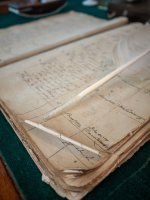
Mead brand. Wide-ruled. The cover was soft from handling, the corners rounded, the spine cracked in three places. Gayle picked it up and her hands knew the weight of it before her mind caught up—the specific heft of a book that had been written in for a long time.
She opened it.
Next part:
https://www.abctales.com/story/soulfire77/kept-ledger-2
- Log in to post comments