


The Kept Ledger (2)

By SoulFire77
- 513 reads
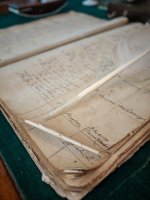
The first page. Dated. A name. A specific grievance. Written in a hand that was not hers but moved the same way.
4/7/83 — Dr. Rowe. Said it was God's plan. Did not say whose.
Gayle read the entry twice. Her hands did not move. Then she turned the page.
4/22/83 — Donnie. Came by to get the crib. Did not ask if I wanted to keep it.
5/1/83 — First Baptist. Casserole committee sent a dish with a card. Card said "in sympathy." Sympathy is not the word for what happened.
She stood in the front room of a dead woman's house with the book open in her hands and the light coming through unwashed windows the color of old milk. The recliner behind her. The angels on the shelf. The pale yellow room above her, closed, with its cedar box and its twelve-dollar price tag. She turned more pages.
The entries continued. Dated. Named. Specific. The same grammar Gayle used in her own book—the grammar of accounting, of debts logged and never collected. Nedra's early grievances were small and precise: a sister who didn't call on the anniversary. A foreman at the furniture factory who docked her pay for a bathroom break. A neighbor who let his fence fall and didn't fix it. And between them, the God entries. Short. Dated. No accusation. Just a name and a silence where the accusation should have been.
4/7/84 — God. One year.
4/7/85 — God.
She skipped ahead. The handwriting changed in the middle years—not deteriorated, expanded. Entries grew longer. Some included weather. Some noted what Nedra had eaten. A grievance against Duke Energy sat beside a description of a cardinal on the fence wire, both recorded with the same flat weight, the same careful hand. The ledger had stopped distinguishing between injury and observation. Everything was evidence now. A Tuesday with rain. A bill. A bird. A silence from God on a date that meant something. All of it entered, all of it counted, the way a machine counts without knowing what it's counting.
She skipped further. And here the book became something else.
Pages of shapes. Circles drawn over and over, tight and small, filling margins. Lines that might have been words once, compressed into a shorthand that had stopped being language. Symbols Gayle didn't recognize—a private alphabet developed over decades, the way a path worn through a field becomes a ditch, then a gully, then something the original walker wouldn't recognize. Some pages had stains—coffee, maybe, or tea, soaked into the paper and dried to the color of old skin. The handwriting trembled. It listed. It repeated itself. One page had a single word written forty times in columns, and the word was April. She ran her fingertip down the columns and the paper was worn to velvet where the pen had pressed.
She turned to the last entry.
Tues. Dog next door again all night.
Then nothing. Blank pages, clean and waiting, until the back cover.
The house had gone dark around her. Late afternoon in March, the light dropping fast. She had not turned on a lamp. She had not finished the inventory. She held the book in both hands the way the young woman at the auction had held the cast-iron skillet: carefully, with an attention that had stopped being professional.
She should have put it back. The composition book belonged to the estate—county property now, part of the manifest, an item to be tagged and priced and sold or discarded. She knew this. She knew the procedure the way she knew her own name, the way she knew that a Corelle set in the Spring Blossom pattern was worth eight dollars and a worn Bible was worth two and a shoebox of old letters was worth nothing to anyone except the person who'd written them, and that person was dead.
The book was in her bag. She didn't remember putting it there. That wasn't true—she remembered exactly. She'd held it against her side and slid it into the canvas tote between the roll of pricing stickers and the extra pens, and she'd done it the way she did everything: efficiently, without hesitation, the way her hands worked when her hands knew something before she did.
She sat in the truck with the engine running and the heater blowing dust from the vents. The headlights cut down Lassiter Mill Road and caught the bloodroot in the ditches—the stems red, the white flowers closed against the cold, the sap bright where a tire had crushed one flat into the gravel. She did not write it down. There was no column for this.
The drive home took twenty minutes. The book sat on the passenger seat where nobody had sat in a long time. She drove the speed limit and used her turn signal at the county road and pulled into the gravel drive and sat in the cab for a while with her hands on the wheel and the engine ticking as it cooled.
She went inside without taking off her boots.
The kitchen table. The overhead light. The hum.
She set both books on the table. Hers on the left, Nedra's on the right. Opened them side by side. Her own book to the most recent entry—the Keller estate, Holt's shorted day rate, the fifteen dollars she'd never see. Nedra's book to the first page, the first entry, April 7, 1983.
She read.
Not skimming now, not standing in a dark house with the inventory unfinished. Reading. Entry by entry, the way she might have read a novel if she'd been the kind of woman who read novels. She followed Nedra's grievances the way you follow a story—waiting for what came next, recognizing the rhythms, anticipating the turns. The sister who didn't call. The foreman. The furnace repair that cost more than quoted. The God entries, April after April, getting shorter until they were just a date and a name and nothing else.
She read the middle years, where the ledger expanded. Where Nedra had started recording everything—the weather, the food, the birds at the feeder, the price of gas, the sound of the furnace cycling on and off. All of it entered with the same flat authority as the original grievances. As if the whole world owed her something and she was keeping the receipt. Gayle's hand kept turning pages. The gesture was the same one she used at work, flipping through a manifest, checking numbers. Her hands knew this rhythm. They didn't need to be told what kind of book they were holding.
She read the late years. The shapes. The symbols. The private alphabet that had outlived its own language. The page of April written forty times. She ran her fingertip down the columns again and the paper was worn to velvet where the pen had pressed.
She turned to the last entry. Read it again. Tues. Dog next door again all night. Then the blank pages, white and patient, still waiting for a hand that would not come.
The other half of the duplex was silent. Outside, the same dark. Inside, the hum of the overhead light and the sound of her own breathing and the two books open on the table like hymnals at adjacent seats.
She went back to 1997. A section she'd passed through earlier, middle-period, when Nedra's entries had begun to blur but hadn't yet broken down. An entry from October: a complaint about the church, something about a deacon who'd promised to fix the front steps and hadn't, and Nedra had written that they'd been broken since 1994. But they hadn't. Gayle had read the 1994 entries. The first mention of the steps was June of 1995, a different deacon entirely. Nedra had misremembered. Had gotten the year wrong and the name wrong. A small error. The kind of thing no one would ever catch, because no one would ever read this book with the attention it required.
No one except a woman who had a thing about numbers being right.
Gayle picked up her pencil. She kept mechanical pencils in the cup by the phone—0.7 millimeter, the kind that didn't need sharpening. She turned back to the October 1997 entry and in the margin, in her own neat hand, she wrote: 1995, not '94. Deacon Gregg, not Harold.
A proofreader's correction. The smallest possible act of care. The most Gayle Barbee thing in the world: not grief, not tenderness, but accuracy. The right year. The right name. The record set straight in the margin of a dead woman's forty-one-year accounting of everything the world had failed to give her.
She put the pencil down. She did not close either book. The overhead light hummed its one note and the duplex held its silence and the two ledgers lay open side by side, one kept for eleven years and one for forty-one, both written in the same hand, which was to say: in the hand of a woman who had learned to count what hurt and couldn't stop.
She turned the page.
- END
- Log in to post comments
Comments
Fascinating! It never
Fascinating! It never occurred to me that there might be someone in the world keeping a daily list of grievances like that - I find it slightly unnerving!
- Log in to post comments
all diaries are grievances.
all diaries are grievances. child's shoes, for sale, unused is more dramatic.
- Log in to post comments