


Ridgeline - Part Five: Flinch and Hold

By SoulFire77
- 473 reads
She didn't move. The dog didn't move.
Ten feet of gravel between them and the dusk thickening into something heavier and the dog sat on its haunches with its nose working the air and Dana sat on the root ball with Bree against her ribs and neither of them did anything for what felt like a full minute. Maybe longer. Time had gone strange since the attack — she couldn't tell anymore whether a minute was a minute or whether her body was running at a different clock speed than the world. The dog's remaining ear — the left one, upright, intact — rotated in small adjustments, tracking sounds Dana couldn't hear. Its nostrils flared in a rhythm that seemed to have nothing to do with breathing. It was reading her. Whatever it was finding in the air between them — the blood, the sweat, the formula on Bree's onesie, the Lysol still on Dana's hands from wiping the doorknobs that morning — the dog was taking it in and processing it through a system she had no access to.
She tried to stand. The dog flinched — a full-body contraction, shoulders bunching, weight shifting to the back legs, the mechanics of a body preparing to run. But it didn't run. It held. The contraction frozen at the peak, the muscles locked between going and staying, and it watched her with those steady eyes and waited to see what she'd do next.
She sat back down. The dog's shoulders dropped a quarter-inch.
This was the negotiation now. Not a conversation. Not even an exchange. Just two bodies calibrating to each other in the failing light, each one tracking the other's movements for the thing that would break the arrangement — a sudden reach, a loud sound, a shift in weight that meant lunge instead of settle.
Dana sat against the downed tree and bled and held Bree and the dog circled.
Wide arcs. Fifteen feet out, then ten, then fifteen again. Nose to the ground, then up, then to the ground. It moved in a pattern that looked random until she watched long enough to see the structure — it was orbiting her, a fixed radius around a fixed point, and the fixed point was Bree. Not Dana. The dog's arc tightened when it passed downwind of the baby and widened when the wind shifted. Its body did something visible each time it crossed through the blood-smell — a stiffening in the shoulders, a lift of the head, the nose pulling away from the ground as though the scent were a surface it didn't want to touch. Then the arc would carry it into the baby-smell and the shoulders would ease and the nose would drop and the orbit would tighten by a foot.
Dana watched it do three full circuits before she thought she understood: the dog was smelling the blood and the baby and the blood was wrong and the baby was right and its body was doing two things at once and couldn't resolve them.
The cat at her mother's house when Bree was born had done something similar. Her mother had said she's jealous and Dana had thought no, she's trying to figure out what the baby is. The cat had resolved it by sleeping under the bassinet. Close. Not touching. Present.
The dog completed a fourth circuit. Sat again. Ten feet. The same distance.
Dana made a sound. Not a word — a soft exhalation, a shh, the sound she made over Bree's crib at three in the morning when the crying had gone on long enough that words were useless and all she had left was the sound itself, the vibration of breath through a constricted throat. Then a cluck. The sound her mother made at the cat. The sound you make at an animal when you want it to know you're not going to hurt it and you don't have any other tools.
The dog's shoulders dropped. Half an inch. Not a relaxation — a reduction. Something in the musculature easing from a ten to an eight. It sat more fully on its haunches, the rear legs spreading slightly, the posture shifting from ready to run to sitting but watching. Its mouth closed. The teeth disappeared behind the lips and the face changed — not softer, but less. Less display. Less hardware visible.
Dana made the sound again. The shh. Longer this time. Bree stirred against her chest, the small body adjusting to the vibration of Dana's voice through the ribs, and the dog's ear rotated toward the movement and held.
The light went.
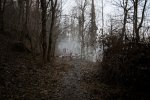
Not all at once — the sky above the canopy was still a deep blue that hadn't fully committed to black, and the western edge of the ridge held a band of orange that leaked through the trees in horizontal bars. But the trail was dark. The gravel she could see was gray, then darker gray. The dog became a shape — brindle on dark, the scars invisible now, the torn ear just an absence where symmetry should be. She could see its eyes because the eyes caught what light was left and held it. Two points, low to the ground, steady.
The temperature dropped. Not gradually — the ridge lost its heat the way a parking lot loses heat after sundown, the stored warmth radiating upward and leaving the ground cold beneath you. Dana's arms prickled. The t-shirt was ripped, the bottom six inches gone for the forearm strip, and her stomach was exposed above the leggings and the air on the bare skin made her aware of how thin she was — how little tissue separated the night from her organs. The rib wound ached differently in the cold, a tighter pain, the edges of the cut contracting. Bree's warmth against it was the only heat she had. She curled around her daughter the way she curled around a heating pad on the couch during cramps — not for comfort but for function, the body organizing itself around the single source of warmth because the alternative was shaking, and shaking would jostle the wounds, and the wounds would bleed.
The dog's head snapped left.
A sound from the treeline — something moving through the brush, small, a rustle that could have been a possum or a raccoon or the wind in the laurel. Dana's body responded before the sound registered as non-threatening: a surge of something hot behind her sternum, her arms tightening around Bree, her shoulders pulling inward. The dog's head tracked the sound for three seconds, the ear rotating like a dish, then the head swung back to Dana and held.
This happened four more times in what she estimated was the next hour. Each time a sound from the trees. Each time the dog's head snapping toward it. Each time Dana's body spiking — the chest, the arms, the involuntary contraction around Bree that pressed the baby harder against the rib wound and sent a flare up her side. Each time the dog's head swinging back to her. On the third snap she looked down at the forearm strip while her arms were tight around Bree. The fabric was dark to the wrist. The seep had started again at the edges, a slow warmth spreading past the cotton, and she couldn't retie it without putting Bree down and she wasn't putting Bree down. She watched the dark line on the fabric widen by a quarter-inch and then the fourth sound came from the trees and the dog's head snapped and her body spiked and she stopped looking at the strip.
After the fifth time she realized the dog was doing something she wasn't: it was assessing the sounds and dismissing them. Its head snapped toward the noise, held, cataloged, and returned. Dana's body spiked and stayed spiked. The dog's body spiked and came down. Whatever system the dog was running — whatever triage it performed between threat and not threat — it was faster than hers and each time its head returned to center she felt her own system ratchet down a notch, following the dog's lead because the dog seemed to know something she didn't.
She was trusting a stray dog's threat assessment over her own. She was too tired to think about what that meant.
Stars appeared through the gaps in the canopy. A handful at first, then more, the sky darkening in stages. She hadn't seen stars in months. The apartment faced east and the parking lot lights washed out everything above the treeline and she'd stopped looking up sometime in April. Bree had never seen stars. Dana tilted her head back against the downed tree and looked up through the canopy and the stars were cold and far away and beautiful and she was bleeding on a trail in the dark with a baby and a dog and the stars did not help and she looked at them anyway.
The dog was watching her.
She looked back. Ten feet. The steady eyes. It hadn't moved during the star-gazing — hadn't circled, hadn't shifted. Just watched.
She reached toward it.
Slowly. Her right hand, the uninjured one, extending from her lap toward the dog's muzzle, palm down, fingers loose. Here. Smell me. I'm not going to hurt you.
The dog flinched.
The same full-body contraction from the first time she'd moved — shoulders bunching, weight back, the body compressing around its center. But the rear legs didn't engage. The flinch happened and peaked and the dog held at the peak. Frozen. The muscles locked between run and stay, the body suspended in the space where those two things pulled hardest against each other.
Dana stopped reaching. She left her hand where it was — extended, still, four feet from the dog's nose. She didn't push forward. She didn't pull back. She sat against the downed tree with her hand in the air and the dog flinched and held and neither of them moved and the frogs were starting up somewhere near the creek and the sound filled the space between them with something that wasn't silence and wasn't conversation.
She brought her hand back. Put it on Bree's back. The dog's eyes tracked the hand the whole way.
She closed her eyes. Not to sleep — sleep was impossible, the rib wound pulsing with each breath, the forearm strip soaked through and warm against her skin. But she closed them because the dark behind her eyelids was the same as the dark in front of them and her eyes were burning and the muscles that held them open had been running for hours and had nothing left.
Bree breathed against her chest. The frogs pulsed. The dog didn't make a sound.
She opened her eyes.
The dog had moved. Six feet away now, down from ten, lying on the gravel with its nose on its paws. Its eyes were open, watching her with the same steadiness as before, and the body was different — flatter against the ground, the legs tucked under rather than coiled, the posture of an animal that had made a small decision while she wasn't looking. She could smell it from here — creek water and dead leaves and the warm, thick musk of an animal body, unwashed and real and alive. It was the first warm thing near her that wasn't Bree.
It hadn't approached while her eyes were open. It had waited until she stopped watching.
Six feet. She could see the muzzle scar from here — the thin white line running across the bridge of the nose, old, healed clean. The intact ear still upright, still tracking. The ribs still visible but the breathing slower than the panting she'd seen an hour ago, the flanks rising and falling in a rhythm that had changed without her seeing it change.
She didn't reach. She didn't speak. She sat with Bree against her chest and the dog six feet away and the frogs filling the dark with a sound that wasn't silence and the stars coming through the canopy in cold, useless light. Something between them had shifted and she couldn't name it and she wasn't going to try.
Go to the next part: https://www.abctales.com/story/soulfire77/ridgeline-part-six-only-warm-t...
- Log in to post comments
Comments
Lovely way of negotiating
Lovely way of negotiating unease and trust. Maybe the moron's moron should send you to the Straits of Hormuz
- Log in to post comments
unfortunately the moron's
unfortunately the moron's moron used to be a joke. Now the joke is on us.
- Log in to post comments