


Before the Ridgeline - Part Three: "The Sound"

By SoulFire77
- 409 reads
A woman on a porch on Hickory Street, three blocks south of the strip mall, saw the dog for the first time on a Tuesday in mid-April. A brindle, crossing the road at the far end of the block. Moving with direction — not wandering, not circling, heading from somewhere to somewhere else along a route the dog appeared to have traveled before. The route ran between the dumpster behind the Pizza Hut on the corner and the drainage ditch where the road dead-ended at the tree line.
The dog was thin. Thinner than its frame accounted for — the architecture of a sixty-pound dog carrying maybe forty-five, the ribs not quite showing but the tuck at the waist too deep, the hips too sharp. The coat had dulled to the flat brown of a dog that hadn't been touched in weeks. The dog moved past the woman's porch at the far edge of the sidewalk. It didn't look at her. Didn't adjust its path, didn't slow, didn't perform any of the small negotiations a dog performs when it passes a person — the ear-flick, the glance, the briefest orientation that says I see you. The dog moved past the woman the way it would move past a mailbox or a parked car. She was furniture.
The woman watched the dog cross into the next yard and disappear around the side of the house toward the ditch. She went inside. She thought about calling animal control and then didn't because animal control was appointment-only now and the wait was three weeks and the dog would be somewhere else by then.
A man filling his truck at the Route 68 station on a morning in early May saw the dog at the dumpster behind the building. The dog was eating from a torn bag — fast, hunched, the body low, the head dipping and rising, the eyes scanning the lot between bites. The ribs were visible now. The coat had gone rough along the spine, the texture of a dog whose body was burning through its reserves. The dog ate the way a person eats when the eating might be interrupted — without pausing, without lifting the head fully, the jaw working and the eyes working at the same time.
The man watched from the pump. He didn't move toward the dumpster. He watched the way you watch something you don't want to watch but can't stop watching, the way looking at a thing that is failing becomes a kind of participation in the failure. After a minute he looked away and went back to the pump display.
He didn't know that the silver Accord that used to park in this lot — back corner, near the air pump — had carried this dog in its backseat. He didn't know that the woman who used to bring her daughter into the bathroom every morning had kept this dog because her daughter's hand on its ear was the one thing the budget couldn't override. He didn't know the woman or the daughter or the dog's name. He knew the Accord was gone and the bathroom was locked now and the dumpster had a dog at it and none of these facts connected to each other in any order he could see.
A kid on a bicycle saw the dog in late May.
The kid was twelve, riding the loop he'd been riding since school closed — down Willowbrook to the dead end where the houses thinned and the road bent toward the greenway trailhead. He'd ridden this loop a hundred times since March. He knew the mailboxes, the yards, the trucks in the driveways, the specific geography of a neighborhood that hadn't changed in ten weeks because nothing was changing anywhere. He saw the dog lying in the grass at the edge of an empty lot, near the bend where the road turned toward the trail.
The dog wasn't moving. Lying on its side in the grass, the head flat, the eyes open. The kid slowed and stopped and put a foot down. The dog's head came up.
The muzzle scar was the first thing the kid saw. A white line across the bridge of the nose — healed, not fresh, the skin underneath pulled tight and smooth. The scar hadn't been there the last time anyone who knew this dog had seen it. Something had happened between the gas station and this lot, between early May and late May, and the happening had left a mark and the mark was the only record of whatever the happening was. Nobody saw it happen. Nobody treated it. The wound opened and the wound closed and the scar formed and the dog carried it the way the dog carried everything — in the body, without a version of events, without a story that explained the mark to anyone who might look.
The kid held out his hand. Palm down, fingers loose, the way someone had taught him or the way he'd seen someone do it on television. He extended the hand toward the dog from five feet away.
The dog flinched. The shoulders bunching, the weight shifting back, the head pulling down — the same contraction from the lot, the same gesture the body had learned in less than a second when the man's hand came down. But here, on the grass, five weeks later, something different happened. The flinch hit its peak — the maximum compression, the body at its smallest — and held. The body didn't bolt. The body stayed. Compressed, low, the weight on the back legs, the head down, every muscle loaded for the flight that didn't fire. The boy's hand was extended. The dog's body was compressed. Neither moved.
Three seconds. Four.
From the house at the end of the block, a woman's voice: "Caleb! Dinner!"
The kid turned his head. The dog was on its feet and moving before the kid's eyes came back — up from the grass and onto the road and down the road toward the trailhead, the gait quick, the body low, the moment dissolved. The kid watched the dog disappear around the bend where the pavement ended and the gravel began. He got on his bike and rode home and the dog was a thing he'd seen and then a thing he'd seen yesterday and then a thing he might have seen and then nothing.
The dog kept the hold. The body had learned it the way the body learns everything — through repetition, through encounters the dog could not catalog but the body could, the flinch-and-compress becoming the flinch-and-compress-and-stay, the flight response shortening by fractions across weeks until the compression could exist without producing motion. The hold was new. The hold was the body's latest gesture. The hold would outlast everything.
The trail.
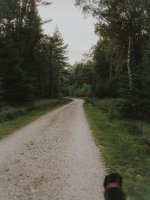
A greenway at the town's edge. Packed gravel along a creek, the canopy closed overhead. Sawhorses at the trailhead, orange and white: TRAIL CLOSED. The lot empty. The gravel undisturbed except by rain.
The dog came down from the road in late May and found the trail the way stray dogs find corridors — by following water, by following cover, by following the absence of the thing that had been making every other corridor dangerous: people. The trail was closed. Closed meant empty. Empty meant the scanning could slow, the hyper-vigilant circuit that had been running for seven weeks could idle — not stop, but idle, the difference between a body that is watching for threats and a body that is watching.
The dog moved along the gravel. The gait steady — a three-step rhythm, unhurried, the gait of a body that has found a corridor it can hold. The body was twenty pounds lighter than the parking lot. The ribs visible through the coat. The muzzle scar white. Both ears intact. The coat dull, rough along the spine, the texture of an animal at the edge of what the body can sustain. The eyes scanning but slower now. The scanning of a body that has mapped this corridor and found it empty day after day and the emptiness is beginning to register as a condition rather than a variable.
The dog slept under laurel. Drank from the creek where the water pooled behind rocks. Scavenged from the trash cans at the trailhead that hadn't been emptied since March — the food wrappers and apple cores and the half-eaten protein bars left by the last hikers who came before the sawhorses went up. The trail was the closest thing to a territory the dog had held since the apartment. The trail had water and cover and gravel that held scent and a ridge that blocked the wind and no humans.
The body carried everything. The apartment floor. The door that rattled when it opened. The sneakers by the door, one upright, one on its side. The steps — the bare feet on carpet in the morning. The hand on the ear. The backseat. The heartbeat against the ribs. The voice — thin and high and slightly off the breath, a melody that went nowhere, directed at the ear and nowhere else. The body carried all of it the way a creek carries sediment — invisibly, in the current, deposited nowhere, suspended.
June 3, 2020. Morning.
The light was gray and then it wasn't — columns through the canopy hitting the gravel, the gravel shining. The dog was on the trail. The trail was the only corridor the body used now — narrow and long, with water and no people — and the body moved through it the way the body moved through everything, carrying what it carried, attending to what it attended to, the scanning and the scavenging and the sleeping and the scanning.
A sound from below. From the direction of the trailhead.
A crunching on the gravel. Rhythmic, steady. Not footsteps — something else. Something rolling. Wheels on stone, the sound small and continuous, the sound of a thing being pushed.
Then a voice. A woman's voice, low, the murmur of a person talking to someone who can't respond yet — the half-words and the soft sounds and the voice pitched down to a register meant for a small ear close to the speaker's chest.
And underneath the voice, the way a creek runs underneath a bridge: a sound.
The dog's body had not heard this sound in eight weeks. The dog's body had been carrying this sound for longer than eight weeks — for the entire duration of the body's life, the frequency laid down in an apartment and deepened in a backseat and carried through a parking lot and seven weeks of drainage ditches and dumpsters and flinching. The sound was not the same sound. The pitch was higher — the vocal cords shorter, the lungs smaller, a cry instead of a song. But the frequency was in the range. The range that a girl's voice had built through months of singing to an ear that rotated toward her in the dark.
The dog's head lifted. Both ears — both, still — rotated toward the sound. The body went still. The scanning stopped. The restless circuit that had been running for eight weeks — the circuit that ran the eyes and the ears and the nose and the legs, the circuit that said attend, scan, attend — paused. Not stopped. Paused. And in the pause, in the space the pause created, something fired.
In the chest. Below the ribs. A vibration.
Not the heartbeat. Deeper. Slower. Something that had been there the entire time — dormant, buried under the weight of the weeks and the hunger and the scanning — and the sound from the trail below reached it the way a key reaches a lock, the way a door-sound reaches a head that turns without knowing why, the way a shoe on a floor reaches a body that orients without knowing what it's orienting toward.
The vibration held. The dog's body oriented toward the sound. The legs moved.
Down the trail. The gravel under the paws. The morning light in the canopy, the columns hitting the ground, the ground shining. The sound getting closer — the wheels, the voice, and underneath the voice the sound — and the body was moving toward it and the body was carrying everything it had carried and the body had no way to set any of it down and the body moved.
The gravel. The light. The sound.
The dog moved toward something it had no name for, carrying something it had no way to set down.
~End~
- Log in to post comments
Comments
Excellent prequel to your
Excellent prequel to your earlier Covid story, thank you!
- Log in to post comments