


The Mystery in Astley Wood

By maddan
- 347 reads
You will not have heard of the Astley girls I suppose?
No matter. The newspapers at the time were occupied with some political scandal and it was in the thankful days before things went 'viral.' It was an unpleasant business though, and never properly explained. Even the coroner's report was unsatisfactory and I was on the team who produced that. It has nagged at me for years. Then two weeks ago I actually chanced to meet one of the girls, now grown up of course, and she finally gave me the parts of the story she was too young to provide at the time.
Lucy was the younger of the two, the other was her sister Clementine. At the time they were just six and seven years old. Their parents were both surgeons and, as you might imagine, very busy people, and the girls were passed around between a variety of child minders, some paid for and professional, some family friends, and one a relative, uncle Alexander. Uncle Alexander, a half-brother of their mother and some years older, lived in a house in Astley. He seems to have been a lonely man. He was a widower from a tragically brief marriage, and a career in the foreign office had not treated him well, and he made his living as a writer of histories. During the summer in question he had the girls first on Thursday afternoons, charged with picking them up from school, giving them tea, and looking after them until they were collected, and then when the school holidays began, twice a week, on Wednesdays and Thursdays, from lunch till early evening.
There is no doubt uncle Alexander was tremendously fond of his nieces but he lacked any experience with childcare. He was busy, having a deadline to meet, and it was typical for him to feed the girls and then let them play in the garden while he worked. The garden was large and overgrown but for a single mowed path which ran a winding route around it, and even though uncle Alexander's office overlooked it, the girls spent most of their time out of his sight.
There were those who thought uncle Alexander deficient in his care. I am reminded of many factors we considered when hearing the case. Had the girls' lives not been so complicated then their game in the woods might have stood out to their parents as unusual; had their mother not been working until late evenings those final weeks, she might have had more time to listen to their stories; had uncle Alexander raised children of his own he might have laid down the law earlier over where they were and were not allowed to play, and trusted to a padlock rather than to their obedience. Ultimately though, like the court, I cannot find sufficient cause to cast blame in any direction.
The two girls were both in possession of lively imaginations. Clem, especially, would entertain her younger sister with tales of faeries and princesses and heroic horses, weaving long and complex stories for her devoted audience of one. Uncle Alexander's garden was excellently suited to this sort of fantasy, with several mature and gnarled trees, a willow whose curtain fell down to the ground to make a den, and a pond prodigious with frogs. Best of all it had a door to the woods situated beneath an ivy-wreathed brick archway which might have come from the cover of a gothic romance.
Lucy is certain they were never forbade to go through the door or they never would, and even when they did they suspected, for they were not dull, that it was something unlikely to be allowed. The temptation was too great though. The door acquired some importance in their games, being one week the gates of a castle, the portal to fairyland another. Eventually it had to be passed, and on her tiptoes, Clem discovered that the latch was not locked and the door would open. There was no intention to go far, but once in the woods a degree of investigation was necessary. In truth they held less wonder than the garden, being scrubby and rather ordinary, no willows or ponds, and holding the danger that some other person might interrupt their games, but, just a little way from the door, there was the hollow.
The hollow, or as Clem christened it, the dell, was a shallow sided basin about forty feet in diameter, wide enough for the sun to penetrate the branches above and light it up. It was a secret, secluded place, bordered on all sides by rhododendron and other bushy trees, and carpeted with a thick mat of bluebells, their flowers long gone of course but their greenery lush. Clem immediately announced that it was the grand meeting place of the fairies where, once in an age, the kings and queens would come in all their finery, their banners flowing, to joust and feast and decide the great matters of the day.
The dell was of regular, but not constant importance. More weeks than not some great faerie matter would occur which could only be settled by a tournament, or a council, or a royal wedding, and one of the girls would proclaim 'to the dell!' and the journey would be made - but, conscious they would probably not be allowed to play there if permission were sought, never for long. That was until the chickens appeared. After that it became the chief place of their attentions.
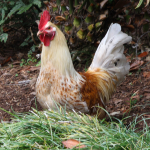
In truth they were cockerels, but whether they knew the difference or not -and they should have because a neighbour kept chickens and petting zoos were a common distraction- the girls called them chickens. They appeared first shyly glimpsed in the undergrowth, and disappeared if the girls so much as moved. It took several weeks of cajoling, cooing, and offering purloined crumbs of biscuits before the chickens would venture into the clearing.
When they did they were magnificent; brightly coloured, crimson combed and with sickle feathers iridescent in the sunshine. Beaks held high and chests pushed forward like matadors, they strutted and kicked at the ground. So proud and martial did they look that Clem decided that they were the old tournament mounts used by fairy knights, and when they ventured close the truth of this was confirmed by their injuries.
At this point the girls games take a different turn. They were the daughters of surgeons and either by nature or nurture, not at all squeamish. Playing at doctors was something they did often and they had a ready supply of doctoring materials, toy syringes and stethoscopes, bandages cut up from old clothes, and doll-size lolly pop-stick splints. Doctoring the injured chickens became the chief activity at uncle Alexander's.
There was not much blood, Lucy remembers, and the feathers of the birds concealed the worst of their wounds, which were sometimes terrible. Cuts, of which there were many, were bandaged, and broken legs and wings were reset (the chickens seemed to have felt no pain) and splinted. Each chicken was carefully examined, lovingly petted with overflowing sympathy, and its injuries addressed.
'There was probably only a couple of weeks of that,' Lucy remembered, 'though it felt like more, and the chickens just kept coming – there must have been hundreds of them. Then the dogs followed.'
Here the exact chronology becomes confused. At some point the girls had described the dell and their mission of mercy to uncle Alexander. 'He asked where it was,' Lucy said, 'and Clem told him it was at one of the other house where they stayed. It is obvious now he would have seen through her but he said nothing at the time and we thought we'd duped him.'
Uncle Alexander, it seems, had taken some interest. Among all the notes for his work he had spread out an early Victorian map of the area and, with reference to existing landmarks, had plotted the position where the house would later be built. The area was mostly grazing land, but a feature was marked named 'cockpit' just beyond the border of the garden.
'The next time he picked us up, he told us we weren't to leave the garden,' Lucy continued. 'It was a sort of a “you girls do understand don't you” sort of a speech, and he placed so much emphasis on us not being in any trouble and it being just a little thing, that it did not really cut through. We still would never have disobeyed him, except that week we had the ointment. I think it was an antiseptic cream Clem had acquired. Mum or Dad must have used it on her because she had a great belief in it, and we were determined it was just the thing to heal the chickens. That was why we disobeyed, we were doing it for the chickens by then, or we would not have dared go because of the dogs.'
The dogs had appeared in much the same way as the chickens, shyly peering through the undergrowth at first, wary of the girls. But their behaviour was very different after that. They were defensive, growling and baring their teeth. Unlike the chickens their injuries were not concealed by feathers and were fearsome, great gouges across their faces, lips torn and hanging loose, ears and eyes gone, flesh sliced to the bone.
'There were more dogs that day,' Lucy said. 'But there were more chickens too and by that time they came straight to us. I'm certain they understood we were trying to help. We invented a system. Clem would examine them and apply the ointment to any cuts, and then I would bandage them, but we ran out of bandages and they kept coming so it became a business just to keep track of the ones we had treated and the ones we had not. Then the chickens got scared and started flocking this way and that, and we saw that the dogs had surrounded us and were coming closer.'
By some stroke of providence it seems likely that uncle Alexander, that afternoon unlike any of the others, had taken the trouble to check on the girls and noticed that the gate was open.
'He came so quickly when we screamed that he must have been in the woods already,' Lucy remembered. 'I think he understood everything immediately, more so that we did. He understood that the dogs were only in the dell. I ran toward him and he did not step foot in it but leaned over. I remember that, him leaning over his full length, he was very tall, hanging from from a tree branch with one hand and plucking me up with the other and lifting me over the dogs and out of the dell. If the dogs were real he would have been standing in among them, his feet at their shoulders.
'He told me to run and get help and called for Clem to come too, but Clem was scared of dogs to start with and didn't move. She was holding her face and cowering and not looking. Then uncle Alexander told me to go get help again and I did not see what happened next.'
Lucy ran back into the house and out the front door and roused a neighbour. The neighbour, I remember, was very anxious that the court understood she came immediately on being alerted. When she did she found Clem, all but catatonic with fear, just beyond the edge of the dell. Uncle Alexander, or what was left him, was inside, torn to pieces.
The police found dog prints around the body, and identified his injuries as dog bites, but despite an extensive search no dogs were discovered. For a while there was quite a state of terror in the village and the woods were sealed off, but gradually, there being no sight of any dogs, the incident was classed as a mystery and life went on. Clem barely spoke for over a year, Lucy says, and even now lives a quiet and brittle life. Lucy's lively, imaginative playmate was gone forever.
Lucy, now a very accomplished young woman, with no-doubt a brilliant future ahead of her, talked to me openly. She has come to a peace with it she says. But when I recognised her name, at my son's twenty-first birthday party of all places, and asked if she were really one of the Astley girls, she turned visibly pale. She thought she was utterly anonymous and she does not want people knowing.
Her parents had kept many details from her, and I was able to explain what the coroner's court had and had not considered, and how we had looked into the history of the hollow and found it had been used for cock-fighting since medieval times at least, and briefly for dog-fighting in the sixteen hundreds when it acquired a reputation for brutality – although none of that was deemed admissible in the end.
And finally, I was able to tell her of the researches undertaken by her uncle Alexander, and how he, unique among every adult in their lives, had taken the girls at their word when they had talked of the dell and the injured chickens.
- Log in to post comments
Comments
So pleased to read another of
So pleased to read another of your excellent Christmas stories - this one is mesmerising - thank you!
- Log in to post comments
This is our Christmas social
This is our Christmas social media Pick of the Day
Please share if you enjoy it too
- Log in to post comments
not a cock and bull, but cock
not a cock and bull, but cock and dog story. well told and believeable.
- Log in to post comments
A lovely tale. Tending to the
A lovely tale. Tending to the injured chicekns has echoes of the story of the bone-setter of Llanfairynghornwy in Anglesey who started out by practising on injured birds.
ITOI
- Log in to post comments