


Ridgeline - Part Six: The Only Warm Thing

By SoulFire77
- 336 reads
She started talking because the silence was going to kill her before the bleeding did.
Not to the dog. Not to Bree. To the air between them — the dark, warm, frog-loud air that sat over the trail like a second canopy. She talked the way she talked to Bree at three in the morning during the colic weeks, the way she talked in the shower when Scott was on a run, the way she talked in the car on the way to the Walmart with the windows up and the mask on the dash and nobody listening.
"The apartment smells like formula," she said. "The whole place. I can't get it out. I cleaned the kitchen — I cleaned it twice — and it still smells like the can, that tin smell, you know? Like the inside of a thermos."
The dog's ear rotated toward her voice. Not the head — just the ear, the intact one, swiveling on its axis like a satellite dish. The body stayed flat against the gravel, nose on paws, but the ear was tracking. Following the rhythm of her speech the way Bree's eyes tracked the mobile over the crib — not the content but the pattern, the rise and fall, the specific frequency of a human voice speaking at conversational distance.
"She won't sleep. Bree. She sleeps for forty minutes and then she's up and she's screaming and I can't — the pediatrician says it's normal, the internet says it's normal, my mother says I did the same thing but my mother also says the isolation is making me paranoid so I don't—"
She stopped. The sentence had been heading somewhere she didn't want to go. She redirected.
"I haven't been to a grocery store in seven weeks. Scott goes. He wears the N95 and he wipes down the bags when he gets home and I stand in the kitchen watching him wipe down cereal boxes and I think — I used to think about other things. I used to think about whether to go back to school. Whether to do the RN program at Guilford Tech. I had a plan. I had a binder."
Something shifted in the dog's body — she felt it more than saw it. She kept talking. The voice was a frequency and the frequency connected them across the gravel the way an IV line connects a body to a bag.
"Scott leaves at six-fifteen. He comes back at six-thirty. Twelve hours. He's driving a truck all day and I know he's tired. I know that. But he walks in and he hands me — like I've been holding her all day and he walks in and it's—"
She stopped again. Bree was making small sounds against her chest — not crying, not the keening. A murmur. The sound a baby makes when it's been crying long enough to exhaust itself and the body has shifted into a register below distress, a low continuous hum that vibrated against Dana's ribs and traveled through the rib wound in a way that was almost soothing, the vibration a counter-frequency to the pain.
The dog's head tilted. A quarter-turn, the way dogs tilt when a sound changes pitch or pattern. Bree's murmur was different from Dana's speech — lower, more sustained, without the gaps and stops of language. The dog's body settled a fraction of an inch closer to the ground, the way a dog drops into a position it intends to hold.
"You probably had a house," Dana said. "Didn't you. Somebody's house. A couch."
The dog didn't respond. She hadn't expected it to. But its breathing changed — or she imagined it changed — a slight deepening, the flanks moving slower, and she wondered if the sound of a voice at this distance and this volume was doing something to the dog's body that was separate from anything the voice was saying. Just the fact of human sound. Just the frequency of it.
She could smell the dog more clearly now. The creek-water-and-dead-leaves from earlier, but closer, and underneath it something else — a metallic undertone, sharp, like the inside of a Band-Aid tin. Something that had bled and healed and bled again. The smell grounded her. It was a real body. A warm body six feet away on the gravel, breathing, alive, its own heart beating at its own rate, and the fact of that — another living thing choosing to stay near her in the dark — was doing something to her chest that she didn't want to look at too closely because looking at it might break it.
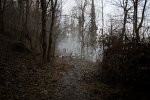
The last light went. The band of orange at the western ridge edge that had been leaking through the trees for the past hour thinned to a wire, then a thread, then nothing. Full dark. The canopy overhead disappeared — not gone, just absorbed into a blackness that was total, the kind of dark she hadn't been in since childhood, since the power went out during Hurricane Floyd and her mother lit candles and the dark between the flames was the dark of the whole world.
She could see the dog's eyes. That was all. Two points of reflected light, low, steady, aimed at her.
"I was going to leave him," she said.
The words arrived without permission. She heard them as though someone else had spoken them — flat, quiet, factual, the way you'd say I left the stove on or I forgot to lock the door. A piece of information she'd been carrying since before Bree was born, since before the lockdown, since before any of this, and the words had been sitting in her throat for so long that releasing them felt physical, a stone passed.
"Not — I don't know. I don't know what I was going to do. I was on the ridge today and I was looking at the houses below and I was thinking about what it would be like to not go back. To just keep walking. And I know that's — with a baby, that's not — but I was thinking it. I've been thinking it since February."
She was talking to a dog. She was talking to a dog on a trail in the dark and the dog couldn't understand her and didn't need to and that was why she could say it. The words had no destination. They went into the air and the frogs absorbed them and the dark absorbed them and the dog lay with its ear turned toward her voice and the words didn't land anywhere and didn't need to.
She didn't say more.
The frogs were louder now. A wall of sound from the creek below — spring peepers and something deeper, a bullfrog, the rhythmic throb of it like a machine in a basement. The crickets had started too, later than the frogs, a higher frequency that layered on top and filled the remaining acoustic space until the dark was full of sound and the silence she'd been drowning in for the past two hours was replaced by something alive and impersonal and constant.
Her legs started to gather under her. The lot — the stroller — she could try. She could stand up and walk back the way she'd come and maybe the gravel would be lighter than the dirt and she'd find the fork and pick right this time and maybe the keys would be there, somewhere in the gravel near the blood. She could try.
The dog breathed four feet away. She could hear the air moving through its muzzle. The weight in her legs dissolved and she sat still.
She stopped talking. She'd said everything she had.
The dog was four feet away. She hadn't seen it move from six to four — it had happened the way the first move happened, during a blink, during the confession, during the moment when her words were going into the dark, and the dog had closed another two feet without her seeing and was lying on the gravel with its head on its paws and its body flat and its breathing steady and slow.
Four feet. She could hear it breathing now. A quiet rhythm, nasal, the sound of air moving through a muzzle pressed against paws. If she extended her arm she could touch it. She didn't.
Bree made a small sound — a half-note, something between a sigh and a hum — and the dog's ear rotated and held and the tail moved. Not a wag. A single lateral twitch, the tail shifting an inch to the right and back, the ghost of a gesture that belonged to a different life and a different floor and a different hand reaching down.
For thirty seconds, nothing happened.
Dana looked at the dog. The dog's eye was open, watching her. Not the gaze from earlier, from the first time it stepped onto the trail. This was different. The steadiness was the same but the quality had changed. It was watching the way a dog watches the person it's decided to stay near — not for threat, not for food, not for information. Just watching. The way a dog lies by the couch and follows you with its eyes when you get up and follows you when you come back and the watching is not about anything except the fact of you.
Dana didn't reach. The dog didn't move. They sat in the dark with Bree breathing between them and the frogs pulsing and the crickets layering their sound on top and the stars coming through the canopy in cold, distant light that didn't reach the ground. Thirty seconds of existence. No threat, no plan, no negotiation. Just breathing in proximity.
The dog stood up.
Not gradually. All at once — the flat body rising in a single motion, every muscle visible, the legs under it, the head up, the ears forward, the whole architecture of the animal suddenly vertical and alert. It sniffed the air. Long pulls through the nose, the nostrils flaring wide, the head turning in a slow sweep that covered the treeline from left to right.
Then it moved.
Away from her. Into the brush at the trail's edge, the body going low, the brindle coat disappearing into the undergrowth the way it had appeared an hour and a half ago — the same sound of weight moving through vegetation, branches flexing, and then the sound thinning and Dana could track it for another ten seconds, maybe fifteen, the crackle of dry leaves under paws getting fainter.
She listened. Her body leaned toward the sound without her choosing to lean, the way you lean toward a car pulling out of a driveway at the end of a visit, watching the taillights. The crackling got softer. Gaps between the sounds. Then the dark absorbed it and the gaps became silence and the silence became the frogs and the crickets and nothing else.
It didn't look back. She was sure of that. She would have seen the eyes — the two points of reflected light that had been her anchor for the past hour — and the eyes hadn't turned.
She sat on the trail with Bree against her chest and the space where the dog had been was four feet of empty gravel and the warmth that had been radiating from a sixty-pound body was gone and the air that replaced it was night air, June but cooling fast on the ridge, and her skin registered the absence the way you register a blanket pulled away in the dark. The frogs were still pulsing and the crickets were still layering and Bree was still murmuring and the dark was the same dark and the stars were the same stars and the trail was the same trail and nothing had changed except that the only warm thing near her that wasn't her daughter was gone and the dark was bigger now and the sounds that had been tolerable with two points of reflected light watching her were not tolerable alone.
She held Bree tighter. The rib wound flared. She held her tighter anyway.
Go to the next part: https://www.abctales.com/story/soulfire77/ridgeline-part-seven-inside-place
- Log in to post comments
Comments
the dark was darker now.
the dark was darker now. great writing. I thought the dog would be her saviour in some unknown way. Might be. I'll wait and see.
- Log in to post comments
I was hoping too
I was hoping too
- Log in to post comments