


Fewer Each Time (1)

By SoulFire77
- 176 reads
Odell Tesh unlocked the front door of his father's shop at twenty minutes to nine on Halloween morning and stood in the doorway with the key still in the lock.
The overhead lights were off. Gray light came in from the square and lay across the floor, and the floor was covered. Dolls lay face down in the aisles. A tin drum had rolled to the foot of the counter. Puzzle pieces ran from the front window all the way to the back hall, and the shelving units in aisle three leaned into one another at angles that made his neck ache to look at them.
Across the glass of the display counter, in black paint marker, in letters as tall as his hand, someone had written I QUIT.
He took the key out of the lock and put it in his coat pocket. Then he took it out again and held it.
He stepped over a carton of wooden blocks and went to the counter. One of the price-sign markers lay beside the register with its cap off. He capped it and set it down. The register drawer was shut. He opened it and counted the bank, and it was all there, down to the roll of quarters he kept wrapped in a rubber band at the back. He closed the drawer and stood with his hands flat on the glass on either side of the Q.
The candy bowl sat at the end of the counter where it sat every October. On Thursday he had filled it with three pounds of peanut butter taffy in orange wax paper, enough for tonight with some left over for Sunday. It was empty. There wasn't a wrapper in it.
He went through the shop the way he went through it every night at closing, front to back. Nobody in the aisles. The office was as he had left it on Thursday, the chair pushed in, the camera monitor dark. The stockroom light was on. He stood in the stockroom doorway and looked at the cartons in their rows and the rolling ladder parked where it belonged. The back door that let onto the alley was bolted from the inside, the long iron bolt shot all the way home. He looked at the bolt for a while. Then he turned off the light and pulled the stockroom door shut behind him.
In the front window the Halloween display was half finished. Two hay bales, a scarecrow slumped against them, a crate of plastic pumpkins with the lid pried up and nothing taken out. The plaster witch his father had bought out of a catalog stood on the left side of the window, where she had always stood.
He took out his phone and called Wade. It rang four times and went to the boy's recording, Wade's voice saying this was Wade and you knew what to do. Odell hung up before the beep.
He opened their messages. The last thing in the thread was from Thursday night, a photo of the window with the hay bales stacked and the witch on the right side, her broom angled toward the street. Under it he had written: Witch goes on the left. Always has. Finish the window after close tomorrow.
Wade had written back: she's been on the left since before my mom was born. let her live a little
Odell had not answered. He looked up from the phone at the window. He looked at the witch on the left side for a long time, and his thumb rubbed the edge of the phone case until it found the crack in the corner.
He typed: call me when you're ready. you're not in trouble.
He read it. He deleted it one letter at a time. He looked at the counter, at the I and the Q and the T, the T dragged long at the bottom where the marker had kept going. Then he typed the same words again and sent them.
Lorna Furr answered on the fourth ring. There was a television going behind her and the sound of a pan.
"He stayed over at a friend's after he got off," she said. "Said he'd be home for supper. Did he forget a shift?"
Odell looked at the drum lying against the foot of the counter.
"No," he said. "No, ma'am. I had a question about the window. It'll keep."
"I'll have him call you."
"No hurry," Odell said. "Tell him no hurry."
When she had gone he found the CLOSED sign in the drawer under the register, the cardboard one his father had lettered by hand, and hung it inside the door on its string. He turned the lock and took off his coat.
He started with the train table, because it was nearest.
The cabinet under it had been emptied onto the floor. Boxed engines, coils of track, the transformer with its cord wound around it, the bag of tiny painted people who waited at the tiny station. The cabinet door hung open on one hinge. He got down on his knees and his knees let him know about it, and he put everything back the way it had always gone, engines on the bottom shelf, track above, the people in their bag on top. The cabinet door had never latched right. He folded a square of cardboard twice and wedged it shut, the way he had for thirty years.
He walked the leaning shelves upright one at a time, rocking each unit on its feet until it stood. He put the dolls back. He picked up the puzzle pieces on his hands and knees and dropped them into a shoebox to sort on Monday.
The stuffed-animal wall had come down entirely. It lay in a drift across aisle three, bears and rabbits and the big brown horse nobody ever bought, all of it pulled away from the gap where overstock went, the foot and a half of dark between the last shelf and the old plaster wall. He rebuilt the pile from the back. When he leaned in to square the back row his arm went into the gap up to the shoulder, and his fingers touched something that was not plush.
He drew his arm out slowly.
It was a twist of orange wax paper, flattened and empty. He held it in his palm and looked at it. He looked into the gap, which was dark and smelled like dust and the inside of the wall. Then he put the wrapper in his shirt pocket and buttoned the pocket, and filled the gap again, the back row and then the middle and then the front, until the wall was as deep as it had been on Thursday. When it was finished he stayed on his knees in front of it.
Afterward he walked to the end of aisle two and turned around. From there he could see down all three aisles to the front of the shop, the counter, the words, the square beyond the glass going about its Saturday. He stood there with his hands at his sides. The furnace came on under the floor and ran and went off again before he moved.
In the afternoon he went into the office and turned on the monitor. A box in the middle of the screen asked for a password. He typed the shop's phone number, and then his own birthday, and the box gave him the same small red sentence both times. He typed the boy's name and got the sentence again. He turned the monitor off and went back out to the floor.
At five o'clock the square filled up.
The other shops propped their doors open. Somebody had a speaker going outside the barbershop that played organ music on a loop. Odell took the second bag of taffy down from the stockroom shelf where he kept it back every year, filled the bowl, and stood in his doorway with it the way his father had.
A boy in a cardboard robot suit came up the walk at a run and told him, loudly, that his sister was a bee and he was a robot. The bee stood behind their mother with her stinger in her fist. The mother had a phone against her ear and said, "Say thank you. Say thank you," without looking at either of them. A small girl in a nightgown and somebody's pearls came the whole length of the walk holding her bag open in front of her with both arms, stiff as a waiter, from the curb to his feet. Odell put two pieces in. She looked into the bag and then up at him and he put in a third.
They kept coming in ones and fours. Babies in pumpkin hats, teenagers with no costumes at all who held out pillowcases and said trick or treat like it was a question. A father dressed as a hot dog. The robot came back twice. The second time Odell gave him one and told him that was the last, and the robot said thank you, mister, and went off clanking.
At seven the parents began calling names across the square. Car doors shut. The barbershop speaker stopped in the middle of a chord. By a quarter past, the square was empty, and the shop windows around it had gone dark one after another until his was the only one lit.
He brought the bowl in, locked the door, and set the bowl on the counter beside the words. There was a handful left in the bottom. He sat on the stool behind the register with the overhead lights off and the counter light on, and did not go home.
At twenty minutes to eight the after-hours bell went off.
It was an old buzzer. His father had wired it to sound through the whole building so a delivery driver at the front door could raise somebody in the stockroom, and it came up through the floor and the shelving and the soles of Odell's shoes. He sat still until it stopped.
Three children were standing on the step.
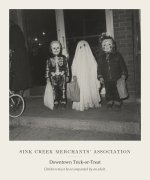
They stood a hand's width from the glass. The one in front wore a skeleton suit, a black one-piece made of thin, shiny vinyl with the bones printed on in white, tied with strings at the back of the neck. Odell had not seen one like it since he was smaller than the child wearing it. The one beside it was a ghost made out of a bedsheet, with two eyeholes cut by somebody who hadn't measured, so that one sat higher than the other. The hem dragged on the step and had gone gray where it dragged. The third wore a face made of papier-mâché, painted white once, with red circles on the cheeks and a crack running down through the forehead. A strip of elastic went around the back of its head.
Nobody else was on the square.
At the curb, under the streetlight, a woman stood with a baby stroller. She wore a long coat and her face was in the shadow of the light above her. The stroller hood was up. It was turned toward the shop.
Odell picked up the bowl and went to the door and unlocked it.
The cold came in. The three of them did not say trick or treat. They had their bags open already, held out in front of them, a pillowcase and two paper sacks, and they did not move them up toward him or shake them. They looked at him and nowhere else.
He put two pieces of taffy in each bag. The paper sacks did not rustle.
"Happy Halloween," he said.
The children turned and walked down the steps and along the walk toward the curb. The ghost's hem dragged behind it. They went to the woman and stood around the stroller, and none of them looked into it, and none of them looked back.
Odell stood in the open door with the bowl against his stomach until the cold reached his hands. Then he stepped back and let the door swing shut, and turned the lock, and through the glass they were still standing there, the three of them and the woman under the light, as if there were nowhere else on the square they needed to be.
Next Part:
Fewer Each Time (2) | ABCtales
- Log in to post comments
Comments
great opening. The lived-in
great opening. The lived-in feel of the toy shop and the three costumed kids with that airy twist.
- Log in to post comments