


The Zero Hours Contract

By Lille Dante
- 142 reads
Diane’s kitchen smelled of pine disinfectant and lemon-scented disinfectant wipes. She still wore her NHS lanyard, the plastic card askew in the V of her cleavage. Jonathan stood close enough to feel the warmth of her shoulder through the thin fabric of her T-shirt as she typed data into her laptop.
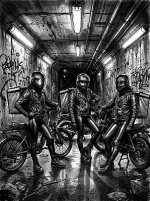
He retrieved his own ID from the windowsill and clipped it to his belt. Looking down, he saw three delivery riders loitering on the pavement below They stood evenly spaced, with their phones held at chest height. Their jackets were zipped up tight to their throats; their helmets gleaming faceless and opaque; their stance oddly martial.
Diane glanced up from the flowchart on her screen. “They’re blocking the threshold,” she said.
Jonathan opened his notebook and wrote down her remark. “What threshold?” he asked.
Diane traced a small circle on her mouse-pad, eyes following an animated simulation of patient flow. “The one people use,” she replied at last.
An old woman with a shopping trolley manoeuvred around the riders, muttering to herself. One of them turned his helmet slightly, tracking her movement without moving his body.
Jonathan asked, “Do they always stand like that?”
Diane inhaled impatiently. “They’ve been there a while.”
Jonathan wrote that down too. Though ‘a while’ was somewhat vague.
Diane hummed softly, dragging multi-coloured graphs around her screen as if arranging flowers.
*
The pavement outside the chicken shop smelled of frying oil and warm batter. Jonathan stood beside Steven, close enough to feel the heat reflecting from his glossy black leather jacket. Steven’s thighs were tense inside his lycra cycling leggings. He clutched his phone like a mystical talisman and tapped his screen repeatedly. The gesture had a definite rhythm to it: compulsive and almost soothing.
Jonathan asked, “Does tapping actually help?”
Steven shrugged without looking up. “Sometimes.”
Behind them, the other riders shifted their weight in small increments, angling their bodies toward the shop door. The extractor fans roared overhead, blowing hot air reeking of chip fat across their backs. One rider in a plain black helmet turned slightly, his visor reflecting Jonathan’s face back at him.
“How long have you been here?” Jonathan asked.
Steven said, “Bit.”
Jonathan wrote it down as if it were an important measure of data. The rider in the plain black helmet didn’t look away once.
*
Ridley Road Market smelled of melting ice and diesel fumes. Plastic crates formed uneven towers beside the fresh fish stall. Jonathan approached Sheila, who held her tablet in one hand and a partially unfolded site map in the other.
“They were aligned yesterday,” she said, mostly to herself.
Jonathan stepped closer. “How can you tell?”
Sheila pointed with her chin. “Stall edge. Kerb. Crate line.”
Jonathan tried to see it. The misalignment, if it existed, was subtle. A few degrees, no more. But once brought to his attention, it was difficult to ignore.
A rider threaded his bike between the stalls, cutting across the imaginary line Sheila had drawn in her head. She didn’t flinch.
Jonathan asked, “Does it matter?”
Sheila closed her tablet’s cover with a flip of her wrist. “It changes how people walk.”
Jonathan wrote that down in his notebook. He observed how a man carrying a box adjusted his path by a fraction. Sheila also watched him with a stillness that felt almost devotional.
*
The multi-storey car park smelled of scorched rubber and damp concrete. Jonathan stood beside Martyn, who sat slumped on the ground beside an empty parking bay, with his elbows resting on his knees. His security guard uniform was creased, the jacket bunched tight round his midriff. His radio emitted a soft hiss.
“Lift kept stalling,” Martyn said.
Jonathan crouched beside him. “Did you fix it?”
Martyn ran a hand along the painted line of the bay, his fingers lingering on the cool surface. “It’s working now.”
On the ramp above them, a delivery rider free-wheeled past, the squeak of his tyres echoing through the structure. Martyn watched him: the rider’s body, not his bike. The way the muscles in his legs tightened as he pedalled.
Jonathan asked, “Why stop here?”
Martyn shrugged. “Feels different.”
Jonathan touched the concrete. It felt cold and inert. Martyn’s eyes stayed fixed on the ramp, down which the rider had disappeared.
*
Behind the supermarket, the loading bay was still in early morning shadow. Two delivery riders stood facing the closed metal shutter, their insulated bags resting at their feet.
Jonathan approached them, waving his ID. “Are you waiting for something?” he asked.
Neither rider answered. Neither looked at him. A faint smell of warm metal and detergent wafted from the shutter.
Diane appeared a few metres behind them, taking a short cut on the way to Homerton.
“They’re positioned wrong,” she said.
Jonathan turned to her. “Wrong how?”
Diane watched the riders, her expression tightening as she analysed their posture and available routes, as if calculating workflow in a hospital corridor.
“They’re in the way,” she declared.
Jonathan recorded it in his notebook, though he wasn’t sure of the significance.
*
Jonathan followed a narrow passage behind the fish stalls, where the air was thick with the smells of brine and ammonia. Two men stood beside a stack of crates, speaking quietly. One held a gutting knife, its blade glinting under the stark fluorescent strip lights.
Sheila was also there, cradling her tablet to her chest with folded arms. She didn’t look at Jonathan. She looked at the knife.
Jonathan flashed his ID. “Urban Behavioural Insight Unit,” he said. “Can I ask...?”
The man with the knife looked him up and down, slowly and deliberately. “You can watch,” he said. “Not ask.”
Jonathan felt Sheila shift beside him: a small movement, but sensually charged, as if she’d been caught doing something private. The men’s bodies remained angled toward her, not him.
A delivery rider passed the passage entrance, turning his helmet briefly to clock them before continuing on his way.
Jonathan recorded nothing in his notebook. The air felt tight and expectant, as if he had interrupted a moment about to turn... not violent, not sexual... but something in between.
*
Diane’s bedroom smelled faintly of antiseptic and warm skin. Her NHS lanyard hung from the bedpost like a trophy. Jonathan sat on the edge of the mattress, with his notebook open on his lap, though he wasn’t writing.
Diane stood in front of him, with her arms folded across her bare midriff. “You’re taking this awful seriously,” she said.
Jonathan nodded. “It’s important.”
Diane stepped closer. Her knee brushed his. She didn’t kiss him or otherwise touch him. She simply stood there, close enough that he could feel her breath on his forehead.
“Then keep going,” she said.
Jonathan closed the notebook. He didn’t know whether she meant the project or something else entirely.
*
Jonathan walked through the underpass between the car park and the train station. The walls were damp and the air had a metallic tang. Two riders stood at the far end; their helmets firmly in place and jackets zipped tight. Their bikes were angled outward to form a barricade.
Steven was one of them. Jonathan recognised the curve of his shoulders beneath his padded leathers.
Martyn stood off to one side, clutching his radio in his hand. His gaze was fixed on the riders. He’d come because of something he’d seen on CCTV: a movement, a gesture, a shadow. But his authority was unclear in this liminal space at the borders of mall security and London Transport police.
Jonathan approached. “Urban Behavioural Insight Unit,” he said. “I’m studying...”
Steven lifted his visor. His eyes remained unreadable. “You’re studying us?”
Jonathan nodded.
Martyn stepped closer, his radio crackling softly.
The other rider leaned in, his blank visor barely an inch away, reflecting Jonathan’s distorted features back at him.
“Then watch this,” came his muffled voice
Jonathan recoiled. Steven tightened his grip on his bike’s handlebars, tensing his knuckles under his leather gloves. Martyn’s breathing grew shallow. The second rider shifted his weight, scraping his boot on the concrete.
Later, Jonathan wondered what to write about this encounter. The air had felt charged... both with threat and invitation... though neither had resolved.
*
The municipal meeting room smelled of steam-cleaned carpet and the dry aroma of printer toner. Fluorescent lights hummed overhead, banishing shadows and flattening the colours of everything. Jonathan sat at the glossy, Formica topped table, with his report spread neatly before him. Pages of notes, diagrams, observations and interviews, all organised into sections with coloured tabs.
A woman entered without knocking. She wore a charcoal suit that looked expensive but slightly rumpled, as if she’d slept in it or simply didn’t care. Her hair was pinned back in a way that suggested precision rather than vanity. She carried an empty folder in one hand and a takeaway coffee in the other. The badge pinned to her lapel identified her as Marla Kestrel.
“Jonathan,” she said, neither warmly nor coldly, just as a statement of fact.
Her air of authority prompted him to stand politely. She gestured for him to sit.
Marla took a seat at the opposite side of the table and immediately flipped through his report. She didn’t appear to be reading it, just checking the presence of pages. He noticed that her nails were short, clean and unpolished. She tapped one finger against a diagram of rider routes and cluster points. A soft and rhythmic, but somewhat impatient sound.
“This is thorough,” she said.
Jonathan waited for further comments.
Marla closed the report. She took a sip of her coffee and placed her cup beside it.
“We’ll file it,” she declared
Jonathan nodded, unsure whether that was approval or dismissal.
Marla looked at him for a moment that felt longer than it was. A look of assessment, as if she were measuring something about him that wasn’t in the report.
“Do you need anything else from me?” he asked.
Marla exhaled through her nose; a small, controlled breath. “Yes,” she said. “Your ID.”
Jonathan blinked. “My ID?”
Marla held out her hand, with her palm up and fingers making a grabbing gesture. “The project’s concluded.”
Jonathan unclipped the card from his belt. He hesitated for a fraction of a second, then placed it in her hand.
Marla didn’t look at the card. She placed it on top of his report, then slid both into her unmarked folder with a single calm and precise motion.
She stood abruptly. “We’ll be in touch,” she said, though her tone made it clear they wouldn’t.
She reclaimed her coffee and left the room with equal abruptness. The door swung and clicked shut behind her.
Jonathan remained seated, with his hands resting on the table. He stared at the empty space where his report had briefly rested. The fluorescent lights continued to hum. The carpet gathered static and a new layer of dust.
He reached into his pocket for his notebook, but realised he no longer needed to record anything. By taking his ID, Jonathan felt that Marla had removed the only thing that actually made him someone.
- Log in to post comments
Comments
change the way we walk. Yes
change the way we walk. Yes it does. We'll be in touch. Means we won't. Yes. Noted. Urban Behavioural at work and play.
- Log in to post comments