


Way Down: September–October 1977

By Cerasus Poetry
- 497 reads
The heat had broken by the first week of September, leaving the air heavy and uncertain. The long drought of ’76 was a distant memory now, supplanted by a season that couldn’t decide what it was. Mornings began muggy, but with a low mist that clung to hedges and bus shelters.
Above the electrical shop on the high street, Paul grimaced at his reflection in the bathroom mirror as he shaved. Ed Stewart’s voice came from a tinny transistor radio on the windowsill, cheerfully announcing Telephone Man. The kind of Saturday morning soundtrack that made the world feel younger and more innocent than it was.
Paul rinsed his razor, patted his face dry, dabbed a sprinkle of Denim on his neck, then buttoned his shirt and went downstairs to open the shop.
*
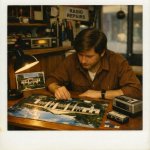
Behind the counter, on a small folding table, he kept a jigsaw puzzle to work on between customers: a thousand-piece picture of Graceland he’d, bought from a charity shop. The box was missing its lid, so he was working blind, fitting pieces by colour and instinct. The white columns of the house were still skeletal and the sky was a chaos of blues.
A better quality radio than his old tranny perched on a display shelf behind him. From it, Kid Jensen’s slick, transatlantic voice filled the silence: “Still at Number One,” he said; “Elvis Presley with Way Down.”
Paul turned the volume lower. He liked Elvis, but the song had begun to feel like a ghost that wouldn’t leave.
The bell above the door jingled. A woman stepped in, shaking raindrops from her umbrella. She wore a belted trench coat and carried a canvas bag with a library logo on it. As she closed the door, her watch gave a sharp, electronic beep. She pressed its button without looking. Paul noticed the brief glow of red digits on its display.
“Morning,” she said. “Do you repair cassette players?”
“Depends what’s wrong with it.”
She placed a small portable model on the counter. “It keeps chewing tapes.”
He lifted the lid and peered inside. “Could be the pinch roller. Or the drive belt.”
“Can you fix it?”
“No problem. Leave me your number and I’ll call when it’s ready.”
She wrote her name - Marian - and number on a slip of paper. Her handwriting was careful and neatly rounded. He noticed the faint trace of her perfume as she leaned on the counter: something floral and delicate, not as pungent as some modern fragrances
“I’m on my way to work,” she said. “Will it be ready today?”
“Should be.”
She nodded and gave a quick, apologetic smile before leaving.
Paul thought about her newfangled watch as she went. “Wouldn’t know where to start mending one of those,” he muttered to himself.
*
By lunchtime, the drizzle had thickened into a steady rain. Paul worked on the cassette player between customers; replacing the belt, cleaning the heads, testing it with an old tape of Glen Campbell he kept in a drawer for that very purpose. The sound came through warm and clear.
Satisfied with his handiwork, he set the cassette player aside and attempted to fit another piece of sky into the jigsaw. The puzzle was slow going, but he liked the quiet concentration of it. Something to occupy his mind when the shop wasn’t busy.
At just after five, the bell jingled again. Marian stepped in, hair dishevelled and cheeks flushed from the walk.
“Is it ready?”
He handed her the cassette player. “Good as new.”
She paid, then hesitated when she notice the jigsaw behind him. “Is that Graceland?”
“Supposed to be. Got it without the box lid.”
She leaned closer, studying the half-formed building. “You’re doing well, considering.”
He shrugged. “Sky’s always the worst bit.”
Her watch beeped again. She silenced it quickly, as if embarrassed by the sound.
“Got to go,” she said. “See you.”
“Bye.”
*
Marian lived alone in a one bed flat near the park. She worked alternating shifts at the library, six days a week. She liked the tranquillity, the smell of books, the orderly shelving of returns.
She had a collection of postcards pinned to her kitchen wall, depicting places she’d never been: Venice, Cannes, Memphis, Osaka. She bought them from charity shops and car-boot sales; anywhere she could find them. Little windows into other lives.
That evening, she sat at her kitchen table with her repaired cassette player and a blank BASF C60. She waited for the DJ to stop talking, finger poised over the record button. When the song began cleanly, she pressed down, holding her breath. She frowned when the DJ spoke over the fade-out, but patiently rewound and tried again. She arranged the songs in her head, thinking about how they would sit next to each other.
She recorded Peter Gabriel, Al Stewart, Fleetwood Mac, a bit of Bowie and later that night, a Peel session by The Slits she liked the idea of. Nothing romantic. Nothing too obvious. Just songs that felt like late summer turning into autumn.
She didn’t know exactly why she made it, but it felt like preserving a moment that was already fading.
*
The following week, Marian returned to the shop with a small transistor radio.
“It’s gone silent,” she said. “I think it’s sulking.”
He laughed. “Let’s have a look.”
She waited while he worked; watching his hands as he patiently checked each component. After he cleaned the corroded contacts, the radio crackled back to life with a burst of Oxygene.
“You’re good at this,” she said.
“Been doing it a long time.”
She hesitated. “Do you ever get tired of fixing things?”
He looked up. “Sometimes. But it’s better than breaking them.”
She laughed softly. “True.”
Her watch gave an intrusive beep. As she fumbled to press its button, she diverted attention to the jigsaw. “You’ve done more.”
“Bit by bit.”
Before she lost her nerve, she reached into her bag. “I’ve got something for you,” she said as she handed him a postcard of Graceland, the house standing crisp and clear in bright sunlight. “I remembered you didn’t have a picture to work from.”
He looked at the postcard, then at her. “Thank you.”
“It’s nothing. Just… I collect them. Places I’ll probably never see.”
He pinned the postcard above the jigsaw table.
“It’ll help,” he said.
She smiled, embarrassed. “Good.”
*
By late September, the evenings were drawing in earlier. The air smelled of bonfires and damp earth. The papers talked about strikes, inflation, the pound falling again.
One damp Saturday, Paul hung the CLOSED sign on the shop’s door and went to meet Marian at the café near the library during her break. The windows were steamed and the air smelled of coffee and wet coats.
She stirred her tea. “It’s strange,” she said. “Everything feels unsettled lately.”
He nodded. “Maybe it always does.”
“Do you ever think about leaving?”
“Leaving where?”
“Here. Doing something else.”
He considered. “Sometimes. But I wouldn’t know where to go.”
She nodded. “Me neither.”
Paul blew his coffee to cool it down. “Maybe it’s not about getting far. Maybe it’s about staying put and making it bearable.”
She looked at him, thoughtful. “You sound like my father.”
“Was he right?”
“Sometimes.”
Outside, the clouds briefly parted and the sky brightened. Marian watched raindrops sliding down the window, each one catching the light before disappearing.
Her watch beeped. She silenced it and gave a small, resigned smile. “Back to work,” she said.
*
October arrived with a layer of fog that clung to the ground until noon. The leaves turned and fell. Customers spoke about more strikes, rising prices, the coming winter.
In the shop, Paul repaired heaters, kettles, portable TVs. The Graceland postcard watched over him, sometimes making him wonder what it meant to keep something that belonged to someone else’s dream.. The jigsaw was approaching completion, with only the sky still in pieces.
One afternoon, Marian came in with a cassette tape.
“I made this for you,” she said, suddenly shy. “It’s just songs I like. Nothing special.”
He took it carefully. “Thank you.”
“It’s silly,” she said. “I just thought… you might want something to listen to while you work.”
He smiled. “I do.”
*
That evening, he played the tape while tidying the shop and sweeping the floor. The songs were an eclectic mix of genres, most of which he didn’t recognise. Nothing romantic and nothing obvious. Just an expression of Marian’s taste, honest and unguarded.
He lingered by the puzzle and fitted another piece of sky into place. The different shades of blue were difficult to match, but the picture was finally taking shape beneath his hands.
When the tape ended, he turned it over and played the second side. He was in no hurry to go upstairs for dinner, to eat alone while watching The Professionals and Fawlty Towers.
*
The next Saturday, Marian arrived late for their usual coffee. Her hair was damp from the mist, her cheeks flushed.
“Sorry,” she said. “Bit of a flap at the library. There’s talk of budget cuts and reduced hours.”
He nodded in sympathy. “It’s OK.”
She looked wistful. “Do you think we’ll look back on these days and remember them as something important?”
He shrugged. “Probably not. But maybe that’s what makes them worth remembering.”
She smiled, uncertain. “Maybe.”
Her watch beeped. She silenced it quickly, without any sign of apology or embarrassment. “I’ve got to go,” she said.
He stood up. “I’ll walk you.”
They stepped outside, the mist unable to decide if it was rain. They walked side by side, not touching, their footsteps echoing faintly.
The library wasn’t far. She paused at the door and said, “Thank you.”
“For what?”
“For fixing things.”
He smiled. “It’s what I do.”
She hesitated, then reached out and touched his sleeve in a brief, uncertain gesture. “See you, Paul.”
“See you.”
*
By mid-October, the fog thickened again. Elvis relinquished the number one chart position to David Soul’s Silver Lady. People hurried past the shop, their collars turned up and hands thrust deep in pockets.
Paul worked quietly, with Marian’s tape playing in the background. He sometimes thought about her; the way she’d smiled when her radio came back to life, the sound of her voice saying thank you. He didn’t expect anything more.
That evening, after closing, he stayed downstairs in the shop. He liked the quiet; the smell of solder and warm plastic. The jigsaw waited on the small table, one final piece remaining to be placed.
He couldn’t explain why he had delayed the moment so long, but he eventually fitted the last piece of sky into position. The picture was whole now: Graceland in bright sunlight, its white columns gleaming and the lawn impossibly green.
The tape ended. Paul sat back, listening to the faint hum of the shop’s fluorescent lights. Outside, the fog pressed softly against the windows.
He looked at the finished puzzle, then at the postcard pinned above it. There was a whole world going on somewhere else, uncertain and imperfect though it was. Maybe he could be part of it.
- Log in to post comments
Comments
Great interweaving of songs.
Great interweaving of songs. I wonder how many thousands of people sat, finger poised, with their cassette recorders while John Peel was on!
- Log in to post comments