


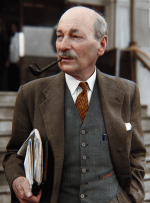
Thanks Clem!...Sorry about The Queue

By Makis
- 1104 reads
In July 1967 my contemporaries and I graduated into a world bristling with enterprise and opportunity, eager to employ our individual talents. We had emerged from the state funded system, well nourished, healthy and debt free, into a society determined to rid itself of the lingering austerity of a catastrophic world war. And we were able to do this largely because of one man.
Eighty years ago, I was born under a government led by Clement Attlee, a man of whom it could be said, achieved more during his six year tenure (1945-51) than any other Prime Minister before or since. But then he had to, because we had just come through a six year horrific experience that had all but finished us off as the once mightiest empire in the world; leaving us battered, bereft, beholden and bankrupt.
Yet, in spite of this, I was the beneficiary of free school milk, free secondary and further education and free medical care. My father enjoyed employment rights and my mother received family allowances before they eventually progressed to a state pension: all courtesy of the ground breaking social reform measures introduced by the Attlee government.
In 1945, the average male lifespan was sixty-three years and today it's in excess of seventy-nine. There is little doubt in my mind that much of this remarkable progression is down to the Attlee led government that provided the social reform and necessary infrastructure to achieve this. The welfare state, social security, the national health service, education reform and nationalisation of public services were all introduced under an Attlee government. And it did this during severe post-war economic hardship, food rationing throughout its tenure, and a crippling balance of payments crisis.
Clement Attlee’s government is widely regarded as the most progressive in British history, establishing the foundation for the welfare state and transforming the UK into a much more egalitarian society. During my lifetime I have survived nineteen different governments led by eighteen different Prime Ministers (Harold Wilson served twice) and none came close to the prolific and life changing achievements of Clement Attlee. Had I graduated in July 2025, I would now be saddled with a fifty thousand pound student loan and very probably working part-time behind a bar, whilst waiting in vain for responses to my fifty job applications. Oh, how the worm turns!
Winston Churchill (1951-55) spent his time focussing on cold war relationships, being ill and demonstrating how out of touch he was, whilst Anthony Eden (1955-57) drowned any reputation he had in the Suez Canal. Harold McMillan (1957-63) wallowed in a post war boom largely created by Attlee's foresight and told us all we'd never had it so good, whereas Alec Douglas-Home (1963-64) spent his one year in office agreeing with McMillan.
Harold Wilson (1964-70 and 1974-76) was all for modernisation and the white heat of technology, but struggled with inflation and price rises, resulting in union conflict and many sessions of 'beer and sandwiches at number 10'. All of which was of little interest to Ted Heath (1970-74), whose focus seemed to be on jailing anyone daring to go on strike whist dragging us, kicking and screaming, into the Common Market. This at least meant that he could park his yacht in St. Malo harbour every week-end, paperwork free...as I once witnessed in the Summer of 1973.
Jim Callaghan (1976-79) oversaw a troubled economy, endless strikes, confrontational unions and double-digit inflation, all of which resulted in him borrowing zillions from the IMF in order to bail us all out. As a result, a sick to the back teeth electorate voted into power perhaps the most infamous of all post war Prime Ministers, Margaret Thatcher (1979-90).
Margaret Thatcher was the very antithesis of Clement Attlee and ran the country the way she ran her household budget, except the arguments were louder and her handbag became a weapon. She looked at inflation, the militant unions and the nationalised industries and devised a cunning plan. By the time she resigned in 1990, half the country owned shares, the unions had been neutered, the coal industry destroyed and privatisation had become flavour of the decade.
She treated economic policy like a cold bath: brisk and numbing, but good for you in the long run. Supporters saw her as the iron-lady restoring Britain’s swagger, but critics saw her as someone who'd reorganised the deckchairs by throwing them overboard. In short: she gave us a stern talking-to for eleven long years and I'm not sure we've ever recovered. Her top generals eventually turned on her and replaced her with someone a little less virile...John Major.
For John Major (1990-97) think librarian minus the excitement. A steady hand at the helm who, following a run on the value of the pound (Black Wednesday)
took us out of the European Exchange Rate mechanism, but compensated by introducing The Lottery and privatising the railways.
After twenty years of Conservative government, Tony Blair (1997-2007) britpopped into our lives like a startling guitar riff, bristling with energy and intent. He was cool Britannia, hanging out with pop stars and celebs. He was a polished performer, slick and smooth, light years away from the formal image of his predecessors. He was the debonair head prefect with the nuclear codes in the back pocket of his week-end Levis.
Blair introduced the minimum wage, channelled billions into public services and brokered the historic Good Friday Agreement. Yet his legacy is equally defined by dissent. He cuddled up to George W. Bush and drew Britain into US-led wars in Afghanistan and Iraq, a commitment that would ultimately overshadow much of his domestic agenda. Having arrived at the school gates to the soundtrack of Oasis, increasingly fraught staffroom meetings eventually saw him escorted from the premises by the dependable school caretaker, Gordon Brown.
Gordon Brown (2007-2010) was the epitome of a dour Scotsman and looked
as if he'd just realised he'd left the immersion heater on while away on a two week camping holiday. During the world wide financial crash of 2008, the big UK banks came to his door for a 'wee loan', and got much more than they expected. He seized their assets, gave them the bus fare home and insisted on receipts. Unfortunately, the financial crash and its consequences together with MPs claiming the cost of cleaning their moats on expenses, brought about enough nationwide discontent to vote in a new coalition government headed by David Cameron.
David Cameron (2010-2016) made the mistake that, to my mind at least, links him inextricably with his successors Theresa May (2016-2019) and Boris Johnson (2019-2022). They were all consumed by the issue of Brexit in one way or another. Cameron promised a referendum in 2013 and held it in 2016, Theresa May marred her premiership with ineffective negotiation and Boris Johnson finalised our exit from Europe in his entirely predictable unkempt, cavalier manner. It seems unfair to bracket three premierships under one banner, but Brexit has become that chesty cough of ours that we can't seem to get rid of.
About the only other significant achievements affecting the everyday lives of people on the Clapham omnibus during this entire period were the introduction of Universal Credit and Same-Sex Marriage legislation.
Liz Truss didn't have time to learn how to set the timer on the Downing Street microwave before she was removed by the stock market, and a hasty in-house coup introduced us to Rishi Sunak, our first ever Asian Prime Minister. Rishi (2022-2024) did his best during a difficult economic and political climate, but he was perceived as a continuation of twelve years of Tory misrule by an increasingly disgruntled electorate. Under pressure, he called a snap election in 2024 and the result was inevitable.
Keir Starmer (2024-until the Daily Mail decides otherwise), a man with nearly as much charisma as John Major, now heads our current government and inherits the same central tension that his eighteen predecessors struggled with: how to balance social justice against the ever escalating costs of the welfare state on which we all now depend. To a large extent, Attlee's dream of banishing the 'five giants' of want, disease, ignorance, squalor and idleness have been achieved (well, not quite sure about idleness), but the costs and pressures of doing so are, and have been, enormous.
In Uncle Tom's Cabin, when Topsy was asked who made her, she replied, 'I just growed.' So did the United Kingdom, by twenty million more people who, on average, live sixteen years longer than in Attlee's era. These factors, along with huge advances in medical science, have been a thorn in the side of every government since the war. The issue has never been one of ideology, but more matters of exponential dilemma and arithmetic.
What Attlee and his Health Minister, Aneurin Bevan set in motion is now firmly established as an almost divine right, and would be impossible to retrench. This leaves every government with the task, as Attlee’s was, of persuading the public that expectation must always be tempered by fiscal realism. Escalating costs are an enduring feature of the success of our welfare state and apply ever present pressures to its daily operation. In this sense, we might say that the length of the waiting lists is an accurate measure of its success, although a nation now free from want, disease, ignorance, squalor and idleness, may occasionally disagree.
- Log in to post comments
Comments
An excellent precis, Makis -
An excellent precis, Makis - and I couldn't agree more. I was born in 1959, but also benefitted from the measures that the Attlee administration (the finest post-war administration, in my opinion) brought in. It enrages me when I hear people moan about the NHS. It's served me throughout my life, and still serves me now, in my early retirement years. Sure, it has its structural and managerial problems (among many other factors). But I always say to the moaners 'Go and live somewhere where they don't have one, then - then just make sure you don't ever get ill or break a leg, because you'll have to sell your house.'
Your descriptions of our past leaders are spot on, too. I remember naively being jubilant when Blair got in - just to see the back of the Tories. I was working at the time, though, with a seasoned socialist who gave me the third degree: 'Can't you see what he is? You soon will.' He was right. Yes, he can be credited as you say. But what a legacy. 'Labour' has never recovered - apart from briefly under Corbyn. But the Establishment were never going to allow him to gain control. Chuckled at that description of Gordon Brown! Cameron's Brexit vote - a deliberate electoral ploy - backfired spectacularly on him (ably assisted by foreign interference and social media misinformation).
As for Thatch... well... I'd better not say too much! Among other things, 'Right To Buy' decimating the social housing stock and enriching some of her chums... and, of course, creating generations of working-class Tory voters, which was her main intention in spite of her stated aim. Relatives of mine got rich from buying their Wandsworth council flat for peanuts in the late '80s. And the council block I lived in as an early teen in Battersea, where dad was the caretaker (so our rent was free) - that's all in the private sector now. A couple of years back, our old 2-bedroom flat came on the rental market. £850. I thought that wasn't bad at all for London. But hang on... £850 per week! That means the tenant will need to be in the top 2% of earners at least. For an ex-Battersea council flat on a sink estate. There you go...
An excellent piece that I'll come back to.
- Log in to post comments
I put my back out a couple of
I put my back out a couple of weeks ago (a long-standing problem) and finally rang my surgery Monday morning because I couldn't wait any longer for it to settle down. Took me ages to get through, so I wasn't hopeful. But when I explained to the receptionist, she said 'It's probably best if you see a physiotherapist first.' Uh-oh', I thought. Another couple of weeks, maybe? 'He can see you this morning, how's that?'
Wow!
And that's not the first time I've got such quick service. And today my back's better!
- Log in to post comments
Thanks, Makis. Nye Bevan's
Thanks, Makis. Nye Bevan's observations about the Conservative party echo my own. Enough said! As for Deform UK... likewise!
Like you, I've never really been a political animal. But everything we do is political, whether we're conscious of it or not. And I know where my heart lies, even if it over-rules my brain at times. Always with the underdog, and the planet we all share. I maintain my independence - but in my heart, I hope the Greens take Gorton and Denton. Politics needs a good shake up in this country. The two-horse race has been run for too long.
Perhaps more people need to follow their heart on these matters.
- Log in to post comments
That's a fascinating,
That's a fascinating, sweeping summary of post-war PMs. A piece written with a good deal of authority. I guess you could say it's been quite a rollercoaster in terms of policies and personalities. We could be in for yet more radicalism at the next GE as things stand at the moment. If the Greens win at Gorton & Denton then politics will have never been more fractured (albeit they won seats at the last GE); not in my lifetime anyway. Enjoyed this and, I imagine, a thread where opinions will be divided. That's what democracy is all about, I guess.
- Log in to post comments
It used to be acceptable to
It used to be acceptable to call 'Tory scum'. 'Reform scum' are sailing on the same boat. Monopolising the ideas of efficiency and fairness. Oh, how the Tories run. To think how the Americans used to come here to find out how to run a health service that costs little and does so much. We are getting older. But sicker too. Those in the Tory scum areas live longer and better lives. You've probably guessed. I'm a fan of Clem Atlee. Imagine a White Paper becoming a best seller?
- Log in to post comments
People forget too quickly. Or
People forget too quickly. Or become self-satisfied and complacent... and impatient. They won't know what they've got 'til it's gone.
- Log in to post comments