


Admission (2)

By SoulFire77
- 569 reads
He moved on. A Fiji Mermaid — a monkey's torso stitched to a dried fish tail, seams visible, the face a shriveled primate grimace. GENIUNE FIJI MERMAID, the card said. The misspelling didn't look intentional. A GENIUNE CYCLOPS LAMB in fluid too cloudy to see through. A centipede curled on itself, reddish-brown. Might have been real. Might have been rubber.
The corridor narrowed. Taxidermy. A jackalope with antelope horns glued on, dried glue yellowed at the base. A "devil bat" — fruit bat with wire-spread wings wider than Cody's armspan. A goat skull with one horn painted gold, the paint chipping. Card: UNICORN SKULL — DISCOVERED IN THE MOUNTAINS OF NEPAL.
Deeper. Dimmer. Wax figures. A torture scene behind a velvet rope: a figure in a pillory, paint chipping from its face. Cody looked at the figure's hands, spread flat on the wood, the fingers molded wide, and he looked at the hands longer than he looked at anything else and then moved on. An "Egyptian mummy" — plaster wrapped in stained linen, one hand visible: a mannequin's hand, shiny and pink and smooth, nothing like a real hand that had ever done anything.
A "witch's cauldron." Mannequin. Dollar-store cobwebs. Green lightbulb. Price tag still on the robe.
Oddities table. A rubber shrunken head with doll hair. He looked at it. At how small it was. How something that had been a whole person had been reduced to something you could hold in one hand. "Spirit photographs" in cheap frames — one of the ghosts was wearing a wristwatch. A "genuine vampire killing kit" in a wooden box: two stakes, a tarnished cross, a vial labeled HOLY WATER with a Walgreens sticker on the bottom.
The corridor was dim now. The boombox was a faint hiss somewhere behind him. The midway was nothing. Just Cody and the dust and the fading blue light turning yellow at the far end.
He could see the sign from here. Hand-lettered, more elaborate than the others, gold paint chipped to show the white cardboard underneath:
THE MAGICIAN'S HAND — LEGEND SAYS IT HAS THE POWER TO GRANT YOUR HEART'S DESIRE — TOUCH THE GLASS AND MAKE YOUR WISH
Below it, a typed index card, the typeface uneven, the ribbon fading: RECOVERED FROM THE TOMB OF AN OTTOMAN SORCERER, CONSTANTINOPLE, 1923. ACQUIRED BY THE GREAT DONATELLI FROM A PRIVATE COLLECTION IN BUDAPEST.
The same as everything else. A prop with a story typed on a card.
He was close now, walking the edge of the corridor the way he'd walked the edge of everything all night — the perimeter of the midway, the margins of the crowd, the spaces behind things where you could see without being seen. The canvas wall to his left didn't quite meet the tent pole at the corridor's end. A gap, maybe eight inches, where the fabric bunched and sagged and left a triangle of dark space.
He looked through it. Behind the exhibit partition, on the ground: a cardboard box. The flaps open. Inside, packed in newspaper: hands. A dozen of them. Life-size, flesh-colored, the same rubber or wax as whatever was in the glass case on the pedestal. Some wrapped in newspaper, the fingers poking through. One had slipped free, its fingers curled in the same slightly open pose he could see through the gap — the same gesture, the same nothing, repeated twelve times in a cardboard box.
He looked at the display hand in its case. A glass box on a wooden pedestal, lit from beneath with a yellowish bulb. Flesh-colored rubber over some kind of armature. Fingers slightly curled in a gesture that was supposed to look mystical and looked instead like a mannequin reaching for a doorknob. The seam where the wrist met the base was visible. The material had a sheen that said factory, that said there was a warehouse somewhere with a thousand of these on shelves.
He had imagined something different. Something dead and real. Gray skin tight over bone, nails gone dark. Something that had been part of a body and still carried the power of whatever had been done to separate it.
This was rubber.
He looked at the box behind the partition. He looked at the display hand in its case. He looked at the sign: TOUCH THE GLASS AND MAKE YOUR WISH.
He crouched. Reached through the gap at the base of the canvas, his arm going in up to the shoulder, and pulled a hand from the box. It came out trailing newspaper. Life-size. Heavier than he expected — the armature inside gave it weight, gave the fingers a specific gravity that made them press against his palm the way real fingers would. Room temperature. A faint chemical smell. The fingers were slightly curled and the rubber had a softness to it, a give, that was close to something he didn't want to think about being close to.
He pulled it to his chest and stood up. He held it against his stomach under his t-shirt and pressed his arm over it to keep it there. The fingers rested against his skin. The rubber was cool and then not cool. His heart was beating against it, or the other way around.
He stood in the dim corridor at the end of the Weird Wonders of the World with a stolen rubber hand pressed against his body and the wish came up in him the way nausea comes up — not chosen, rising from somewhere below his thoughts.
Boots on the stairs. The third step creaks and the fifth doesn't and when the footsteps stop on the fifth step it means he's listening, it means he's deciding, and the silence on the fifth step is worse than the boots.
Beer. Not the smell of beer but the smell of that beer, the specific sourness of Busch tallboys breathed out close enough to feel the heat of it, the wet grain smell of a man's breath when his face is close enough that the smell is the only thing between you and what comes next.
A hand. A real hand. On his upper arm. Fingers that go all the way around because his arm is small enough for that. Squeezing until the fingers meet through the muscle and the pain is a white sound that drowns out everything else.
A door. The knob turning. Slow. When it opens fast it's just noise, just yelling, the TV kind. When the knob turns slow the air in the room changes, the room gets smaller, and the slow turning is the last sound before the other sounds start.
And through the wall, through the plaster and the lathe and the wallpaper with the yellow flowers his mother picked when she thought this time was going to be different — a sound. Not screaming. Quieter. The sound of someone trying to be quiet while something is happening to them, and the trying is a thing she does for him, he knows that, the trying-to-be-quiet is so he won't hear, and he hears anyway, every time.
Make it stop.
He pressed the rubber hand against his stomach. The fingers dug into his skin.
Make him stop. Make him gone.
He opened his eyes. The tent was quiet. The rubber hand was against his stomach, warming. The exhibits behind him were still fake. The air still smelled like formaldehyde and dust.
He pulled the flannel closed over the bulge and held it shut with one hand and walked back up the corridor.
The exhibits passed him in reverse. He didn't look at them. The boombox played its tape, the hiss swelling as he got closer to the entrance.
He stepped through the tent flap. The woman on the folding chair turned a page. She did not look up.
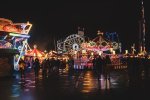
The midway was dying. Half the lights were off. The Scrambler had stopped. A ride operator was chaining a gate. The PA played a recording — Thank you for visiting, we hope to see you next year — tinny and distant, coming from everywhere and nowhere.
Cody moved through what was left of the crowd. Families heading for the exit. A father carrying a sleeping child. He walked with his right arm across his stomach, the flannel buttoned wrong to hide the shape underneath, and the hand shifted against him with each step, the fingers pressing and releasing as he moved, and the rubber stuck to his sweat through the t-shirt and he adjusted it, peeled it away from his skin and repositioned it between the flannel and the t-shirt where the outer layer held it better, and he carried it the way you carry something you're not supposed to have, something that belongs to you anyway.
A man in a yellow vest — security, or something close to it — stood near the front gate. His eyes moved across the crowd and landed on Cody and stayed there for one second.
Cody stopped walking. His eyes went down. His shoulders dropped. Small. Still. Ready.
The man's gaze slid off him and onto something else, someone else, and Cody was walking again, through the gate, into the parking lot, the gravel crunching under his thin soles, into the stream of families dispersing to their cars.
Dome lights came on in a Cutlass. An engine turned over in a wagon with wood panels. Headlights swept across the lot, across Cody, and moved on. He walked through the parking lot and out the other side, past the gravel and onto the road, and the carnival was behind him, its remaining lights a glow against the low clouds, its sound already less than a sound, already becoming the memory of a sound.
He shifted the hand to his chest and held it there with one arm crossed over it. There was no one to see him now. Just the road and the dark and the distance between here and the house he had left three hours ago, when he climbed out his bedroom window and didn't look back.
The road was two lanes with no center line and no shoulder. Trees on both sides, their branches meeting overhead so the streetlights — sodium vapor, spaced too far apart — came through in patches, orange circles on the asphalt that he walked through and out of and through again. His shadow stretched ahead of him in each pool of light, then shortened and disappeared as he passed underneath.
His limp was worse. The hip had stiffened during the hours on his feet, and now each step on the left side was a negotiation — put the weight down, feel the catch, shift off it before the catch became a lock. He knew this rhythm. He'd walked this way before, home from other places at other hours, with other pains in the same place.
There was no one on the road. No headlights. No porch lights close enough to reach him. He pulled the hand out from under his shirt and carried it at his side, hanging from his fingers, because it was easier than pressing it against his ribs. The weight of it swung slightly with each step. The rubber had warmed against his body and the night air cooled the side that faced away from him, so the hand had two temperatures — warm where it had been against his skin, cool where it hadn't.
He passed a house with a porch light on and a dog that barked once, twice, then stopped. He knew that dog. He knew which houses had dogs and what kind and when they stopped. Not from school. He didn't walk this way to school. He knew them from other nights, from the walks he took when the house was loud and then quiet and the quiet was worse and he climbed out the window and walked until the walking used up whatever was in his chest that he couldn't name and didn't try to.
Somewhere between the dog and the next streetlight his fingers shifted. The hand was hanging at his side and his fingers were around the wrist of it, and then they weren't — they were between the rubber fingers, sliding into the gaps the way your hand finds the railing in the dark. The rubber was warm and the fingers gave when he pressed and his hand fit there and he let it.
The houses got smaller. Older. The sidewalk started, cracked and lifted where the tree roots had been working at it for years. He knew the cracks by feel.
He thought about his mother. Not a thought, really. An image: her face turned toward the sound of the truck in the driveway. The way she moved — not fast, not panicked, just efficient, tidying something that was already tidy, adjusting something that didn't need adjusting, her hands busy so they'd have something to be besides still. The way she said Cody, go on upstairs in a voice that was even and calm and meant the opposite of calm.
He held the hand tighter. He kept walking.
His street was three blocks away.
Two.
One.
He was close enough now to hear the neighborhood. Or not hear it. Something was missing. The television — he could usually hear it from the end of the block, the volume the man kept it at, a constant drone that leaked through the walls and the windows and sat on the street like weather. It wasn't there. The truck — the diesel rattle of the engine that he could hear idling from two houses away on nights the man came home late and sat in the cab finishing the last tallboy before coming inside. That wasn't there either.
The street was quiet in a way it wasn't supposed to be quiet. Not silent — crickets, the interstate, a television from a different house, farther away. But the sounds of his house, the ones he listened for the way he'd listened at the fence, the way he always listened before entering a space — those were gone.
He turned the corner.
Red light. Blue light. Pulsing against the siding of the houses, turning the white paint pink and then blue and then pink again. A police car in front of his house, angled across the driveway. An ambulance behind it, the back doors open, the interior light on, nobody in it. The lights were on but there was no siren. The scene had the quality of aftermath — the paperwork someone would fill out, the report someone would file, the thing the neighbors would talk about tomorrow while they said they always knew.
The truck was in the driveway. The porch light was off.
Cody stood at the end of the street. Fifty yards from his house. The red and blue light washed over him and receded and washed over him again. He could see the front door. It was open. A shape moved inside — an adult, a uniform, a clipboard.
He was holding the hand at his side, its fingers laced through his. He looked down at it. In the dark and the red-blue pulse of the lights, the rubber looked the same as skin. He couldn't tell where his hand ended and the other one started.
The fingers tightened... a small, comforting squeeze of his palm.
Like a handshake.
- END
- Log in to post comments
Comments
Wonderful - well done!
Wonderful - well done!
- Log in to post comments
A cornucopia of the curious
A cornucopia of the curious and fascinating to read. Well done!
- Log in to post comments