


Ridgeline - Part Four: Wrong Direction

By SoulFire77
- 366 reads
She picked left.
No reason. The trail forked where she stood — not a real fork, just the loop continuing in both directions — and she picked left because left felt like downhill and downhill felt like the lot. The logic was clean and complete and wrong. Left went deeper into the trail, away from the lot, uphill after the first hundred yards where the ridge curved back on itself, but she didn't know this because the trail was new and she'd only run it once and she'd run it with earbuds in and she hadn't been paying attention to which direction the grade went because she'd been paying attention to the podcast and then to the man and then to the knife.
She walked. Bree against her chest, right arm holding her, left arm pressed against her side to put pressure on the rib wound with the forearm wound facing up because facing up seemed better than facing down though she didn't know why she thought that. Without the stroller, Bree's weight sat differently — eleven pounds concentrated in the crook of one arm instead of distributed across a frame with wheels, and her right bicep was already burning by the time she'd gone fifty yards. The blood from the forearm ran along the inside of her arm in a line that reached her elbow and dripped. She could feel each drip separately. The interval between drips was a kind of clock she didn't want to be listening to.
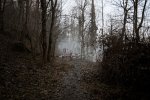
The trail curved. Then climbed. The gravel gave way to packed dirt and the packed dirt gave way to a section that was still rough-graded, the trail crew's work unfinished when the shutdown came — ruts from machinery hardened into ridges, a puddle in a tire track that reflected the sky in a color she couldn't name. Not orange, not gray. Something between that had no business being beautiful.
This wasn't the way to the lot.
She knew it the way you know a wrong turn on a highway — not from a sign but from the feeling of unfamiliar road under you, the absence of landmarks that should have arrived by now. The landscape timbers should have been visible. The sawhorses. The pale gravel of the parking area. None of it. Just trail, climbing, the canopy thickening overhead until the sky was a series of ragged holes in the leaves and the light coming through them was the color of the puddle. She'd been walking five minutes. Maybe ten. Shock was doing something to time, compressing it or stretching it, and she couldn't tell which. The forearm wound was throbbing in time with her pulse and the pulse was fast, too fast, and she could feel it in her teeth.
She stopped. Turned around. The trail behind her looked the same as the trail ahead — dirt, trees, the shapes of stumps in the thickening dark. She could not see the place where the attack happened. She could not see the lot. The trail curved in both directions and the curves hid everything and the light was going and she was standing in the wrong place bleeding and holding her daughter and she had walked the wrong way.
Go back. Turn around. Walk the other direction. The logic was simple. Her legs didn't move. The direction she'd come from was the direction the man had run, and the man had run without looking back — hadn't slowed, hadn't checked, hadn't made sure she was done — and something in her stomach clenched when she faced that direction, the body remembering which way the footsteps went. Both directions were wrong. She just had to pick which kind of wrong.
Bree's crying had changed. The new scream — the one from the attack — had burned itself down through stages Dana could track by pitch and volume: the full shriek, then the ragged pulsing cry, then the hard sustained wail, and now something lower. A keening. The sound a baby makes when it has cried past the point where crying produces a response and the body shifts to a mode that is less about signaling and more about endurance. Dana had heard this once before — a night in March when Bree had colic and Scott was on a run to Charlotte and Dana walked the apartment for four hours and Bree made this sound at hour three and Dana had called her mother and her mother hadn't answered because it was two in the morning.
The keening was worse than the screaming. The screaming had been Bree doing something. The keening was Bree becoming something — a small body conserving energy because the world had not responded.
Dana sat down.
Not a decision. Her knees folded and she sat on the trail edge where the dirt met a root ball from a downed oak and she held Bree against her and the rib wound sent a flare up her left side that made her vision go white at the margins. When it cleared she looked at the forearm. Still bleeding. The sheet had thinned but hadn't stopped and the left side of her leggings was dark from hip to knee where the rib wound had been seeping through the t-shirt.
The t-shirt. She could use the t-shirt.
She shifted Bree to the crook of her right arm — Bree's head against Dana's collarbone, the small skull hard through the skin. Bree's keening pitched up at the movement, then settled. Dana grabbed the hem of the UNC-G shirt with her right hand and pulled. The fabric was old, washed soft over years, and the cotton tore more easily than she expected — a strip came free from the bottom, six inches wide, trailing threads. She wound it around her left forearm, wrist to mid-forearm, covering the cut, and pulled it tight with her teeth and her right hand. The pressure was immediate and sharp and the wound protested — a hot flare that ran from wrist to elbow — and then the bleeding slowed to a seep at the edges of the fabric. The strip turned dark in seconds. But it held.
The ribs were harder. She couldn't wrap them — not with one hand, not sitting on a root ball in the dark, not holding a four-month-old. She looked at the wound through the cut in the t-shirt. The fabric edges were stained and sticking to the skin and she couldn't see how deep it was and didn't try to separate the fabric to look. She pressed Bree against it instead. Bree's body as compress. Her daughter's warmth against the cut, the small weight providing steady pressure that Dana's arm couldn't maintain. It was ugly. It was the best she had. The fact that it worked — that her baby's body fit against the wound like it was designed for this — made something in her chest tighten in a way that had nothing to do with the cut.
She sat on the root ball and held her daughter against her ribs and the light failed around them.
The silence was the thing she couldn't get used to. She'd registered it after the attack — the birds gone, the insects absent — but she'd been standing, bleeding, dealing with the phone, listening for sirens. Now she was sitting still and the silence had a presence. It pressed against her ears the way the apartment pressed when the dryer stopped in the middle of the night and the hum she'd been ignoring was suddenly gone and the absence of it was louder than the hum had been. The creek that she'd heard from the ridge was inaudible here, either because the trail had climbed above it or because her hearing had narrowed to the space around her body. No mockingbird. No cardinal. No crickets. The canopy overhead moved in a breeze she couldn't feel on the ground and the movement was silent, the leaves turning without sound.
She thought about the sirens. They hadn't come back. The distant wailing had faded south and east and new ones hadn't replaced it and the ridge was quiet and the highway was quiet and whatever had drawn them was still drawing them or was over. Nobody was coming. She'd told Scott she was staying in. She'd told her mother she was fine. The Facebook post — the woman who'd written about the trail — didn't know Dana existed. The sawhorses didn't have an emergency number. The trail was closed. Officially closed, officially empty, officially not a place where a person could be.
She had made herself invisible to every system that could find her. Scott wouldn't worry until seven. Maybe eight. He'd call. The phone was dead in the cup holder of a stroller sitting on a trail she'd walked the wrong direction on. He'd call her mother. Her mother would call back. By the time anyone thought to check the trail it would be dark and the sawhorses would still be up and no one would know which trail to check because Dana hadn't told anyone where she was going because going was the crime.
She reached for the stroller's handlebar. The carabiner where she'd clipped the keys that morning — she could see the empty clip in the failing light, the gate still closed, the ring empty. The keys had torn free when the stroller tipped. They were back there. In the gravel. Near the blood.
The car was in the lot and the lot was behind her and the keys were in the gravel and she had no phone and no light and no way to find them even if she walked back and the dark was coming and Bree was keening against her ribs.
The trail ahead of her was dark. The trail behind her was dark. She needed to move because sitting still meant bleeding and cooling and Bree's keening dropping another register toward the thing below keening that Dana didn't want to hear.
She stood up. The rib wound flared. She breathed through it. Bree pressed against the wound, warm and shaking and alive.
Something moved in the brush.
Not a squirrel or a chipmunk. This was large — a body displacing undergrowth, branches flexing and releasing, the particular sound of weight moving through vegetation rather than over it. Twenty feet to her right, off the trail, in the trees where the light was already gone.
Dana stopped breathing. Bree stopped keening. The silence was total.
The sound came again. Closer. A branch cracking under something heavy enough to crack it. Then the underbrush at the trail edge parted and a shape came through low to the ground and stood on the gravel.
A dog.
Brindle. Dark — almost black in the failing light. Sixty pounds, maybe more. Short coat over ribs she could count from ten feet away. A muzzle scar, old and white. One ear torn, the other ear upright, rotating toward Dana, then toward Bree, then back. Its mouth was open and she could see teeth — not bared, not aggressive, but visible, the jaw slack, panting. The eyes were fixed on her and they weren't the eyes of a dog about to bite. They weren't scared either. They were steady in a way she didn't have a word for, and she thought of Dr. Pham on the phone screen, the half-second before he decided what to say.
It didn't growl. It didn't approach. It stood on the trail ten feet ahead of her, between her and whatever was further up the trail, and its nose worked the air in her direction and its remaining ear tracked back and forth and it waited.
Dana had nothing. No weapon. No phone. One arm holding a baby against a knife wound. A strip of her own t-shirt around the other arm. And now something with teeth standing between her and the dark.
Bree made a sound. Not the keening — a single note, high, almost curious.
The dog's ear rotated toward it. The nose lifted.
It sat down.
Go to the next part: https://www.abctales.com/story/soulfire77/ridgeline-part-five-flinch-and...
- Log in to post comments
Comments
Great writing but quite a
Great writing but quite a hard read because of the plot.
- Log in to post comments