


Ridgeline - Part Seventeen: Gray Light

By SoulFire77
- 265 reads
The light came without announcement.
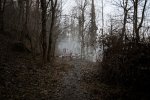
Not a sunrise. Not the golden spilling that the word "dawn" promises. A grayness — slow, directionless, the sky brightening the way a room brightens when someone turns on a light in the hallway and the glow leaks under the door. The gray arrived from everywhere at once, not from the east, not from any direction Dana could have pointed at and said there, just a general lessening, the dark thinning the way fog thins, and the world came back.
She saw her hands.
The right one — the one that had been holding Bree — was white. Not pale. White. The color of paper. The fingers curled around Bree's onesie in a grip she couldn't feel, the knuckles bloodless, the skin stretched over bone without the usual cushion of circulation underneath. The left hand was worse. The forearm bandage — the strip of t-shirt she'd tied hours ago — was soaked through, the fabric black with old blood, and below the bandage the fingers were swollen and purple, the hand twice its normal size, the skin tight.
She saw the dog.
The gray light showed what the flashlight's amber had not. The left flank — the parallel tracks she'd felt under her hand in the dark — was open from shoulder to hip, the fur matted in dark ridges around wounds that had stopped bleeding and started weeping a clear fluid that caught the gray light. The missing ear was a raw oval on the left side of the skull, the cartilage base visible, scabbing at the edges but still wet at the center. The ribs on the left side were visible through the coat — not individual bones but a general concavity, the chest wall dented where the impact had broken something underneath. The muzzle scar was white against the brindle. The body was on her legs. The body was smaller than she'd thought it was in the dark. The body was alive — the flank rising and falling, the breath fogging faintly in the morning air, the eye half-open.
She saw Bree.
The baby's face against her chest. The skin — blue-tinged at the lips, at the fingertips, at the earlobes. Not the blue of suffocation. The blue of a body that had been cold for too long, the capillaries constricting, the blood retreating to the center, the periphery going the color of a thing that isn't getting what it needs. The eyes were closed. The mouth was slightly open. The breath — the breath Dana had been counting against her cheek for hours — was visible now, a tiny plume in the gray air, and the plume was small and the plume was there.
She did not look down the trail.
The shape was there. Forty yards. In the gray light it would have been visible — not amber and peripheral and fleeting, the way it had been in the flashlight's last sweep, but present, detailed, the gray light showing what the gray light shows. She didn't look. Her eyes stayed on Bree's face, on the dog's breathing flank, on her own ruined hands. The trail extended in both directions and she looked at neither.
Gray-light. The warm-one's face above. The face has a color now — the face didn't have a color in the dark. The color is wrong. The face is the color of the sky. The small-one breathing against the chest. The breath-plume in the air. The thrum quiet. Not gone. Quiet, the way the inside-place was quiet when the floor was warm and the hand meant good. The body on the warm-legs. The warm-legs less warm. Eye closed. Opened. The warm-one still there.
A voice.
From the trail. From below — the trailhead direction, the parking lot direction, the direction Dana had driven twelve hours ago in a Civic with a Palm Sunday cross on the dashboard. A male voice. Calling. Not calling her name — calling the way a person calls when they arrive at a place and expect to find it empty and find it not empty.
"Hello? Hello — is someone—"
Footsteps on the gravel. Fast. The crunch changing rhythm — walking to jogging to running. The voice getting closer and the voice changing as it got closer, the tone shifting from announcement to alarm.
A man. Parks jacket — the brown canvas, the shoulder patch, the radio clipped to the chest. Young. Twenties. The face pale under a sunburn that had been there before this morning. He came around the bend in the trail and he saw her and his face did something Dana would remember longer than anything else from this morning — a rearrangement, the features reorganizing from professional-calm to the expression of a person who has walked into a thing he cannot process at the speed he's encountering it. The mouth opened. Closed. The eyes went to Dana, to Bree, to the dog on her legs, to the blood on the gravel, to Dana's hands, to the bandage on her forearm. The circuit took three seconds. The face didn't recover.
He keyed the radio. His hand was steady. His voice was not.
"Dispatch, this is Ranger Hartley at Ridgeline Greenway barrier — I need EMS and air ambulance to the upper trailhead lot. I've got a — I've got a woman and an infant, both injured, both hypothermic. Possible animal attack. We need — I need warm packs and a backboard and I need them now."
The radio crackled. A voice responded. The ranger was crouching in front of Dana and his hands were moving — pulling off his jacket, draping it over her shoulders, the canvas warm from his body, the weight of it settling on her back like a hand. He was talking. She could hear him talking — "You're okay, I'm here, what's your name, can you tell me your name" — and the words were arriving from somewhere far away, the consonants softened, the meaning lagging behind his mouth the way sound lags behind a mouth on a phone with a bad connection. He was two feet away. The words were coming from somewhere much farther.
"Dana," she said. The voice was the voice from the night. The cracked, wire-thin voice. "The baby. Please. The baby."
He looked at Bree. His hands hovered — wanting to touch, wanting to assess, stopping because Dana's arms were locked around the baby and the lock was not voluntary. The grip had gone past the muscles' control and become something structural, the arm curled around Bree the way a root curls around a rock, the shape fixed.
"Dana. EMS is coming. They're going to help your baby. Can I—"
She shook her head. Not a decision. A reflex.
The dog growled.
Low. From the chest. The same frequency Dana had heard from behind the man on the trail — but weaker, shorter, the growl starting and stopping in the space of one breath. The ranger froze. His eyes went to the dog on Dana's legs — the blood, the wounds, the missing ear, the teeth visible because the lip had dried and retracted. The ranger's hand moved slowly toward his belt.
"It's—" Dana said. "It's with me. Don't."
The growl stopped. The dog's eye moved from the ranger to Dana. The eye held on Dana's face for three seconds and then the lid dropped to half-mast and the body settled deeper against her legs and the growl didn't return.
More voices. More footsteps. The gravel crunching under boots that moved with the particular urgency of people trained to move urgently. Orange vests. Bags. A stretcher carried between two people jogging. The gray trail filling with color — the orange of the vests, the white of the backboard, the blue of gloved hands.
They reached for Bree.
The hands — blue latex, two sets — reached for the baby against Dana's chest and Dana's arms didn't open. The EMT said something. A woman's voice, calm, practiced, the voice of a person who has said these words before: "We need to check her, Dana. We need to warm her up. I need you to let me take her."
Dana's arms didn't open.
The EMT looked at the ranger. The ranger looked at Dana. Dana looked at Bree's face — the blue-tinged lips, the closed eyes, the breath-plume in the gray air.
She opened her arms.
The muscles unlocked in stages — the bicep first, the arm straightening, the fingers last, the grip releasing joint by joint, and the release was the hardest physical act of the night, harder than the crawl, harder than the drag across the gravel, because every hour since the knife had been spent tightening the hold and the tightening had become the body's identity and releasing was the body becoming a thing it had forgotten how to be.
The EMT lifted Bree from Dana's chest. The baby's weight left her arms and the absence was a cavity — a space where the warmth and the weight and the breath had been and now wasn't, the body suddenly hollow where it had been full, the sternum cold where the sternum had been warm.
Bree cried.
Not the subvocal vibration. Not the bone-conducted frequency. Not the keening or the register below the keening. A cry. Full-throated, enormous, the pitch of a four-month-old baby being touched by cold hands after hours of a warm chest. The cry hit the gray morning like a bell — sharp, carrying, the sound bouncing off the canopy and coming back and the sound was the sound of a body that objected to being moved and the objecting was the best sound Dana had ever heard because objecting meant breathing and breathing meant alive and alive meant the machine had worked. The breath had powered the cycle. The cycle had held.
Someone was wrapping the dog. She saw it peripherally — a second EMT, kneeling, moving carefully, a thermal blanket being draped over the body on her legs. The dog's lip pulled back. A rumble in the chest — not the growl from before, something smaller, a token. The EMT's hands were slow and the blanket settled and the rumble faded and the dog's eye — the one she could see — tracked across the chaos of orange vests and blue gloves and found Dana.
The eye held. Across the stretcher and the backboard and the EMTs working on Bree and the ranger keying his radio and the helicopter sound starting somewhere in the distance, the eye found Dana and the eye held and the look was the look from the trail — not the flat, fixed gaze from the standoff but the look from before that, from the bonding, from the six feet, from the nose on the paws. The look that was not recognition. The look that was orientation. The source located. The thrum settling toward quiet.
They put Dana on the stretcher.
The trail moved under her. The gray canopy above — the branches she'd been lying under for hours now sliding past, the laurel at the edges, the gravel crunching under the wheels of the stretcher as the EMTs jogged. She could see the trail from a height she hadn't seen it from — not standing height, not the height of a jogger pushing a stroller, but stretcher height, horizontal, the trail as a narrow corridor through the green, the trees pressing in from both sides, the gravel a gray line between the green.
The trailhead. The lot. The Civic sitting where she'd left it twelve hours ago, the sawhorses still standing in front of it, the car exactly where it had been when the only problem was the walls breathing and the baby who'd never seen the sky.
Then the helicopter. Then the lifting.
The trail from above. A line in the green. The ridge, the creek, the canopy, the gravel — all of it shrinking as the helicopter climbed, the trail becoming a cut through the forest, a thin mark on the surface of the earth where someone had cleared the trees and laid the stone and strung the sawhorses across the entrance and closed it and a woman had ducked under and run and bled and held and stayed.
A cut. In the green. Then gone.
Go to the next part: https://www.abctales.com/story/soulfire77/ridgeline-part-eighteen-what-s...
- Log in to post comments
Comments
wow, sense of release. They
wow, sense of release. They made it. Bree made it.
- Log in to post comments