


Incredible India - Part 2

By SteveHoselitz
- 305 reads
I realise now that the arduous six-week overland trip was a perfect preparation for my time in India.
Jim had made the journey to his Pakistan homeland several times before, so his ability to prepare for the adventure was excellent. He had the route planned, the places to stay en-route identified, the timetable worked out in detail, and peppered the trip outline with interesting visits.
We hurtled through the road network of Western Europe, and down into what was then Yugoslavia. At the Serbian town of Niš we stopped to see the amazing skull tower, a monument dating back to the early 19th Century and a war with the Ottomans. To this day the tower is emblazoned with embedded the heads of victims.
Our route continued through Bulgaria, stopping overnight in Sofia, before going on to Edirne in the European part of Turkey and then Istanbul, which was our first planned stop of more than an overnight stay. Jim’s meticulously prepared vehicle was parked on the street outside our budget guesthouse.
At breakfast the next morning he gathered us all together for a council of war. Overnight, thieves had unbolted the roof-rack from the bus. Some inessential luggage had been left on there, but what bothered Jim most was the loss of four spare wheels with special tyres for the most arduous part of the journey ahead. Without those, Jim was not sure that his trusty vehicle would make it all the way to Delhi, our eventual destination. He was inviting us to decide whether to risk pressing on or to cut our losses and return to the UK and get a refund. Our decision was unanimous. So he bought a new roof-rack and we headed on after a day seeing the sights of my first ever Asian city.
Our journey went first to eastern Turkey along the Black Sea coast, and then past Mt Ararat, of Noah’s Ark fame, and into Iran.
It was early March and eastern Turkey looked like I imagined the Flanders trenches of the first world might have seemed. A sea of mud on either side of the road and almost no vegetation. The road past Mt Ararat was still covered in deep snow and we now faced the first real impact of the stolen wheels, two of which had already been fitted with snow chains. Somehow, we made it over the pass and down to Tabriz in Western Iran.
All the time we had been having overnight stops in simple hostels along the way, but when we got to Tehran we had a longer break. It was in the schedule but I guess Jim also needed to try to prepare for the testing journey through eastern Iran.
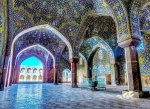
I found little to interest me Tehran so I got on a public bus and went to Isfahan – I must have read about it somewhere. It took nearly six hours – the same as it does today. But it was worth it: Isfahan remains to this day probably the most beautiful city I have ever been to. The centre is packed with onion-domed mosques covered with intricately decorated blue tiles, one more stunning than the last. Of course the sun was shining and I took photo after photo. I am sad that world events have made revisiting this wonderful site a too difficult to repeat now.
Back in Tehran, Jim had been asking about the best route east and had been warned that the more northerly, popular route was too muddy. Even big lorries were not making it through. So we took a more southern diversion; a way Jim had not been before. I remember this part of the trip vividly. The dusty, sandy route was along what can only be described as a corrugated track. Large lorries of a certain type were the most common transport and perhaps because their suspension was all so similar they had degraded the unmetalled surface to a regular sequence of bumps and humps which shook the life out of every other kind of vehicle. Drive slowly to survive the uneven surface and you’d get nowhere any time soon. Faster and you would probably destroy your own form of transport. Apparently, Jim’s stolen wheels with their oversized tyres would have been the perfect answer to this, but they were a thing of the past… Tehran to Mashhad, in eastern Iran is 900 kilometres – more than 550 miles - and rather further if you travel through the Mesr Desert. How Jim managed to safely propel his vehicle and its passengers over this inhospitable, unrelenting, uncomfortable terrain remains one of the wonders of life! We got to Mashhad exhausted but intact. And later the next day we continued the far easier route to towards Herat in western Afghanistan.
Jim was paying for our simple lodgings – he’d calculated this when setting the fare – but we were paying for our food. So we didn’t need much spending money, but every time we crossed a border, we needed to get a little local currency. These were the days of Travellers Cheques in Europe and long before credit cards were internationally ubiquitous. Dollars cash were the commonest currency to trade. Sterling came second.
In Herat all of us decided to exchange a ten dollar note for Afghanis. There appeared only to be one bank, a one storey building set in the middle of a large almost bare sun-drenched plot of land. Each of us entered the building to be greeted by an elderly guard with an old but menacing rifle. At the first counter we filled in the inevitable paperwork, name, address, passport details, etc.
Then we were passed another similar armed guard, complete with white lungee headdress. He took us one by one, to the next counter where we needed to fill in another form giving our name, address, date and place of birth and passport details yet again. The third armed guard took us to a counter where we declared how much money we were exchanging in which currency. The next guarded counter was where we handed over our precious ten-dollar bill, which was carefully examined. It was then that we exited the building, to sit on in the sun on the brown grass next to another (completely unguarded) elderly Afghani man who dispensed local currency with notes and coins to the amount stated on the form we’d been given. The piles and piles of notes he was using surrounded him surrounded and were weighted with stones to stop them blowing away in the light breeze. Comparing details later, itg seemed that each of us came away with a different amount of money. I did rather well and I think I had about ten times more than some of the others. (Someone in the bank was not very good at arithmetic). It certainly wasn’t like the NatWest back home!
From Herat we drove on in the early spring sunshine to Kandahar and then Kabul where we stayed a day or two. Apart from the bank experience I remember little about Afghanistan. It seemed to me that the people were getting poorer and poorer the further East we travelled.
Our next encounter was a drive through the infamous Khyber Pass to Peshawar in northern Pakistan, where Jim had relatives. We’d been warned that this part of the trip might be dangerous but it went without incident until we got to the Pakistan border. It seemed that the Pakistani border official took an immediate shine to our policewoman passenger, examining her very much too carefully, rubbing perfume from her bag into his beard, and inviting her to become his lover. In the end Jim had to intervene with a bribe to put an end to the ordeal and get us all through into his homeland. It was the only time on any border we had been troubled at all.
Jim took us to interesting places in Pakistan including the then little-known site of Mohenjo-daro, the archaeological site of one of the largest settlements of the ancient Indus valley civilisation - one of the world's earliest major cities, contemporaneous with the civilisations of ancient Egypt circa 2,500 BCE. At totally the opposite end of the time scale, we called in at Islamabad, a newly built city only just declared the capital of Pakistan and still under construction.
We then made our way to Lahore which was really Jim’s old stamping ground, and he’d laid on a special feast to welcome us. Sadly, I was suffering from what I think was probably sun-stroke and spent the entire evening alone in the hostel where we were staying. I was told that the meal was sensational!
After a few days more we went on through the Punjab towards Delhi. All the roads were quite humped in the middle, presumably to deal with heavy rains. The roadsides were peppered with crashed trucks. This is Sikh country and most of the truck drivers were proud men who wanted to keep their brightly decorated vehicles in the centre of the road, to straddle the hump. They would hold show one arm, with its tell-tale gun-metal bangle, out of the truck window to tell oncoming drivers that as brave warriors they were not giving way to anyone. All was fine until a similar driver drove his truck in the opposite direction. (I wonder if such fatal bravado persists to this day).
Delhi and the Taj Mahal at Agra marked the end of my journey with Jim and the others and we said our farewells.
I had one contact in the Indian capital, a young Indian woman named Devaki who I had met home in England. She’d been studying first in Chicago with my professor uncle and then had come to Oxford, at which time she had visited our home a few times.
A bit like Satish, she was hard to contact, but eventually I did get through. Her life had moved on, she was married and a mother, and my visit probably caught her a bit unawares, so apart from a bit of advice about where I could stay, she was of little help.
It was late April, and I thought my job in Mumbai was due to start on May 1, so I had little time. I was staying at an international hostel in the diplomatic quarter and for the first time in my life I came down with acute dysentery. For most of a week I existed on weak black tea and toast. When I should have been exploring the exciting Indian capital, I was lying on a bed with the curtains drawn, trying to stay hydrated.
It was the only time I ever got ill in my entire stay. I like to look back on it as acclimatising. I’d already learned not to eat meat and to drink only bottled water.
By the time I got better, it was time to catch the train for the next part of my adventure.
- Log in to post comments
Comments
This is a real kaleidoscope
This is a real kaleidoscope of experiences. What a wonderful trip for a young person to make.
I was fortunate enough to live in Iran during the 70s, way down in the southwest of the country, but I did enjoy my visits to Tehran. Agree with you about Isfahan - it's stunning. Reading this makes me wish I'd crossed a few more borders while I was there, but I was only in my mid teens so I don't think anyone would have given me a job!
Please keep these coming, they're a great read.
- Log in to post comments
wonderful memories you're
wonderful memories you're sharing with us disconnected in a too modern world full of images with no meaning.
- Log in to post comments
Adventure
What an incredible adventure, and so wonderfully described.
I’ve lived in Bulgaria for the last ten years. It’s changed dramatically in the time that I’ve been here, so I’d love to know more about what you thought of it in the 1960s. I would also say that Isfahan is the most beautiful city I have ever visited, and I hope it still is.
This is a great read. Thank you for sharing it.
Turlough
- Log in to post comments