


A Hare's Breath 5 - The Dark Hedges


By Turlough
- 6946 reads
A Hare’s Breath 5 - The Dark Hedges
I’ve found that the advantages of renting a car from the Hertz office at Dublin Airport are numerous. In such a vehicle you can ride about anywhere you like in Ireland without anybody laughing or shouting at you provided that you return it with a full fuel tank and without blood or scratches on the paintwork. In 2022, in a Hyundai Lucozade all shiny black and top-of-the-range, Priyatelkata and I did a three-week tour across the middle of the country, up the Atlantic coast to the top and then over the soft border to wallow in the beautiful County Antrim countryside.
Along the way we encountered other intrepid wanderers from all corners of the globe who were keen to share with us details of their plans for visiting all the usual quaint and/or spectacular world-famous Irish places, plus one that I’d never heard of before. It was unusual for a country so steeped in history and legend to suddenly acquire a new point of interest on its tourist agenda, so I was more than curious. This place was called the Dark Hedges.
It turned out that Aoife, the lovely young hostess who welcomed us to a family-run guesthouse in Ballycastle on the famously gorgeous Antrim Coast Road where we’d be staying for a couple of nights, was also a schoolteacher. It was only a minor coincidence that she worked at the school in Ballymoney, the nearest biggish town, where I had been a pupil back in the mid-twentieth century. I wondered had the stuffed shirts in the offices of the local education authority been at the poitín bottle in recent years as she was nothing like the sinister bamboo-cane-wielding beldams they employed in my day. I was old enough to be her retired headmaster. Over a cup of tea we had a good old chat about how the school, the town and County Antrim generally, had changed. Thankfully I didn’t have on the vomit-encrusted pullover or the leaky wellington boots that had been permanent features of my schoolboy wardrobe back in those times of tadpoles, torment, tribalism and trauma.
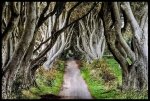
I asked her what the Dark Hedges tourist attraction was all about. She said she’d recently taken a class of ten-year-olds there on field trip and went on to describe it as an avenue of beautiful old beech trees whose branches met in an intricate overhead tangle. It’s on the Bregagh Road connecting the villages of Armoy and Stranocum. Apparently it had regularly been used as the filming location for the King's Road in the television series Game of Thrones, which was something I had never watched. They’d also used the trees in the 2017 Transformers film called The Last Knight which I’d never even heard of. However, despite my ignorance of the film and television industry, I knew exactly what she was talking about. The Dark Hedges were surely what my friends and I had referred to as the big peculiar tunnel made out of old twisty trees that look too old to be still alive but really they are, and to which we had cycled many times as kids from our homes in the then sleepy market town of Ballymoney. Thinking back to those childhood adventures I had the feeling they were set in period of time so long ago that they were as much a folklore fantasy as the Game of Thrones story was itself.
A couple of days later, having done a lot of very interesting poking about in scenes from my past, it was time to move on again and in doing so we made a slight adjustment to our route that had been months in the planning. Provision had already been made for a couple of hours to take in the delights of Ballymoney, but Stranocum had unexpectedly been added to the itinerary at short notice. I’d only ever been there before as a passenger in the back of my father’s white Morris 1000 van, or as the rider of a heavy old second-hand bicycle with a hand-painted black and white frame and rod brakes. This was to be a brand new experience for me at an old, very well-known and much loved location.
When we arrived at the big peculiar tunnel made out of old twisty trees we found ourselves a parking space in the big peculiar coach and car parking area adjacent to the Hedges Hotel, a seemingly a modern construction, and eagerly jumped out to do some exploration on foot. Passing by The Pantry at the Dark Hedges (which boasted ample seating inside and out) and the reception building of Gracehill Golf Course, I wondered where a wee boy these days might sit to eat his apple and drink the bottle of red lemonade that his mammy had given him to put in the saddlebag attached to the rear of his bicycle seat. The beautiful old beech trees were just as I remembered them but I’d never seen people there before. At 9:30 on a chilly Sunday morning in late September there were already forty or fifty visitors admiring the majestic avenue. The wee folk from the faerie hill down the road must have been absolutely enraged by the changes the human people had made to the place, and to tell the truth I was on their side.
When I was a wean I’d have sneaked behind one of the trees for a wee after drinking the red lemonade but that wasn’t going to be possible on the day of my return on account of all those visitors admiring things, so we had a wander inside The Pantry at the Dark Hedges for sustenance and comfort purposes. At the counter we ordered freshly baked mushroom scones with locally produced butter and a pot of tea for two. The waitress told us to find a table and she’d bring them over to us.
Our order, when it arrived a few minutes later, came with an explanation of the Dark Hedges so detailed that an overhead projector and a pointy stick wouldn’t have looked out of place. Everybody’s friendly in North Antrim except sometimes when they’re talking to people of the opposing religious denomination, and everybody uses the word wee (meaning small, not urine) at least twice in every sentence, but the enthusiasm of the wee woman who became known to us as Annie from the Pantry suggested she must have just passed the final exam on an advanced friendliness course.
‘Give your tea a few wee minutes to brew before you pour it into the wee cups’ she said, followed by ‘Did you enjoy your wee walk?’ and ‘Where is it you’re from?’ Priyatelkata and I have led lives that might be described as nomadic so we didn’t bore Annie with the full details but I’d have been mad not to have told her a bit about when I had lived in Ballymoney in days of yore.
‘Ah it’s a grand wee town apart from all its terrible problems. I live in Ballymoney myself but I’m only there since I got married as before that I was living away in a wee place called Dunloy (a village I knew to be less than ten kilometres distant). Have you relatives and friends still living there? What are their names? Which school did you go to? Your daddy was Irish now, so where was he raised?’ We had a plane to catch four days later so for that reason I didn’t answer all her questions and also I had questions of my own to ask. I wanted to know when the surtourisme had arrived to ruin a spot that had provided me with a wealth of special childhood memories.
‘Ah, it’s all the Game of Thrones eejits. In the summer there’s thousands of them here. I hate what they’ve done to the place but if it wasn’t for them I wouldn’t have a job. My friends and I would have a wee wander over here on the bicycles too when we were weans but it was nothing like this. I quite like the work but I wonder how long I’ll have it if they take the programme off the television and people start to forget we’re here.’
She went on to say that the trees had been planted in 1775 by a rich local landowner by the name of James Stuart. Their purpose was to form an imposing approach to his estate where he had built his home and named it Gracehill House after his wife Grace Lynd (but not Grace Hill). I vaguely remembered the house being there but in a state of dereliction when I was a kid, and there was no golf course then. But the visiting golfers’ money had since transformed Stuart’s house into a clubhouse and the fields around it into the sort of place where Oscar Wilde might have gone if he’d wanted a good walk spoiled.
Despite having been there almost 250 years, the vast majority of the trees were still standing, but in recent times a few had died and fallen down due to physical stress to their roots caused by the impact of traffic, both automotive and pedestrian, on the road that ran between them. A tree preservation order had been put on them in 2004 but by then the damage was done and a terrible storm would often see another gap appear in the two parallel rows. And then Game of Thrones fanatics from all over the world would pay thousands of pounds to whichever farmer it was that owned whichever field they had fallen into to get their hands on a piece of the wood to take back to wherever they came from. There they’d boast having a front door made out of ancient timber cut from a tree from the King’s Road of phoney folklore fame.
On some of the days when the big crowds were there, Annie would earn more in customers’ tips than she’d got as a day’s pay in her previous wee job in a wee tea shop in the Main Street in Ballymoney. Occasionally there’d be hardly anybody there because the really really mad eejits would come, usually from places like Nevada or Wyoming, bringing with them their horses in trucks and they’d dress up like some sort of a legendary fella with a pike and a tin hat and have some of their people film them as they rode up and down between the trees on the poor creatures, pretending to be Seán Bean or Russell Sprout. She repeated Russell Sprout and we had a wee laugh together even though it was obvious that she repeated her wee joke numerous times to customers every day, and it wasn’t all that funny, but we liked her. Apparently, ridiculously vast amounts of money had to change hands to make those solo visits possible but the absence of members of the general public on such days meant there was no need for her Pantry to be open, so the tip tin would see no pieces of silver.
I could have chatted to Annie all day but we had to crack on with our journey. She’d left us in peace a few minutes to let us eat and drink the delicacies we’d paid for. Then she returned to see us off. Shaking our hands, she said, ‘Nice meeting you. I hope you’ll come and see us again sometime, but before you head off you should go back down the lane and pick up a few wee nuts that have fallen from the beech trees to take home and plant in your garden, and one day you’ll have a patch of wee trees to sell on to the fellas over from America for a million dollars. I’ve a few myself growing in my garden. They’re my pension for when this place shuts down.’ But we didn’t go back to pick up a few wee nuts because Priyatelkata already had a wee pocket full of them.
***
In the late summer of 1970, my mother and father, my sister, our dog and I left Ballymoney in a bit of a hurry and went to live in Leeds in the North of England. My Irish Uncle had already lived there for several years and by putting our names down on a waiting list and doing a bit of pestering, he had been able to secure for us the keys to a maisonette above a concrete shopping centre on a sprawling council estate. At the time, Leeds City Council were keen to help the world with its growing displaced persons problem and had seen us as watered-down refugees who were easy to deal with and we would be a feather in their flat caps.
Round about the same time, my friend Bobby and his family emigrated to New Zealand. The monthly air mail letters that we sent each other from opposite sides of the world were little more than lists of why we were both homesick. The exchange dried up after less than a year and we lost touch completely and forever.
I hadn’t been especially close to other friends I had had in Ballymoney and I would sometimes get a little distressed by some of the sectarian bigotry elements of their parents’ conversations. They were Protestants and, although nobody in my family had leaked the news to anyone, I was sure they knew that we were secret lapsed Catholics poking our noses into their Orange Order world. So I made no attempt to remain in contact with any of them.
Ballymoney witnessed some very dark events after our departure and a number lives were lost. In October 1971, whilst watching the BBC evening news in our living room in Leeds, we discovered that the father of one of my sister’s Irish school friends had been murdered. Seeing on our television screen the face of a man that we had known and who was now dead at a young age shook us all. My parents’ decision for us to leave the place had certainly been a wise one even if I hadn’t been happy about it at the time.
Years later a cousin told me that during the Troubles in the North of Ireland, mixed marriages almost always attracted violent intimidation from one side or the other, or both, and our white Morris 1000 van had been only a hair’s breadth from being the target of some paramilitary eejit with a wee packet of Semtex in his back pocket. The weans in our street might have been shouting at me there goes the poor wee boy with the black and white bicycle that he can’t go about on anymore because the U.V.F. or the Provos blew the legs away from him.
Although the black and white bicycle went with us to England I had no desire to ride it around a council estate where kids would laugh and shout the Yorkshire language equivalent of there goes the poor wee boy that lives in a no-go area and only has potatoes to eat for every meal. So it lay rusting in our shed for years. At one point, a long time after our arrival in Leeds, my girlfriend’s brother offered me two pounds for it. I was surprised that he was prepared to part with so much money in exchange for what had become a heap of junk, but my father considered this an insult and it stayed in the shed until we moved house a couple of years later, at which point it went in a skip.
Back in Ireland, the words Glover Site Investigation in blue joined-up writing on the sides of the white Morris 1000 van were painted over and replaced with Seán Bean’s Wagon, and Game of Thrones fanatics from the poor parts of Nevada and Wyoming would drive up and down in it beneath the Dark Hedges for the price of a couple of nice pints of Guinness. Or at least that’s what I imagined Mr Investigation, who was the owner of the business and really called Ken Glover, would have done with it.
On that day that we met Annie from the Pantry, I sat a few minutes on the stone wall beneath the old twisty trees and thought back to 1968, my friend Bobby and the bottles of red lemonade. As Priyatelkata furiously foraged for the beech nuts that would eventually make us rich, I looked at the lovely County Antrim countryside that surrounded me. Beyond the avenue nothing had changed. I spotted a big old hare sitting nearby in a field. It looked at me for a few minutes and I saw the condensation of its breath rise in the chilly air of the Irish morning. Then it turned and ran away to play with its friends.
It was an altogether beautiful animal and an altogether beautiful place to be sitting, and it was just grand to remember that I was fortunate enough to have once lived in County Antrim.
Image:
My own photograph of the Dark Hedges near to the village of Stranocum in the lovely County Antrim countryside.
The first part:
- Log in to post comments
Comments
A perfect and bittersweet way
A perfect and bittersweet way in which to end things Turlough. Beautifully done, thank you
- Log in to post comments
Thank you for the
Thank you for the autobiography of a wee hare-loving lad from Ballymoney, Turlough, it's been a delight.
One comment and two questions :
Comment : Instragram et al seem to be spoiling every quiet and beautiful place in the world. I can't understand the mentality 'let's go to a really quiet and beautiful place - and spoil it'.
Questions :
- What is a Hyundai Lucozade ? This stumped me.
- Did your gappy toothed friend by the well know anything about the single children's shoes ?
- Log in to post comments
I had to think about that,
I had to think about that, but thank you for the credit !
Somewhere round 1976 I was sharing a house in Southampton with Frank, a trainee teacher from Belfast. Belfast seemed to feature every night on the TV, with shots of checkpoints and barbed wire and jumpy-looking young British soldiers in bullet-proof vests. Frank told us most of Belfast wasn't like that at all, and in fact it was a beautiful city, you just wouldn't know it from the news.
- Log in to post comments
In spite of what he said
In spite of what he said about Belfast generally, Frank's family was not untouched. There was a bomb which exploded which killed a postman, and Frank's mum was the first person to get to him, or what was left of him. She, understandably, had a breakdown. It all seems so random, like anyone could be killed just going about their ordinary business. Or have a close shave, like your cousins.
- Log in to post comments
Always great and for that
Always great and for that reason, it's our wee Pick of the Day. Do share on social media.
- Log in to post comments
Name that car
Re naming of cars, I think with Asian manufacturers there is a bit of a culture blip when naming models, or at least colours.
I freelanced at Mitsubishi in Ciren for a couple of years 1997-1999. One of their biggest (in every sense of the word) sellers was the Shogun. It was a seriously chunky, roughty-toughty proper off -roader, capable of pulling horse trailers etc. Shogun was a suitably macho model name. So far so good. Unfortunately one of the colours you could have had your Shogun in was 'Fairy White'. Bit of a slip up there, we thought.
- Log in to post comments
Shogun was also a book (I
Shogun was also a book (I think). I guess you left just in time to bamboozle the world with your likenessess of likenessess and old hares.
- Log in to post comments
Have seen many images of this
Have seen many images of this, but yours is really magic, they are like living flames.
I think the faeries might find great satisfaction from daft Americans coming all the way across the sea to Ireland the opposite from desperate Irish going across the sea to America, as they are very transactional, aren't they?
I do hope so much the beech nuts germinate! Is the climate ok for beech trees in Bulgaria as it's much more extreme? The ones here are not managing these winds at all, it is heartbreaking how many have fallen in a few years. Your ones must be well tough to have lost only a few, even with all the road traffic, too. I am SO GLAD you saw a hare :0)
- Log in to post comments
Oh!!!!!!!!!!!!!!!! PLEASE go
Oh!!!!!!!!!!!!!!!! PLEASE go visit them :0) I just looked up photos and they are not the best, I REALLY LOOK FORWARD to your photos :0) will you go in Autumn or Spring, do you think?
- Log in to post comments
maybe you will see a bear AND
maybe you will see a bear AND beautiful beech trees :0)
- Log in to post comments
You,ve a keen eye for detail
You,ve a keen eye for detail in your narration of Dark Hedges and evoke the mystery Turlough. Those old beech trees with their intricate overhead tangle must be a magical place to visit, no wonder the faeries hang out there.
You know I've never felt excited about visiting a place of younger days, I'm always disappointed by the changes. That word 'change' always rings in my ears whenever I return to Bristol, or Shirehampton village where I grew up, although the woods are still there, most everything else apart from the church has changed out of all proportion and leaves me out of balance, so I don't go back anymore, except in my mind. So I understand completely how you feel on your return, I'm sure the faeries feel it too.
Did you manage to grow a beech tree from those nuts Priyatelkata collected? You combine so much knowledge in an interesting way and kept my attention from beginning to end.
Congrats on the well deserved Pick Of The Day Turlough, well deserved.
Jenny.
- Log in to post comments
As a gardener I found this
As a gardener I found this chain of comments about beech nuts very interesting. I've just looked them up and apparently they are notoriously difficult to get to germinate. Even in the wild the germination rate is only 10%.
This is an interesting and helpful article about it : https://chainsawnerds.com/beech-nut-seed-germination/
It's a brilliant article. I thought you might like the fact it's written by a fellow chain saw enthusiast.
I'm definitely inspired by it to go out and find some beech nuts and enter the ABC Beech Nut Germination Challenge 2026.
- Log in to post comments
Great ! There should be
Great ! There should be beech nuts around right now. If we can find some and do the float thingy, and put them in the fridge for the specified 90-120 days, that should be just right for planting in spring.
Unfortunately I don't know where there are beech trees in the Cotswold Water Park, but I have emailed the rangers to find out. It's just about wall to wall willow here, with the occasional alder, because of the permanently high water table.
- Log in to post comments
Just had this reply from the
Just had this reply from the ranger Kieren :
"Not too many Beech trees around as they aren’t really the right tree for the Waterpark landscape (they don't like wet feet!) "
But he told me where there are a few so if it ever stops raining here I'll go out on my trusty old Dawes Discovery (not black and white) and have a look. I think you're right - the first challenge is going to be actually finding some of the pesky little critters.
- Log in to post comments
Boing !
It has sprung round here.
It may be Winter Solstice, but I've got bees in my garden (bees at Christmas !), mozzies in the house, the male blackbirds are fighting and the bulbs are coming up. Anyone else finding this ?
- Log in to post comments