


5. Secondhand Prose

By HarryC
- 1258 reads
What it says, really. A piece from years ago that I've rewritten to fit with something new.
Next morning, I sat down with a pot of coffee and rolled a fresh sheet of paper into the typewriter. I figured I'd use that rather than the laptop. Back to something more basic. No internet to distract me. Over the course of two hours, I pecked in some ideas, but nothing that really fired me up.
Husband and wife each have sex changes to save their marriage.
Stage play set in traffic jam on M25 (environmental theme).
Couple go on holiday somewhere. Both disappear without trace.
Man gets on a bus to go to work.
Town where nothing happens. Something happens?
Forty-six words in two hours. At that rate, I might finish a novel in, say, ten years? If my liver lasted that long.
I pulled the sheet out, balled it up and threw it away. I needed some fresh air. A walk, I thought, might get the cogs turning again. Up through the town, maybe.
The town where nothing happens.
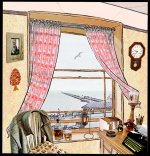
Perhaps I do it a disservice. Things do happen here. Just not very often. And they're not usually very exciting when they do. It's a funny town in many ways. Too shabby to be a favoured holiday destination (except for people as skint as I am). But it holds some faint charm if you don't look too closely. Like many towns, the High Street has been hollowed out by the internet. To serve the forty-thousand or so inhabitants there are twenty-three hairdressers, eleven nail bars, thirty take-aways, seven tanning salons, nine tattoo parlours, twelve estate agencies, fourteen charity shops, four gyms, seven churches, thirty-eight retirement homes, three bait shops, a dozen amusement arcades, two angling clubs, two sailing clubs, one greengrocer, a few hundred CCTV cameras and a broken pier. There are nineteen pubs (including micros), only one of which I frequent. There are NO bookshops. None selling new books, anyway. Even the library has less book space now that the Birth and Death Registry is based there. The seafront car park is a regular skid-pan for the local boy (and girl) racers, and the boating lake often gets used as a park for trolleys from the nearby supermarket. In summer, jet-skiers invade like a lunkhead Luftwaffe. In winter, it's as cold, wet and empty as a lost glove.
It's about what you'd expect for a small town on the 'little England' coast.
But lest I paint too bleak a picture... it has its good side, too. Its characters. Its places of interest. Its curious side-alleys and corner-ways, where you can often find something worthwhile. These people and places are part of what keeps me interested - and, I suppose (financial imperatives aside), part of what keeps me living here.
Next to The North Pole, the other little oasis of sanity is The Bean Bag - the 'world food' shop next to Mole's motor yard. It's run by a Rastafarian called Tam and his Welsh partner, Fee. They used to be travellers - pitching up here and there, doing some work, saving some money, moving on. Then one day they drove their ancient converted pantechnicon into Dunhaven Bay, liked it for some reason, saw the shop up for let, and decided to stop. In there, you can get - as the hand-painted sign outside says
'Everything From A Bag Of Spice To A Sack Of Rice.'
Oat and soya milks, every type and colour of lentil, star anise, asafoetida, ghee. Organic cold-pressed extra virgin olive oil in gallon cans. Raisins the size of teabags. Coriander fresh from the earth. Stoneground spelt flour, taramasalata, biodynamic wine, feta cheese, fair-trade Columbian coffee, Imzir figs, dried cepes and chanterelles... and a smell, like eastern souks and rain-washed gardens, that sharpens the air and makes your taste buds throb. By the doorway, there are shelves and racks of books, magazines, flyers and cards covering everything from trans-fats and compost toilets to monkeywrenching, rebirthing and chakra-balancing. Tam and Fee have a bagging room at the back of the shop where they'll weigh things up as you want them. They run a Mindfulness group once a week in their upstairs flat, and Fee does Reiki massage. Tam - gentle-natured and unassuming almost to the point of diffidence - is the third-dan Sensei at Yoyo's Bujinkai dojo. He's one of the few people, actually, that Yoyo's wary of.
"You have to watch those quiet types," he told me. "He swings a roundhouse kick like a fuckin' helicopter rotor. It could take down a tree."
There's a courtyard at the back of the shop with a few tables, and during the summer it's nice to sit out there and nurse your hangover with a sun-dried tomato and houmous bap and a cup of turmeric tea, and think some thoughts - the only sounds being the distant tinkling of spanners from Mole's yard, interspersed with coughs or a cry of "Cunt!" at some recalcitrant nut or bolt.
Then there are the charity shops. Everything covered from cats to cancer. Most of my kit comes from these. It's about much more than simply being skint a lot. They have some excellent stuff. Good books, too, if you take the time to sort through the boxes. In amongst the Sophie Kinsellas and the Lee Childs, you can often find a Dickens, a Steinbeck, a Kafka or a Balzac. I've even found Bukowski and Hunter S. Thompson sometimes. Not a clue in town who might have handed them over. Me, possibly.
B-Side the Seaside does you for everything vinyl, video and disc. Every label, every band, every genre. Frank Sinatra and Frank Zappa. Johnny Cash, 50 Cent, Dire Straits. Epidemic and The Cure. Pink Floyd, Deep Purple, Black Sabbath, Green Day, Barry White, Deacon Blue, Cream, Indigo Girls, Simply Red. He doesn't discriminate.
"Taste is taste," he told me. "However bad."
And then, the secondhand shops. Plenty of those, too. Some conventional ("Objets d'art, if you don't mind!"), some off-the-wall entirely. In Belshazzar's, for example, you can get a Victorian prophylactic (long past 'use by'), a stuffed skunk, a prayer mat with a compass, a glass eye and a set of dog's dentures. Sell-Fridges does what it says on the sign, as long as you don't want an ice box newer than about 2010.
But the biggest and best by far is El's Emporium, down in the High Street. The proprietor (and Yoyo's sometime employer) Eric is mostly known by the diminutive. The only people it confuses are Spanish tourists. "El... ¿quién?" they always want to know. "El Pastor," is the correct answer. Plain old Eric Shepherd. You then have to try to explain why he doesn't have any sheep.
"El vendedor de muebles antiguos?"
"Sí. Creo que lo entiendo."
El's is housed in what was once the town's old music hall theatre. It's one of the oldest buildings in town, and one of the most striking - rising from a drab row of tacked-on take-aways like a temple in a council terrace: a merchant's mausoleum in a broken-tooth churchyard. The architect must have been jointly inspired by the Pharos of Alexandria and too many mushrooms. Above the entrance arch, stone fauns frolic in a pillared apse, from the dome of which El flies his flag of trade. Further up, the facade bulges outwards and is dotted with tiny windows, like a lighthouse. On the very top, where the lantern should be, sits a cupola, like a vast upturned cooking pot that was stewing seagull guano.
The archway and foyer are El's front stall, where he keeps some of his better bargains - book-ended by a couple of gold-painted grinning Buddha statues. Sofa beds, granny rockers, tall-boys, ornamental fountains - plus a life-sized fairground Cossack mannequin that waves its arms and booms with sinister laughter as you pass. Moving in past the the old Ticket Booth (now El's office) the place opens up like a cathedral. The nave is stacked with double layers of bureaus and suites, while the two side aisles house bookcases, wardrobes, cabinets, dressers, upright pianos, tables, recliners and desks. Lacking the floorspace, he hooks dining chairs in ranks high up on the walls - like they're set up for a rock-climbers AGM, or for when Mary Poppins drops in for tea.
A clerestory of windows runs down to the stage, and on a bright day the dust motes rising off the old furniture swirl in the light like miniature universes. The stage is where El keeps his special stuff: older, heavier, pricier. Here, you might find a Second Republic French closet wardrobe - big as a bedsit bathroom - bulking up next to a Georgian bureau-desk and a '50s walnut cocktail cabinet. There's an old Bechstein grand - possibly the theatre's original, and allegedly once played by a holidaying Horowitz - and a full-size slate-bed snooker table which still gets plenty of use (though the balls tend to collect in certain areas). It looks like how the set of a Chekhov play might have looked - translated by Harold Pinter, with a score by Wagner. You won't find much veneer here. No chipboard or plastic. Nothing out of a flat-pack. This stuff's solid as a forest, and so heavy it might even be rooted like one.
A staircase to the side of the foyer takes you up to the old Circle, which houses the more exotic items. El’s laid it out like a sultan’s den. Fine Turkish rugs cover the floor and the walls. Satin drapes plunge and loop around plush chaise-longues. Tall, baroque hall-stands rise in the corners, topped with vases of fluted crystal and slender porcelain figurines. A glass-topped coffee table, broad as a rowing-boat, holds a chess set in green and white marble. Flashes of rose-light and bronze catch against surfaces and in mirrors, giving the place a museum glow. A Chinese screen, depicting the four seasons in delicate strokes, folds its way across an alcove. There’s even a garment draped over it – though not the one you’d expect. It’s El’s old demin jacket.
You could almost believe someone lives there. Which is interesting, because someone does. Fold back the screen and you’ll find a very cosy domestic arrangement: sofa bed, table and chair, TV, turntable, wardrobe, bookcase, drinks cabinet, heater. Along inside the alcove, a small electric cooker, a sink and a fridge. It’s been El’s home for five years, since he got divorced and sold his house. Since he became ex-El, you might say.
“There’s something about the place, Harry,” he told me one night over a beer and a game of lop-sided snooker. He spoke very softly, almost reverentially. “It’s the history or something. You can feel it in the air. It gets into you... like right in the blood. And it suits me. Being alone with it. I wouldn’t want to live any other way now.”
I watched him chalk his cue – eyes darting about at the different groupings of balls. He’s a striking figure of a fellah. About fifty, wiry as a pipe-cleaner, hair in a thinning grey ponytail, big silver earring, scuffed cow-poke boots, jeans as faded and thin as blotting paper. He looks like Neil Young did before he became Neil Old. He took his shot and watched as the balls scattered off and regrouped. A red dropped into a pocket.
“My great-gran on my mother’s side, bless ‘er… she used to sing here, you know… way back. Played the piano, too. Taught herself. So there’s that connection I’ve got. Family. They say that when someone’s been part of a place, their spirit gets into the wood and the stone... so they’re always there, in a way. I’m happy to go along with that. It's the same with the furniture, too. A lot of it comes from house clearances after people have died. And it's like part of their personality, you know? They're still there in it. I can feel it.”
He took a swig from his can, then put a line on the black.
“It’s funny, but some nights… when I’m sitting up there, quiet like…”
He arched his eyes towards the Circle, louring up in the dark like a mouth beyond our pool of light. He was just about to play his shot when he glanced at me a moment. Then he chuckled and put his eye to the ball again.
“Well… you know. Full of sounds, these old places. Probably just the wind in the rafters.”
The balls cracked together and the black disappeared like a bat down a well.
“Eight,” he said, grinning.
I wouldn’t mind living in a place like that – spooks or not. Plenty of space. Pick of the furniture. Quiet-ish. Bit of a sod to dust, I suppose, but you can’t have everything. So I envy El in a way. A friendly way, of course. Work he likes in a place he likes with an atmosphere that keeps him rooted in his own past. A lucky fellah.
You couldn't odds it, could you?
I know I couldn't.
- Log in to post comments
Comments
Some wonderful description in
Some wonderful description in this Harry
- Log in to post comments
This is great, Harry. The
This is great, Harry. The place and the people just come alive. Wonderful piece of writing.
- Log in to post comments
Pick of the Day
This is our brilliant social media Pick of the Day! Please do share if you can.
- Log in to post comments

Live and Let Live!
These are not as far-fetched as it sounds I have heard similar (some true, in fact) stories.
We are not one to judge! Live and Let Live! Tom
- Log in to post comments
Thanks, Tom. I don't judge.
Thanks, Tom. I sincerely hope I don't judge, and can't really see any element of judgment here. Perhaps I'm overlooking something. If Harry's judgment (a fictional narrator) is that he couldn't make anything of the story ideas, then that just reveals the limits of his imagination, I suppose - nothing else.They are all story ideas I've used myself from time to time. And I know of cases, too, having worked with LGBTQ+ communities over the years. These are the things that I find interesting about the human race. Being unconventional myself, I certainly wouldn't have a clue - much less any interest - in anything 'normal', whatever that might happen to be. Outsiders, misfits. non-conformists and minorities are those I feel most at home with, personally.
Fiction is the truth inside the lie, I think. And there's nothing original under the sun. As Jean-Luc Godard said: 'Steal from wherever resonates with your imagination. It's not where you take things from. It's where you take them to.'

- Log in to post comments
Fabulous Harry. The best
Fabulous Harry. The best piece I've read for a long, long time. Just up my street.
- Log in to post comments
Excellent writing, loved
Excellent writing, loved reading this
- Log in to post comments
Like Turlough, you have the
Like Turlough, you have the gift of bringing the mundane to life and making it fascinating, Harry. And funny. And sad. And, in this case, just a bit spooky too. Good writers can make great stories out of apparently very little material, and you have definitely got this talent. (Like Edward Thomas and Adlestrop). I really enjoyed your story very much.
- Log in to post comments
Thank you, Kat. That's a very
Thank you, Kat. That's a very encouraging comment. One of my favourite film-makers is Jim Jarmusch, and he said 'The beauty of life is in small detalis, not in big events.' I keep that quote pinned on my desktop. If you're interested, one of my touchstones - and definitely my 'desert island' book - is this. I've read it several times and am reading it again now. Joseph Mitchell wrote millions of words about ordinary people, and made every one of them special. The brilliant Stanley Tucci turned one of the pieces, 'Joe Gould's Secret', into a film starring Ian Holm in the title role. You can find it online if you search around. But the book is a must for any writer.
(I haven't read Adlestrop for years now... but yes, I remember it  )
)
Two other favourites of mine: Sherwood Anderson's 'Winesburg, Ohio' and John McNulty's 'This Place on Third Avenue' (the latter a contemporary of Mitchell on The New Yorker, but in a more Damon Runyon style of writing - great ear for dialogue).
- Log in to post comments
Jane Austen said much the
Jane Austen said much the same sort of thing as Jim Jarmusch.
Thanks for the recommendation. I've just ordered the Joseph Mitchell book, and also John McNulty's This Place On Third Avenue, which is on my recommendation list and I think must have come from you. Sadly, Joseph Mitchell doesn't have a single book in Gloucestershire or Wiltshire libraries. Yet when I go into Cirencester library I see multiple copies of the same novels which also fill the shelves of the charity shop I work in. Oh well, shouldn't be a book snob, I guess it's a supply and demand thing, and the council only has so much money.
- Log in to post comments
Working in the book section
Working in the book section of the charity shop is great though. I get introduced to all sorts of new (to me) authors. Somebody local must be into contemporary Japanese literature written by women, because three have come in recently - Butter, Convenience Store Woman and There's No Such Thing As An Easy Job. I've also only just discovered Claire Keagan from the shop. Can't believe I hadn't heard of her before, but so many books so little time ..
- Log in to post comments
Exactly! The relationship
Exactly! The relationship with the bottle... and the gun. 
- Log in to post comments
Not so much with guns.
Not so much with guns. Definitely with bottles... and cans...
- Log in to post comments
Belshazzar's or Bust
But lest I paint too bleak a picture...
You’ve done the complete opposite. The detail with which you’ve described your town tells me it’s packed with places that I’d spend much of my time in if I lived there.
When Mary Poppins and I come to visit Dunhaven Bay, we’ll meet you in the Bean Bag for a brew or a pint of taramasalata. But we’ll stuff our own skunks thank you.
Turlough
- Log in to post comments
I like Kate Chopin and Eudora
I like Kate Chopin and Eudora Welty. I've always just called them Southern. Never heard the term Southern Gothic before. Gothic to me means Ann Radcliffe or Edgar Allen Poe.
I know there's a genre called Southern Noir. I tried reading Razorblade Tears by S. A. Cosby, but the violence was just too graphic for me.
- Log in to post comments