


Spinning a Disaster

By Makis
- 748 reads
One cold evening in February 1818, in a land where King George III had recovered his madness well enough to appear sane and where Mary Shelley had just published her novel, Frankenstein, a ten year old boy named James Thornton trudged his way down frozen tracks in borrowed boots, to his place of employment.
Darkness had already fallen as he entered the yard of Atkinson's Spinning Mill in Colne Bridge in the West Riding of Yorkshire, where he was about to begin a twelve hour night shift alongside twenty two other children and three adults.
The mill was one of several owned by Thomas Atkinson, the Captain Commandant of the Huddersfield Yeoman Cavalry and who was, by all accounts, a dashing character admired by the ladies. He was not however, admired by the Luddites, who had targeted his mills on a number of occasions and labelled him one of the worst employers in the county.
James Thornton shook off his brother's boots as he entered the mill and tucked them away with others under the stairs, much preferring bare feet for freedom of nimble movement amongst the relentlessly dangerous machinery. James and his brother Jacob shared the boots during Winter months whilst working alternate shifts.
The night dragged on as it always did, lit by dull whale oil lamps and overpowered by the deafening noise of the Spinning Jennies, Water Frames and Mules and the treacherous belts that powered them. James and the other children were harried constantly by the two overlookers, William Smith and James Sugden, into the non-stop labours of spinning imported American cotton into the yarn required by the weavers. The fetching and carrying of raw materials and finished spun reels, along side the frightening tasks of attending to the relentless demands of the deadly machinery. Only three days earlier, nine year old Nancy Bennett had been trapped by her hair in a drive belt and horrendously scalped. James and his friends lived in a state of constant terror.
At 5am James was sent down to the carding room for more rovings (unspun strands of fibre) by the foreman William Smith and was handed a lit tallow candle to see his way. Carding is the process of disentangling the cotton fibres ready for spinning and in doing so, fills the atmosphere with highly inflammable materials. It was a ludicrously dangerous act which should never have happened and the consequences were inevitable. As James entered the room, the atmosphere ignited into a wall of fire which quickly began to devour the stacked bales of cotton awaiting process. The horrified boy raced back up the stairs to report that the factory was on fire and then rushed out of the building to safety in such a frenzied state that he forgot his brother's boots.
Up on the spinning floor, eleven year old Sarah Moody had seen the flames below them through gaps in the floor boards and rushed across to overlooker James Sugden in alarm, only to be told to return to work and that the matter would be dealt with. Fearing the flames more than Sugden, she fled the building, more in terror than in defiance of his instructions and watched on as the entire building was consumed within just thirty minutes of young James entering the carding room with his lighted candle.
Desperate attempts to put a ladder to a rear window and entice the children to safety were in vain, as it quickly became evident that the ferocious heat had long since overcome any chance of survival. Three adult overlookers and six children survived. Seventeen children, all of them girls, did not.
The following day, the remains of fourteen bodies were found and taken to a nearby hostelry where they were placed in the cellar; the missing three presumed totally consumed by fire. An inquest was hastily arranged two days later and a verdict of accidental death quickly determined by those in authority. It was clear that Captain Atkinson's influence was considerable and nobody was ever prosecuted or held responsible.
Just nine days after the tragedy at Atkinson's Mill, Sir Robert Peel moved the second reading of the Factory Bill in order to 'prevent a recurrence of such misfortune as that which had lately taken place at Colne Bridge.' It passed into law in 1819, forbidding the employment of children under nine, banning work by children at night and limiting those between the ages of 9-16yrs to sixteen hours per day. However, with no means of any enforcement, the legislation was mostly ignored.
Many lives were still to be lost and much spinning of events was still to be done by mill owners until the Education act of 1870 finally took children out of the mills and put then into the classroom.
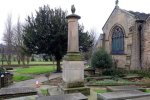
This is the inscription on the memorial to the disaster, pictured above, in the nearby Church of St John the Baptist. It reads: In memory of the seventeen children whose remains are interred who fell lamentable victims to the destructive element of fire in the Cotton Manufactory of Mr Thomas Atkinson at Colne Bridge on February 14th 1818; this melancholy catastrophe was occasioned in consequence of the foreman sending a boy into a lower room with naked light.
- Log in to post comments