


The Less Miserables Break a Board (1)

By SoulFire77
- 1362 reads
The board snapped clean in half on the third attempt.
Zara stood at the top of the six-stair, the broken pieces scattered below her on the concrete landing, and felt something break inside her too. Not her heart—nothing that dramatic, nothing that romantic. More like a wire that had been holding everything taut suddenly giving way, all the tension releasing at once into something slack and useless.
She'd been trying the kickflip for two weeks. Every day after school, sometimes before school, sometimes skipping school entirely just to get more attempts in. The same kickflip Nova had landed back in November, the one that had made everyone cheer and whoop and act like it was the greatest achievement in skateboarding history. Dusty had lifted Nova onto his shoulders. Tanner had done that stupid thing where he pretended to bow down. Even Hector, who never got excited about anything, had cracked a smile.
Zara had smiled along with them. Clapped Nova on the back. Said all the right things—"That was sick," "You killed it," "Two thousand attempts and you finally got it." Her voice had been steady. Her face had been right.
Inside, she'd been furious.
Not at Nova—Nova had earned it, had done the work, had logged her two thousand attempts like Hector taught her. Had tracked every single one in that sketchbook of hers, with diagrams and notes and the obsessive detail that Zara had always secretly admired and publicly mocked. Nova had been patient and methodical and all the things Zara didn't know how to be, and she'd gotten the result she deserved.
Zara's fury was aimed somewhere else. At herself, maybe—for not being able to do what Nova had done, for not having the patience or the discipline or whatever mysterious quality it took to succeed. At the universe—for making some things easy for some people and impossible for others. At the simple, grinding unfairness of watching someone else succeed at something she'd been trying to do for months.
And underneath all that, something even uglier: the fear that maybe she just wasn't good enough. That maybe some people were born to be great at things, and other people were born to watch and clap.
She hated feeling jealous. Jealousy was for weak people, petty people, people who couldn't handle seeing others win. That's what she'd always told herself. Strong people celebrated their friends' successes. Strong people used other people's achievements as motivation, not as reasons to feel like garbage.
But here she was, fifteen years old, standing in a skate park in the freezing January cold, feeling jealous of a girl who'd never done anything wrong except be better at something Zara wanted to be good at.
The worst part was that Nova was her friend. Not her best friend—Zara didn't really do best friends, didn't trust anyone enough for that level of closeness—but someone she trusted. Someone who'd never looked at her like she was trash, never made assumptions about where she came from or what she was capable of. Nova had always treated Zara like an equal, even when they'd first met and Zara had been hostile and defensive and ready to fight.
And Zara had repaid that by secretly hating her for two months.
She'd started practicing the next day after Nova's triumph. Not the patient, methodical way Hector recommended—she didn't have patience for notebooks and tally marks and the slow accumulation of data. She practiced the way she did everything: hard, fast, angry. Throwing herself at the trick until something gave.
Usually what gave was her body. Bruised shins, scraped palms, a twisted ankle that she'd hidden from the others by skating through the pain. The night after that particular injury, she'd limped home and soaked her foot in ice water while her mom's boyfriend complained about the ice cube tray being empty. She hadn't said anything. Hadn't asked for help. Hadn't told anyone that she'd been skating on a swollen ankle for three days because admitting weakness felt worse than the pain.
But today, what gave was her board.
The deck had been dying anyway. She'd had it for almost a year, bought used from a kid at school whose parents had made him quit skating. Thirty-five dollars—more than she could afford, but she'd saved for weeks, eating less at school, skipping the occasional meal at home when nobody was paying attention. The wood was delaminating at the nose, layers of maple separating like pages in a wet book. The graphic was worn down to bare wood, the skull-and-roses design that she'd never liked but had come to think of as hers. The tail was so razor-thin from abuse that she could see light through it in certain angles.
But she'd loved that board. It was hers—the one thing in her life that belonged entirely to her, that nobody could take away or borrow or decide she didn't deserve. And now it was in two pieces at the bottom of the stairs, as broken as everything else in her life.
"Zara?" Nova's voice, coming from somewhere behind her. "You okay?"
Of course it was Nova. Of course she'd witnessed this particular humiliation. Of course the universe had that kind of sense of humor.
"Fine." The word came out sharper than she meant it to. "I'm fine."
"Your board—"
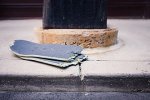
"I know what happened to my board." Zara walked down the stairs, picked up the pieces. The break was clean, right through the middle, the wood pale and raw where it had split. Fresh maple, never meant to see the light. "I was there."
Nova didn't say anything. Just stood at the edge of the flatground, her own board under her arm, watching with an expression Zara couldn't read. Concern, maybe. Pity. The look you gave someone who'd just embarrassed themselves and didn't know how to recover.
"Stop looking at me like that," Zara said.
"Like what?"
"Like you feel sorry for me."
"I don't feel sorry for you. I feel—" Nova paused, her brow furrowing. "I don't know what I feel. Worried, maybe."
"Don't be." Zara tucked the broken pieces under her arm, started walking toward the parking lot. Her throat was tight. Her eyes were burning. She was not going to cry in front of Nova. She was not going to cry in front of anyone. "I just need a new board. That's all."
She didn't look back. Couldn't look back. Because if she did, she might have to explain why she was crying, and she didn't have words for that.
The problem was, she couldn't afford a new board.
Her mom's boyfriend—Rick, or maybe Rich, she'd stopped bothering to learn their names after the third one—had "borrowed" her savings three weeks ago. Forty-seven dollars, everything she'd scraped together from odd jobs and birthday money and the occasional five she found in the couch cushions when she was helping clean. She'd been saving for almost a year, dollar by dollar, hiding the money in different places as the amount grew because she'd learned that visible money disappeared.
He'd said he'd pay it back. He always said he'd pay it back. He never did.
The first time it happened, she'd believed him. Had waited by the mailbox for days, thinking maybe he'd slip her the money when her mom wasn't looking, like it was a secret between them. Like he was the kind of person who kept his promises.
She'd confronted him about it once, early on, when she still thought arguing might accomplish something. He'd laughed at her. Told her she was lucky to have a roof over her head, lucky he put up with her attitude, lucky her mom had found someone willing to deal with a bratty kid. Then he'd taken another beer from the fridge—a beer her mom had paid for with money that could have gone toward groceries—and gone back to watching TV.
"You should be grateful," he'd said, not even looking at her. "Some kids don't have anybody."
Zara had learned not to confront him after that. Had learned to hide her money better, to keep the things she valued out of sight, to make herself small and quiet when he was around. Survival skills, she called them. The things you learned when you lived with people who saw you as an obstacle instead of a person.
Her mom was no help. Her mom loved Rick—or said she did, or needed to believe she did because the alternative was admitting she'd made another bad choice. Her mom worked double shifts at the diner on Battleground, came home smelling like grease and cigarette smoke, and was too tired to notice that her daughter was slowly disappearing. Too tired to notice anything, really, except whether Rick was happy and whether the bills were getting paid.
Zara sat on her bed that night, the broken board pieces on the floor in front of her, and did the math. A new deck was fifty, maybe sixty dollars if she wanted something decent. She had eight dollars to her name—four crumpled ones and some change, stashed in a sock at the back of her closet where Rick wouldn't think to look. Plus whatever she could beg from her mom, which would be nothing because rent was due and the electric bill was past due and there was never, ever enough for anything.
She could ask the others for help. Garrett would probably just give her the money—he was like that, generous in a way that came from never having to worry about where his next meal was coming from. His dad was something in finance, his mom was a lawyer, their house had three bathrooms and a swimming pool. Garrett didn't even think about money. It just existed, like air.
But taking charity from the rich kid felt wrong somehow. Like admitting she couldn't handle her own problems. Like confirming all the assumptions people made about girls who looked like her, dressed like her, came from where she came from.
She could steal a board. The thought surfaced unbidden, ugly and tempting. All-City Board Shop had terrible security—she'd seen kids shoplift from there before, just tucking decks under their coats and walking out. The owner was half-blind and usually stoned. It would be easy. Probably.
But she thought about Garrett. About the assumptions he'd made when the ramp money went missing, back before they really knew each other. About the way he'd looked at Zara first, before looking at anyone else. About the shame on his face when she'd called him out, and the slow work of rebuilding trust that had followed.
She wasn't a thief. She'd never been a thief, no matter what people assumed. No matter how desperate things got. There was a line, and she stayed on the right side of it, even when the right side was harder.
So stealing was out. Charity was out. That left... what?
She looked at the broken board. At the half with the graphic still visible—the faded skull with roses in its eyes, some punk rock thing the original owner had thought was edgy. She'd always hated that graphic. But she'd loved the board underneath.
Maybe that was the problem. She'd been so focused on what she didn't have—the trick, the recognition, the proof that she mattered—that she'd forgotten to think about what she actually wanted.
The next morning, she went to Hector.
He was at the park early, as always, running kickflips on the flatground with his usual machine-like precision. Pop, flick, catch. Pop, flick, catch. The same motion over and over, each one identical to the last, like he was a robot programmed to do one thing perfectly forever.
The January cold had finally broken a little—still chilly, but not the brutal freeze of the past few weeks. The kind of weather where you could skate without your fingers going numb in the first ten minutes. The kind where the concrete didn't feel like it was trying to crack your bones every time you bailed.
"I need your help," Zara said.
Hector caught his board, looked at her. His face was neutral, the way it always was. She'd never seen him angry. Never seen him sad. Never seen him anything, really, except calm and focused and slightly distant, like he was always thinking about something more important than whatever was happening around him.
"With what?"
"With—" She gestured vaguely at the park, at the stairs, at the general disaster area that was her life. "All of it. The kickflip. The board. Everything."
"That's not very specific."
"I know." She sat down on the bowl's edge, the broken pieces of her board still tucked under her arm. The concrete was cold through her jeans, but she ignored it. "I broke my deck yesterday. Trying to land the six-stair kickflip."
"I heard."
"From Nova?"
"From Dusty. He saw the whole thing from the parking lot." Hector sat down beside her, his notebook in his lap. The notebook was battered, held together with tape, pages warped from being shoved in his backpack after sweaty sessions. But he carried it everywhere. Treated it like it was sacred. "How many attempts did you make? On the six-stair?"
"I don't know. A lot."
"A lot isn't a number."
"Maybe thirty? Forty?" Zara shrugged. "I wasn't counting."
"That's your first problem." Hector opened the notebook, showed her a page covered in neat handwriting. Columns of numbers, notes in the margins, little diagrams that looked like stick figures doing tricks. "When I learned the six-stair kickflip, it took me two hundred and twelve attempts. I tracked every single one. Wrote down what went wrong, what went right, what I needed to adjust."
"That sounds exhausting."
"It's the opposite of exhausting. It's efficient." He closed the notebook. "You've been practicing for two weeks. How many total attempts would you estimate? Across all your sessions?"
Zara thought about it. The long hours at the park. The repeated failures. The growing frustration that had turned into rage that had turned into desperation. "Maybe... three hundred? Four hundred?"
"Okay. And how many have you landed?"
"None."
"None in four hundred attempts." Hector's voice was neutral, not judging, just stating facts. "Nova landed hers on attempt eight hundred and forty-eight. After two thousand attempts total on flat. You're trying to skip the middle part."
"The middle part is boring."
"The middle part is where you learn." He looked at her directly, his dark eyes holding hers. "Why do you want to land this trick?"
The question caught her off guard. "What do you mean?"
"I mean, why? What's the goal? What are you trying to prove, and to whom?"
"To land it. Obviously."
"But why does landing it matter to you?"
Zara opened her mouth to answer, then closed it. The truth was complicated. The truth involved Nova and jealousy and the desperate need to prove she was worth something, that she could do things other people could do, that she wasn't just the angry girl from the wrong side of town with the messed-up home life and the chip on her shoulder.
"I don't know," she said finally. "I just want to be good at something."
"You're already good at things. Your boardslides are cleaner than mine. Your frontside airs have better style than anyone else here. Your grinds are aggressive in a way that most people can't pull off." Hector paused. "You don't need the six-stair kickflip to be good. You want it for something else."
"Like what?"
"That's what you need to figure out."
Go the the next part:
https://www.abctales.com/story/soulfire77/less-miserables-break-board-2
- Log in to post comments
Comments
Pick of the Day
Wonderful to renew acquaintance with these brilliant characters, and this is our social media Pick of the Day! Congratulations!
Picture by Isaac Bowen, copyright free on Wikimedia Commons: https://tinyurl.com/373pacnm
- Log in to post comments
This is great writing
This is great writing SoulFire, and instructional too. Skateboards were way after my time and apparently a whole new world of teenage angst!
- Log in to post comments