


Eva of the Seven Wonders

By Turlough
- 1574 reads
Eva of the Seven Wonders
Among my secret possessions there’s an old suitcase that belonged to a woman called Mary Campbell, a niece of my maternal grandmother (a.k.a. my Nan, or English Electric Grace). She’d been a woman of great beauty and intelligence with a rare spirit of mischievousness and a love of travel. She was born in 1913 and lived seventy-eight years during which she neither married nor had children.
Her suitcase was small and made from tough compressed cardboard. It was the sort of thing you’d see carried by 1950s emigrants in old documentary films. Mary left us before Ryanair arrived, but had she still been around I’m sure she’d have been thrilled to know that her sturdy but well-worn case would have met all the requirements of the airline’s strict cabin baggage policy.
This wonderful vintage piece of kit conceals stories of its own, but what makes it all the more precious is the collection of treasures that I keep in it. Here are seven of them…
The Buddha
Somewhere in the years between the introduction of electricity for domestic use and the appearance of Nintendo as a sedative for children, a great source of entertainment for bairns on rainy days was the contents of the family button bag. My grandmother was a tailor, she sewed my new blue coat, and consequently she had buttons to brag about in her button bag. But I always called her Nan.
Also in that bag made from deftly hooked together rags, was a tiny figurine of Buddha, less than two centimetres tall and carved from ivory. There’s a limit to the number of times you can re-enact the 1965 FA Cup Final with buttons so I eventually got bored of them. But the little Buddha in his teaching pose (Dharmachakra) always had me mesmerised.
It had been my Grandad’s. He was born in 1899 and from being a young boy he carried it everywhere in his trouser pocket. It had been with him to bring luck in the Flanders trenches in 1918. He never spoke about his experiences of World War One but after the guns had fallen silent he stopped carrying his amulet because he said he had already used up all the luck that it contained.
Pleased that I’d grown attached to it, he gave it to me and I’ve kept it ever since. I’m usually uncomfortable with anything made from ivory but this little man is now well over 120 years old, so the poor elephant from which it was born would have passed on by now anyway.
The Badge
When World War Two broke out, Great Uncle George was in his late-thirties and a skilled metalworker at a shipyard on the River Wear in Sunderland. His age and experience earned him classification as a ‘recognised worker’ exempt from military service. To identify him as a person granted such status, he was given an enamel pin badge bearing the image of a steamship and the words ‘North Sands Shipbuilding Yard - National Service’. The number 1342 was punched by hand onto the metal clasp on its reverse.
My bit of research revealed that it was produced by the manufacturer Thomas Fattorini Ltd of Birmingham, and that Uncle George’s shipyard had built forty vessels during the war period.
My Nan, who was Uncle George’s proud little sister, would often tell that although he’d been spared the horror of active service abroad, his job in Sunderland hadn’t been totally devoid of danger. At the stage of construction where a ship was little more than a hull, an engine and a propellor, engineers would take it out on ‘sea trials’ in the North Sea. During two such trials George had found himself floating about in the water surrounded by bodies of colleagues, or sitting in a lifeboat, after the half-built ships being tested had been torpedoed by German submarines and sunk. Apparently, the first sinking had been horrific and he’d refused to talk about it, but on the second occasion shipyard employees had all managed to clamber into lifeboats, nobody died, they were picked up by an army truck on the shore near Hartlepool and made it home in time for their tea (i.e. working-class dinner).
The badge probably missed these ordeals, remaining attached to Uncle George’s coat throughout as it hung on a peg back at the shipyard. He’d have been wearing his working overalls. Nevertheless, it’s seen some action and fully deserves the safe place it now has in Mary Campbell’s old suitcase.
The Shilling
‘Daddy, I’ve found a shiny penny!’ my five-year-old daughter Rose exclaimed, holding up a 1928 Irish shilling that she’d seen lying on the footpath on her way home from school. ‘Can we buy something nice with it?’
Such a coin had never been legal tender in Harrogate in North Yorkshire, where we lived at the time, but I was so delighted with her find that I took her and my other two kids to the shop up the road to buy us all an ice cream. She couldn’t understand how I was able to acquire such treats without giving the shiny penny to the shop lady, so I had to explain to her the concepts of ‘a five-pound note’ and ‘not much change’. But she had her Calippo and she was happy.
1928 was the first year in which Ireland had minted its own coins after gaining independence from the British in 1922 so, for several years after that, all Irish coins bore the date 1928. All Irish shillings minted up until 1942 had a silver content of 75%, so it was worth more than a shilling but not enough to finance an ice lolly frenzy.
I still have it and because of what it is and the circumstances in which I acquired it, it’s utterly priceless.
The Mighty Magyar
By 1999 my son Seán had become a football fanatic and an avid collector of Corinthian footballers, those seven-centimetre, small-bodied, large-headed, caricature-style miniatures of footballers. He had a list of them on which he would underline with coloured pens the ones he had and the ones he ‘needed’. He became a member of the Corinthians Collectors’ Club and was invited to their annual convention held that year at the Premier League Hall of Fame in County Hall on London’s South Bank.
On the day, he and I travelled by train from our Chippenham home. Four years earlier that would have been a treat in itself as prior to his discovery of football Thomas the Tank Engine had been his big passion. The venue was easily reached and upon entering the building we were hit by the chaos and squabble of the dealers’ buying, selling and exchanging little Michael Owens and George Bests. Sean traded wisely and cautiously and we completed the day with a look round the football museum. It was all history to me and completely new to nine-year-old Seán, but both of us were captivated by the wonderful array of artefacts on display.
When I was a young lad myself, each year for my birthday I would receive from a generous relative (usually my Nan) a copy of the News of the World Football Annual. This wonderous paperback was stuffed with statistics and, as it had exactly the same dimensions as my coat pocket, I’d take it with me everywhere. Pages and pages of results, league tables and facts from countries all over the world were pored over for countless hours. European club competitions were just gathering pace at that time and there was hardly any televised football, so this was my sole means of introduction to exotic sounding names like Red Star Belgrade, Carl Zeiss Jena and Trakiya Plovdiv. My early love of football and my early desire to travel were combined without me realising it.
The most enigmatic individual player that I read about was a Hungarian by the name of Ferenc Puskás. He had played for the great Real Madrid of the late 1950s and early 1960s, and was a member of the Hungarian national side who earned the nickname The Mighty Magyars after thrashing England twice in 1953, first with a 6-3 win at Wembley and then 7-1 in Budapest.
On the day of our convention in London, old Ferenc was there for the launch of the Corinthian caricature of himself. He smiled, signed his autograph for me on a Hall of Fame publicity card, and shook my hand. I wanted to tell him that I’d spent much of 1970 lying on my bed and thinking of him, but thankfully I didn’t know how to say that in his language.
Seán still has over a thousand Corinthian footballers. The world has lost interest in them and he can’t give them away. I still have Ferenc Puskás’ autograph and it’s as mighty as it is precious to me.
The Book
The family that lived next door to us in Middlesbrough in the early 1960s were called Miller. Mr and Mrs Miller were very kind people who always smiled and said hello when they saw me. Their twin daughters, Marion and Linda, would sometimes sit and talk to me on the front doorstep. They were probably about six years older than me. I was still in the middle years of primary school life and they had moved on to the big school.
I remember one day seeing Linda coming out of their house and feeling dumbstruck as she announced that her and all the other Millers were moving away to live in another town. She wasn’t very happy about it, largely because her mother was making her and Marion turf out a lot of their belongings as they packed up for the flit. I was unhappy too because I was to lose my grown-up twelve-year-old friends.
‘I like this but it’s a bit tatty,’ she said, ‘So our Mam won’t let me keep it. Do you want it?’
I took the battered and stained volume from her and examined it. I didn’t understand any of the writing but I’d never owned a book that had small print and no pictures like the adults read, so I immediately accepted it and thanked her.
Entitled A First Poetry Book - Compiled by M A Woods, it had first been published in 1886 but I had in my hands a more up-to-date edition printed in 1919, and I still have it. It contains works by the likes of William Shakespeare, William Wordsworth and Lewis Carroll, none of whom I’d heard of at that stage of my life. There’s also a delightfully eerie poem about Irish folklore called The Fairies, written in 1850 by William Allingham. It took me some time to improve my reading skills sufficiently to take it on but eventually I fell in love with some of the book’s contents, especially Allingham’s masterpiece.
On the inside cover at the back, written in pencil, are the words ‘Stella is not friends with us’ and ‘I don’t care.’ There are also a few lines of lyrics from early Beatles’ songs. Such items of schoolkid scribble from times before I became the owner fire my imagination as much as the poetry does.
I don’t know where Linda and the Millers went, or what happened to them. I can’t even remember what she looked like, but I always think of her when I read this book.
The Teeth
For several generations, an enclave of our family flourished in South Shields. Three of my Nan’s cousins ran a printer’s and stationer’s business from a shop in Dean Road. The shop also stocked a small selection of toys, so for my sister and I it was like visiting an Aladdin’s Cave where everybody had a Geordie accent.
Nearby was a sandy beach and Marsden Rock, a twenty-seven-metre-high limestone sea stack alive with herring gulls. On every visit a historic incident was discussed at length as family members recounted their own memories of the time a gull deposited a message of good luck on my Dad’s shirt.
One day, wandering the sands alone in search of seashells, I found some teeth. These weren’t like ordinary teeth, or even the false teeth that everyone over the age of forty seemed to have rattling about in their mouths in those days. Measuring about five centimetres square and containing stone, I had a fragment of a creature that I imagined to have been colossal and fierce.
‘Throw it away!’ my mother said, ‘It’s dirty and disgusting.’ I muttered some words of reluctant agreement in response, but I still have it.
Some years later I showed it to the geology teacher at school. He said he was sure that it was a fossil of some sort and suggested that I take it to a natural history museum. I said I would but I still haven’t got round to it. It’ll probably stay in Mary Campbell’s suitcase for another four million years.
The Photograph
The monsoon rains in Manila in August 1978 were much heavier than usual. This wouldn’t normally have bothered me but I’d flown out there with a dozen other crew members to join a ship. Merchant seafaring was my vocation in life, for a while. The ship, the Cape Grenville, was carrying a cargo of steel up from Newcastle in New South Wales to be discharged into barges at an anchorage a kilometre offshore. It arrived three days late but our little party had got there bang on the dot, so we had time to kill.
The Silahis International Hotel on Roxas Boulevard had six hundred rooms on twenty-odd floors. Considered Manila’s most luxurious place to stay, it even had a Playboy Club on its top floor. It wasn’t the sort of place that Scottish Ship Management would normally book for salty sea dogs like us to stay in, but because it had only been open a few months it had numerous vacant rooms and probably discounted prices. We were told to behave ourselves and avoid running up expenses.
We spent three wet nights there with nothing to do because of the intensity of the rain. Sightseeing was out of the question and the swimming pool was closed so that bathers didn’t get soaked. Food and drinks were expensive so we couldn’t even console ourselves with gluttony.
My companions were middle-aged Glasgow Rangers fans with criminal records, in-depth knowledge of Manila’s dark side, and all the infections that come with those things. Thankfully they abandoned me. So alone in the hotel I watched Filipino television, read a book, wandered the corridors, drank expensive beer very slowly, made small talk with other guests and sighed.
The young woman working at the reception desk introduced herself as Eva. She also served the drinks during the day before the hotel’s main bar opened, so that was my excuse for chatting with her. She asked me where my friends had gone and before I’d explained my problem she told me she didn’t like them.
She knew I’d be staying there a fair while and I was already desperately bored, so she suggested that we go for something to eat together when she finished her shift eight hours later. With something to look forward to, my afternoon passed quickly and on the stroke of mid-evening we met in a café five hundred metres down the road from the hotel. She wasn’t allowed to fraternise with patrons so we’d had to find a neutral venue.
We spent the evening talking, laughing and comparing our different lives in places eleven thousand kilometres apart. She loved her country but desperately wanted to escape the oppressive regime of President Ferdinand Marcos. She wanted to travel but worried about the safety of her family. She was beautiful, funny and intelligent, with a university degree in English. I knew she could enjoy success in a life elsewhere.
We met again the next evening. Knowing my ship would arrive the following morning and that I would become stranded on it out at the anchorage, this would be the last time we’d see each other. She wrote down her name and address on a serviette so I could get in touch with her the next time I was in Manila. I did the same. Then she was gone.
We kept in touch by means of occasional airmail letters for two or three years but eventually my wife, kids, mortgage and a horrible office job came along, so I was usually too tired or busy to write. She mentioned in a letter that she was working at the university in Bahrain where she lived with her partner. Inevitably communication ceased.
Approximately twelve years after I’d last heard from her, I was staying with my family at my mother’s house. As excited children ran about leaving trails of Lego and destruction in their wake, my mother announced that a foreign letter had come for me a few days earlier. After several minutes of rooting around in her kitchen cupboard she handed me an envelope. It had a Manila postmark but it wasn’t a manilla envelope.
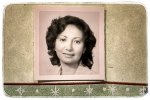
A room full of people watched me open it to reveal a card and three pages in which Eva explained that she was back in the Philippines and life had improved for her. She wanted to know how I was and would I be back over her way any time in the near future. There was also a small black and white photograph of her. She was still beautiful.
This required a lot of explaining to the curious onlookers, especially my wife. They all agreed it was a nice story, though I felt quite sad, especially at the moment my oldest daughter Sophie spilt a glass of orange Fanta on my mother’s new carpet.
I wrote back to Eva but never heard from her again. I’ve kept the tale in my head all these years and I’ve kept her photograph.
The Rest
I’ve described just seven of the dozens of treasures locked away in Mary Campbell’s old suitcase. They stir wonderful memories but also melancholic reflections of bygone days. Perhaps I shouldn’t have kept them.
My Photos of the Seven Wonders
- Log in to post comments
Comments
My dad was at the Wembley
My dad was at the Wembley match in 1953 (he was 25), when Hungary smashed England 6-3 and stunned not just the English players and spectators but the entire country. He's 97 now and remembers it very well - he says the England team considered Hungary a joke and thought it would be an easy win. I wonder if he is the last person alive who was actually there, the same way I wonder if he is the last person alive to see the Luftwaffe sweep in and bomb the Spitfire factory in Southampton in 1940.
That's an amazing coincidence about the fossil with the teeth ! Have you seen this which was found in Northumberland
https://www.bbc.co.uk/news/articles/c7v0ev05mdjo
I'm so glad you kept the objects and all the wonderful stories in your head which go with them. I'm with the Vikings who believed that nobody ever dies, so long as somebody tells stories about them. You have such a talent for making the mundane fascinating.
- Log in to post comments
Daisy and Dino
Death and taxes are said to be the only two certainties in life, but at least you can joke about death, I never heard anyone make a joke about the Inland Revenue, but well done for trying 
The photos are wonderful ! I wondered if the liner on the badge was the Queen Elizabeth, because she had two funnels (the Queen Mary had three, my grandad was a cabin steward on both of them) but I've just googled her and she was built on Clydebank. Do you think the picture is a specific ship ?
I live in a cottage which is reputedly 17th century and in the small bit which is my vegetable patch I've dug up all sorts of interesting things. Incuding some very large teeth and vertebrae which I've been told are from a cow. I don't like to say it, but they look a lot like your tooth, although I don't know how the stone would have got embedded in it. As you say, it's a pity we can't post photos in comments or I'd show you. In the days before refrigeration live cows were taken on ships for food supply. Maybe more Daisy than Dino ?
Eva is beautiful. We all have (or rather we don't have) 'the one that got away'. Maybe that could be an Inspiration Point ?
And it would be so interesting to know where that Buddha came from. In my family it was a Buddha which supposedly brought terrible bad luck. My great grandfather was in the Royal Navy and at some stage visited China, I guess this would have been about 1910. He and his mates went ashore, had a few beers as sailors do, and they broke into a temple and stole a small wooden Buddha. My great grandmother always hated it, my father who was her grandson said she had a real phobia about it and thought it brought bad luck. When my great grandfather was hit in the face in Southampton docks by a block and tackle swinging from a crane, and died as a result of his injuries, she blamed the Buddha and threw it into the fire.
- Log in to post comments
What a wonderful selection of
What a wonderful selection of curiosities and memories from your suitcase Turlough!
I was going to post the link to the 'teeth' but I see GlosKat already has, so instead I'd add one with the good news that the market is back to its original height for your Corinthian football figures.
I'd never heard of them before - maybe it was a regional thing? It was all Pokemon and World of Warcraft in my house, but I don't think any of my sons' friends did the football figures either:
- Log in to post comments
Loved reading about all these
Loved reading about all these precious things :0) All the threads of histories leading back to you
- Log in to post comments
I helped build the Queen Mary
I helped build the Queen Mary and Elizabeth and those teeth are mine--you thief, Turlough. Pity we don't have a link on ABCtales page where you can send old-stolen-teeth back.
- Log in to post comments
I helped build the Queen Mary
I helped build the Queen Mary and Elizabeth and those teeth are mine--you thief, Turlough. Pity we don't have a link on ABCtales page where you can send old-stolen-teeth back.
One of the older guys in Falkirk played with Puskas. He came here to work in the mines and the union wouldn't let him work for a lesser wage that members.
- Log in to post comments
To have that amount of
To have that amount of information at your fingertips is clearly an everllasting treasure that;s irreplaceable Turlough.
Very much enjoyed reading and the photos bring to life the history, along with your writing that's always interesting.
Jenny.
- Log in to post comments
"...an old suitcase..."
"...an old suitcase that belonged to a woman called Mary Campbell..."
A case full of history there Turlough, I know a few who toss memories away without giving the contents a second thought.
Excellent piece to read and one to dip into again.
Cheers.
ps. Your teeth tale, can I suggest posting it on Teeth Tales for more to read.
Another ps. re the shipbuilding tale. There is a link to call up the "...Radio Ballads..." on the BBC archives.
The spoken word, banter and song from all the trades that worked on ships.
Try Spotify
- Log in to post comments