


Incredible India - Part 4

By SteveHoselitz
- 485 reads
Much to the disappointment of my employer, I gave up my job editing the Indian & Eastern Engineer, relinquished my room with Mrs Lalvani, and double checked the details of the contacts TK and Rao had given me. It was mid-October.
Having rented the small but reliable moped from the same dealer quite often now, I had already made a new deal. I would buy an almost new, economical 125cc Honda motorcycle from him on the understanding that I could sell it back to him for an agreed price a few months down the line if it was still in more or less perfect condition. Hondas were very new to India at that time and were not readily available outside Mumbai, the most commercial of the Indian cities. So he told me that were I to sell it to a dealer in Madras, where I was ultimately heading, I might get an even better price. It cost me most of the money I had got from my safety-belt airline ticket home, but the resale price would cover the cost of the cheaper ticket I could buy along more or less the same route…
Early on a warm Sunday morning, I packed my modest belongings into a carry-all and strapped it to the carrier at the back of the bike, added a couple of other miscellaneous bits of luggage and set off to the Gateway to India – a few hundred yards from my lodgings. There I put myself and my motorcycle on a mid-sized ferry which was taking me down the coast to Goa.
The former Portugues colony on the Indian mainland was newly popular in the West, especially with hippies, and the snob in me wanted nothing to do with them. I was a serious traveller, not a weirdo with a drug-induced free spirit! Snobbery aside, actually what I really didn’t like in that movement was the way the hippies moved into India and started begging, as if the nation didn’t have enough of its own genuine beggars.
The all-day ferry journey arrived in Goa in time for me to find a modest guesthouse inland and the next morning I set off towards the Western Ghats. These are the range of hills which separate the coastal strip of the western Indian peninsular from the high Deccan plateau of central India, my next destination. I snaked my way up the Ghats in the way one might use an alpine pass, getting eventually onto the plateau in the Indian state of Karnataka and on to the remote Hindu mutt of Sringeri. This was the somewhat obscure spiritual headquarters of the sect my fellow boarder, Rao, followed. A few monks lived there and a ‘acharya’ or spiritual leader more popularly called a guru. Food and shelter were offered free to expected visitors and Rao had booked me in. It certainly was a learning experience, spending several days on end in this simple spiritual setting. This was an off season and most of the monks’ cells were empty. So much of the time I spent trying to make friends with a slightly smaller or young chained elephant who I think was there for ceremonial purposes. I am not sure if he tried to play with me or frighten me, but as I approached his stable he would suddenly charge at me to the extent of his substantial chain, sending me scurrying backwards. Then we’d go through the same cycle again. After a day or two I had an audience with the guru and we exchanged ideas for a littler while. (Rao told me many years later that the guru had told him he was impressed with me. I cannot really pretend that the feeling was mutual but it was an experience not be to regretted.)
From then on I was really following my own quite well researched itinerary, visiting some of the more remote and more important ancient Hindu temples with their exquisite carvings. I was almost always alone at these sites, a huge contrast to the repeat visit I made with my wife many years later when they same temples were big visitor attractions.
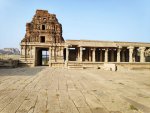
The most remarkable of all these was Hampi, little known, almost unmarked on maps and mentioned in very few of the texts I had been able to find. It is now a UNESCO World Heritage Site. I know not why this part of Indian history has been all but forgotten for it was the capital of the hugely important Vijayanagar Empire from 1336 to 1565. It was a prosperous grand city with numerous temples, farms and trading markets, estimated to be the world's second-largest city by 1500, after only Beijing. It was probably India's richest city at that time, attracting traders from Persia and Portugal. One chronicler estimated it had around 200,000 soldiers including 170,000 foot soldiers, 30,000 cavalry, and 550 war elephants. The Vijayanagar empire was defeated by a coalition of Muslim sultanates; its capital conquered, pillaged and destroyed by Muslim armies in 1565, since when it has remained in ruins. They are spread over 4,100 hectares (16 sq miles) with more than 1,600 surviving remains of the last great Hindu kingdom in South India that includes forts, royal and sacred complexes, temples, shrines, pillared halls, mandapas, memorial structures, water structures and others. For me back then I felt like a world discoverer, and among what I found were – and still are – some of the most intricately carved temple pillars of all India. It was me and my little motorbike alone in the vast area of ruined temples and other buildings with no guides, no explanatory signs, nothing.
I stayed in a very basic guesthouse in a nearby town but even there it appeared that no one really cared much about what was on their doorstep. It was certainly not a good grazing area for their goats.
My extensive tour took me on to other wonderous sites but none so neglected or apparently unknown. I was revelling in what I was finding, learning and starting to understand. Southern India had won me over. The colourful gopurams of several large cities, Madurai being the most notable, were a fabulous colourful thrill. Living temples full of life and devotion with their absurdly high gateways a testament to the concept that “we can go one better here than you can, so there”…
And in between there were visits to the relatives of my boarding-house friends. Sometimes we only had a very few words of language in common, but I was always treated to the kindest most generous hospitality. In one embarrassing visit to a very simple home of an aunt or uncle, the couple moved out of their marital bed and onto the earthen floor for me to sleep.
I was wending my way ever southwards eventually reaching the wonderful site of Mahabalipuram, on the eastern shores of southern India south of Chennai where there are 7th- and 8th-century rock-cut Hindu monuments and the most marvellous the giant rock relief, the Descent of the Ganges, complete with elephants. From there I went to the former French enclave of Pondicherry – now Puducherry - and then even further south to an amazing spit of land reaching out towards Sri Lanka with of course a temple on it called Rameswaram. The southern voyage ended at India’s ‘lands end’ in Kanyakumari, known as Cape Comorin during British rule. It is also a noted pilgrimage site with both a Hindu temple and a church, some kind of centre of Indian catholicism.
Somewhere along the way - I can no longer remember where or when - I had had an encounter with one of the very common long horned water buffaloes pulling a cart over a narrow bridge. Like on many of the roads, the traffic, be it cars, vans, lorries, carts or anything else, obeyed no rules about where on the road they travelled. Sometimes coming towards you alarmingly, sometimes keeping to one side, sometimes turning in front of you without signals or coming out of a side street without warning. Perhaps it was a miracle that it only happened badly once, but the only way not to become part of the buffalo’s headgear was ‘to put my motorcycle down’ to use a technical term. I was not hurt, but the precious Honda, which until then had remained in showroom condition, had slight scratches and a cracked indicator lens.
I suspected that when I came to trade it in at the end of my travels, my repayment might be less than anticipated. So in Chennai, I did as had been suggested and contacted a local dealer. He was happy to have rare stock, but sucked on his teeth when he noticed the scratched paintwork and cracked lens. Some keen negotiation went on for I had to balance the cost of his offer and a train ticket to Mumbai against the cost of motor-cycling for several days the 900 miles back to deal with my friendly dealer back there.
In the end, with a bit of squeezing on both sizes, I got a reasonable deal and sold the bike. He got a good bargain but I saved myself a long road journey.
Back in Mumbai, I collected what little I had in storage and found the best price I could for a plane ticket back with someone dealing with Middle East Airlines.
What I hadn’t expected was that I was told that before I could leave, I would have to get tax clearance. This involved going to a tax office and meeting the relevant official. In a small office not much larger than a generous toilet cubicle, the official sat surrounded by piles of paper reaching to the ceiling and tied in bundles with red ribbons. I feared that I would be with him for hours, possibly days or even weeks! In fact, by some way or another, he quite quickly found what he was looking for, stamped the form and handed me the paperwork that would satisfy the relevant official at the airport.
My ticket bought I said my farewells to Shanti and her brother Patrick, to Rao and TK and a few others and made my way to the airport of the outskirts of town. The route was Mumbai to Cairo, home to MEA and a connecting flight to London. That was the plan, but it didn’t quite work out like that.
We got to Cairo and were shown into the terminal… and there we stayed. It transpired that the Egyptian President, Abdul Nasser, had commandeered our plane to go to a summit with Muammar Gaddafi of Libya. So there we sat in the transit lounge with no information, no food or drink and no prospect of an onward flight. After several hours a tall blond smartly dressed man I took to be British approached me and told me his name was Richard Harrison. He was about my age, perhaps a little older, and he said he was very scared. “I’m Jewish so if there’s any trouble here it won’t go well for me,” he told me. I didn’t quite laugh but I reassured him that no one would know he was Jewish and that there was unlikely to be any trouble. At some stage during the evening a relief plane was found and we were allowed to continue our flight, first to Germany and then on to London. Richard was home safe – and so was I.
I got the free bus from Heathrow to Victoria station and sat on the platform in my tropical suit at about 5am in the middle of a British winter waiting for the milk train out to when my parents lived in Surrey. Sitting there in the freezing cold I was accosted by an inebriated bag-lady with a strong Scottish accent.
With perfect symmetry to the start of my Mumbai life, she asked me if I had had a good night with the call girls.
- Log in to post comments
Comments
I really enjoyed reading this
I really enjoyed reading this Steve, thank you. I don't suppose you took a camera and kept the photos? How lucky you were to be able to see those places while they were so empty of other people!
- Log in to post comments
Oh how annoying! Then this
Oh how annoying! Then this account is even more precious
- Log in to post comments
I fondly remember visiting
I fondly remember visiting India in 2017. I was due to take a tour of Southern India in 2019 but had to cancel at the last minute for family reasons. It really is a breathtaking part of the world.
I enjoyed all four parts of this so feel it's only apt to make this today's Facebook, X/Twitter and BlueSky Pick of the Day.
Congratulations.
[I haven't been able to verify the source of the photo used. I imagine it's one of your own but it would be great if you could confirm so that we know it's copyright free]
- Log in to post comments
What an adventure! I was so
What an adventure! I was so interested in the kindness and hospitality of everybody you encountered
- Log in to post comments
Pure travel
No credit cards, no mobile phones, no Airbnb, no hordes of noisy tourists. That is exactly how overseas travel should be.
I’ve loved all four parts of this account of your great adventure and I really hope you have more travel tales to share with us.
Your golden cherries are well deserved.
Turlough
- Log in to post comments
wonderful story-telling and
wonderful story-telling and you'd a great story to tell.
- Log in to post comments