


The Way We Heard - Rat Trap

By Turlough
- 235 reads
The Way We Heard - Rat Trap
The monsoon rains, it seemed, had forgotten when to stop. The Habagat’s relentless deluge should have ended weeks earlier, the jeepney drivers complained whilst concealing their delight that travelling around Manila had become difficult and the perfect reason for increasing their fares. A leather pouch bursting with money at the end of their shift was the perfect antidote for the dark skies, damp clothes and constantly steamed-up windows.
In the city’s Tondo district near to the port, heavy raindrops rattled on the corrugated iron roof of the Pillar Bar, finding their way in through holes where the metal sheets didn’t meet or had rusted away from the bolts that loosely held them together. Carmelita had grown up in that little bar, clearing tables and washing glasses from the age of five, and had been running it by herself since that terrible night her father was taken away. She’d been in her early twenties and had no other means of support after the old communist and the majority of his customers were handcuffed and thrown into the back of the police truck. Her mother had also been a desaparecido but for different reasons, and had once sent her money in an airmail envelope with an Arizona postmark. The place where the poor girl had been born had become her whole life.
Dark-skinned Mauricio helped her. Despite his advancing years and his slight frame he carried up the heavy crates of beer from the basement storeroom and dragged out into the street the unconscious bodies of merchant seamen who hadn’t been prepared for the kick they’d get from the milky-white coconut vodka poured from bottles that were probably worth more money than the liquor they contained. Lambanóg was its correct name but that was a word too long for the punters to remember even before they’d started drinking it. It was easier to call it alak, the locals’ generic slang word for booze. For four months of the year he bore the additional task of emptying the dozen or more old Castrol cans that collected the rainwater that dripped from the ceiling. On the wettest days this job could be compared to a circus plate-spinning act as he dashed from one corner to another, arriving at each just in the nick of time. He was rewarded with a sweat-stained mattress on a bed frame he’d made himself from discarded wooden packing cases he’d found by the dock gate. It elevated him above the place in the store room where the rats scurried and gnawed in the night, and above the status of many of the homeless people of the Tondo.
Jimmy had gone to the bar with two other men from the ship. Tam and Dougie were people he would loosely call friends but with whom he had absolutely nothing in common other than the fact that they were thousands of miles from home and each had a strong urge to go ashore. Twenty-five-day sea passages, such as the one they had just sailed from Melbourne in Australia, were best described as monotonous. When invited, the remainder of the thirty-strong crew had whinged and whined that they didn’t want to climb into the taxi-boat that would take them from the anchorage to the harbour because they didn’t want their good clothes to get wet. In Jimmy’s opinion they themselves were a bit wet. His main reason for choosing to work on deep-sea-going vessels was to see the world and all it had to offer. So sitting in a pokey cabin with a dog-eared Harold Robbins paperback and a can of rough Aussie lager while the lights of an exciting Far Eastern capital could be seen in the distance through the porthole, at least when the rain eased, was certainly not part of his plan.
A few hours earlier Tam had read for the third or fourth time the letter from his wife in Dundee in which she’d listed a series of household expenses that had piled up in the two months since he’d left home. It was the stuff of the dullest nightmares, like the car needing a new exhaust and the twins wanting to start after-school clarinet lessons. Problems that he wanted to moan about but nobody on the ship was interested in hearing, especially Jimmy who didn’t have a car and was not long out of school himself. Lovely Mags had told her faraway husband that they couldn’t afford him going ashore wasting their precious money on enjoying himself, but he knew that in Manila a night out would be cheap, especially if he went to the Tondo and only had just the one or two, or maybe four. The local alak was cheap and strong. He’d had it before so he knew that three glasses would leave him in a state somewhere between cheered up and death. He could get stotious for less than what he’d pay for a pint of Tennent’s at home. He described it as a tonic for the troops and hoped he might find someone to talk to about his troubles while he drowned his sorrows and internal organs. There was nowhere like a Filipino bar for meeting people, which could be looked upon as both a good and a bad thing.
Dougie loved Manila. He said you could get anything you wanted there, and he meant it, but nobody ever dared to ask him what his precise requirements were. He loved the excitement of mixing with people in shanty towns. They could take your money, slit your throat or give you a night you’d remember for the rest of your life. In his time Dougie had had so many nights to remember for the rest of his life that he’d made a list of them on the back of an Indonesian beer mat in case he forgot any. He kept it with his passport, his Merchant Navy discharge book and a creased black and white photograph of a Latina girl he’d fallen in love with in Valparaíso more than twenty years earlier. He knew exactly where to go on that rainy night and consequently he was the obvious choice as a local guide for Jimmy and Tam, who didn’t.
The taxi driver wouldn’t stop his battered old Datsun outside of the Pillar Bar because the road was flooded. There had already been water coming in through the holes in the floor as they sped away from the dock gates and along the Ferdinand E. Marcos Boulevard. He drove an extra 300 metres up the road and then, from behind a curtain of rosary beads, crucifixes, holy medals and plastic flowers that hung from the rearview mirror and the roof above his seat, he demanded a fare greater than what they’d agreed upon at the pick-up point. This, he explained, was because he’d had to drive further than expected. Tam, with only costly clarinet lessons on his mind, complained that he should have reversed back down the road and charged them less. Dougie knew not to argue as they would probably be needing a taxi back to the ship at some point, and also they didn’t want their heads stoved in by the driver’s workmates.
Carmelita squealed with delight when she saw the three drowned rats walk into her bar. She was pleased to see Dougie again and calculated how much money he would spend with his two friends in tow. She gleefully but abruptly snapped her fingers telling Mauricio to bring up a couple more crates of beer as she proudly poured three large glasses of the coconut vodka that she’d made herself on the premises. She pointed at a collection of metal buckets and coiled-up tubes piled on top of an oil drum in a far corner as evidence of this.
‘On the house!’ she shouted with a grin, ‘Welcome home Dougie, mi amigo!’
Tam was very happy that the first drink had been free. Perhaps they should go out and come back in again for the next one. Jimmy tried to remember when he’d last tasted something that had tasted of coconut, rubber and paraffin. It had probably been at a house party in Bradford. Dougie threw back his drink in one, asked for another, laughed too loudly and put his arm around Carmelita’s bare shoulders in a tactile, over-friendly sort of way. She didn’t flinch. She’d seen it all before and she’d be glad to see his cash.
Everybody was pleased when Mauricio returned from the basement, his weak and gnarled septuagenarian legs buckling under the weight of a dozen litre-bottles of Red Horse in two metal crates. The beer was strong but not as strong as the firewater with the typically tropical taste, so Carmelita was relieved that the three jolly jacks wouldn’t get pissed so quickly and that she’d make a fair old profit out of them. The malty brew was easier to drink and more convivial to a social occasion, though Tam could only think of how his youngest had walked dog shit onto the best living room carpet at home and how much Mags would need to pay to have it cleaned.
Queenie told people she knew that she had a full-time job in the Pillar Bar. In actual fact she would just go there every night and sit and chat to Mauricio until the place started to get full. She always knew it was time when the concentration of tobacco smoke in the air began to sting her eyes. Filipino cigars were very popular because they were cheap and one of them would last longer than ten cigarettes, but they gave off fumes like a barbequed tractor tyre. She’d then ask the old man to go behind the bar and fiddle with the dial to turn up the volume on the jukebox. When she was happy with the music she would start dancing slowly around the room, seductively rubbing her hips against the upper arms of the men sitting at tables, especially the foreigners who were likely to have the most money in their pockets. At short but irregular intervals she would remove an item of clothing and carefully put it on the table she’d been sitting at. They were the only clothes she had so she couldn’t afford to lose them. A combination of the hot humid climate and poverty meant that she didn’t wear many clothes, so within quarter of an hour she was down to just her pants. At this point she would thrust her groin towards the punters, gesturing that they should pay for the entertainment by putting some money where the elasticated waist of all she had on to retain her dignity would hold it in place. Then she’d count the grubby bank notes, put her clothes back on, buy a beer and sit with Mauricio until a new crowd of punters came in. Mauricio looked out for her as best he could. Some people said he was her grandfather.
She’d previously worked long hours for little pay in an old factory where they made clothes for some of the big European shops like Marks & Spencer, C&A and Topshop. A team of eighty women turned out beautiful dresses and coats. She’d have loved to have had one for herself but she’d never been able to afford such luxury. A pair of knickers would have done to replace her own pair that the mice had nibbled holes into as they hung on the back of her kitchen chair to dry overnight after she’d washed them in the sink. She wasn’t sad when she lost this job. Her boss had sacked her when he discovered she’d been doing her striptease routine for money in the yard where the men went out to smoke cigarettes during their short breaks. She could work fast when she needed to.
A couple of hours into the evening Jimmy overheard Tam telling a heavily tattooed man from a Greek oil tanker about the price of school dinners in Scotland. It was hard to see Dougie who was hidden behind an ever-growing forest of empty bottles but it was obvious that he was still there as he could be heard singing about whether to take the high road or the low road to somewhere or other.
Jimmy was bored so he wandered over to look at the jukebox in the middle of the wall directly opposite the bar. Stacked full of seven-inch vinyl records it asked ten pesos (around thirty British pence) for five plays. He only had notes in his pocket. One of them was a ten-pesos note but the machine only took fifty-centavos coins. At the bar he swapped his paper banknote for a pile of heavy metal money that could have been mistaken for pirate treasure, and then started looking for five records that were to his taste. From past experience of Southeast Asian jukeboxes, he expected to find nothing other than Southeast Asian pop music, but on this occasion there were some very nice surprises.
From behind the pile of an alky’s debris he heard Dougie’s voice, ‘Put on The Road to Dundee or I’ll break your fucking fingers.’ Whilst trying to decide which of those two options would be the least painful he pressed the buttons that brought alive Thin Lizzy’s and Waiting for an Alibi and No More Heroes by the Stranglers. These were among a dozen records that somebody, probably off a ship, must have brought out with them from Britain and all of which were, for him, a joy to behold. He imagined what the people who had stayed on his ship would be doing. At eight o’clock in the evening in the officers’ bar on the Cape Grenville they’d usually be listening to drippy music by the likes of the Eagles or Neil Diamond, or that awful cassette full of songs about the Ballachulish Ferry and the Crinan Canal that the captain insisted on playing when he’d been at the Glenmorangie all day. But there in the Pillar Bar, little Jimmy would be in his element for at least five times three-and-a-bit minutes.
He continued to stand in front of the record machine while his five songs played and as soon as they’d all crackled to a finish he bought two more litre-bottles of beer and asked for all his change in coins. With his bagful of pieces of eight and the perfect noise to drown out the awful din of the seafaring hoi polloi behind him, he settled in for a proper music session. There was nothing else he could do as the rain outside had become heavier, as had Tam’s conversation and Dougie’s drinking, so he didn’t really want to go anywhere else with that pair of saddos as companions. He looked over his shoulder to see if they were still there. Dougie was asleep with his podgy face spread out in a puddle of beer on the table and Tam was dropping a fist full of loose change down the front of Queenie’s flimsy pants.
He conceded that in a strange way he was enjoying himself but then disaster struck. About a minute into Sound and Vision by David Bowie the machine’s needle got stuck on one spot on the record. The disc seemed intent on perpetually turning out the words ‘blinds drawn all day’. He knew that giving the machine a little nudge would solve the problem. So he did, and after a split second of screechy-scratchy noise, a shrieky noise came at him from behind the bar.
‘Don’t shake jukebox!’ screamed Carmelita angrily. Feeling a little startled he turned to face her, smiled, held up a thumb in acknowledgement and returned to his one-man rock festival. She didn’t return the smile.
Ten minutes later it happened again. Elvis Costello sang ‘in the bargain bin in the bargain bin in the bargain bin’ over and over again when he was supposed to be explaining why he didn’t want to go to Chelsea. Jimmy repeated his corrective action, Carmelita repeated her words of authority and then a flying beer bottle smashed against the wall above his head. The Tondo ghetto girl wasn’t joking.
Shocked by the near miss and the shattered glass, he was also saddened by the sordid state of the scene around him and the people he was with. It was time to leave, thought the young merchant seafarer, with or without his wearisome salty old sea dog acquaintances. He headed for the door wondering if Tam and Dougie would follow but nobody moved. Instead the fifteen or so people in the bar shouted in unison ‘Curfew! Police curfew! Stay in bar!’
He hadn’t known about the extremes that President Ferdinand Marcos’ regime went to in its attempts to quell demonstrations against the Philippines’ brutally fascist dictatorship. The heavy-handed Manila Police had been instructed to enforce a curfew from nine o’clock each evening until four in the morning so he was stuck there in that sorry hole, or a police station cell, until the early hours.
As Queenie took off her frayed blue cardigan with most of the buttons missing for the third time that evening, Jimmy bought another bottle of Red Horse, took a little walk over to the jukebox, inserted the weighty handful of coins, pressed the appropriate buttons and then sang along to Rat Trap, by the Boomtown Rats.
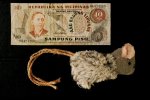
Image:
My own photograph of my own 1970s Filipino ten-peso banknote and my cats’ fluffy toy rat.
- Log in to post comments
Comments
Magnificent, and well worth
Magnificent, and well worth the wait - thank you Turlough
- Log in to post comments
Music as an oasis :0) (not
Music as an oasis :0) (not Oasis!)
Am wondering how on Earth you moved house to Bulgaria, with so many souvenirs? Also, how you know to find the right ones, at the right time?
have just spent half an hour looking for my new bank card, which had forgotten to put in my purse when it arrived, then forgot all about till today when tried to buy my shopping
- Log in to post comments
Is this based on a true tale
Is this based on a true tale from your sea-faring days Turlough ? Very entertaining !
I think perhaps the girl from Valparaíso was Latina rathe than Latino. But maybe not.
- Log in to post comments
Rat Trap, right enough. I was
Rat Trap, right enough. I was going to write a story called I Don't Like Mondays. It was exactly like your story (only better) and set on a Monday.
- Log in to post comments
Fabulous, Turlough. Humid and
Fabulous, Turlough. Humid and dirty and the sort of other worldly tale we need more of in this increasing sterile world of technology, cameras everywhere and prebooked nights out. I enjoyed the contrast between the all out piss up and the borefest of the letter from home.
I recently had an ex army colleague and he told me a story about how his troop all went out drinking in some country and one of them woke up blind, he shouted this to another sargeant who was Russian and the reply he got was, 'One of mine is dead.' The coconut vodka does sound quite nice though.
- Log in to post comments
Tremendous stuff, Turlough. I
Tremendous stuff, Turlough. I want to hear more of your (mis)adventures during your travels. Queenie sounds worth an entire volume all to herself!
- Log in to post comments