


His Running Top

By Jane Hyphen
- 2319 reads
On the radiator, it sat, folded over neatly, waiting for him to put it on, warm on his skin, before his next run.
Now it gathers a layer of dust that requires it to be removed and shaken violently before being carefully replaced, just in case. In case what? He returns from wherever he’s gone to and feels instantly ready for another run.
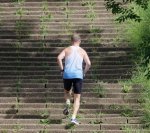
He died nineteen years ago. A keen runner of marathons and half marathons, often winning his age group category for the latter, running was something which gave him both an outlet and a purpose. Something he could do anywhere, any time. It didn’t matter how awful his job was, how terrible his behaviour was, he could still go on a run and reboot himself.
Put one foot in front of the other, accelerate, find a rhythm and breathe. It’s hard at first but it gets easier, at least some of the time and it doesn’t cost anything. You don’t need a gym membership, just a pair of trainers and a share of the earth’s surface.
There is pain too, the sort of pain which might cause a person to feel like they were being punished and if they also felt that they deserved it perhaps it might give them a sense of salvation. Then there is the deeply layered purging which occurs on longer runs, the shaking and burning of flesh, cells which idly float deep in the sleepy chambers of the human body are convulsed.
A purging of the mind may also occur. The constant predictable heavy patter of feet, the continuous pounding of the pavement, one two - one two, predictable and calming. The result is that the mind opens up and achieves a state of flow, breaking off those sticky thoughts which cling to the sides of human consciousness and hang heavy like stalactites.
Mind stalactites fall into the centre of the open mind and crumble into small, manageable crystals, some are transparent, one can see through them and conquer them. Others may be opaque or semi-opanque, these can be partially processed, the remainder returning to the sides of the mind in shorter stalactites, only to be broken again on subsequent runs.
The period between runs is almost as cyclical as the run itself. That euphoric period of time, post run, the exhaustion, the endorphins, circulation circulating without friction. Body lean and flexed, toxins sweated out into the atmosphere, up into the clouds to mingle with the other fluids of the universe.
A thirst and a hunger follows, the body scrambles to replace lost minerals and calories, light headedness may occur. The waxing of the post run high lasts a day or two and the waning sets in. Feelings of psychological bloat, physical mediocrity and a heavy sense of dullness creep in, sometimes even of being dirty. The only cure is to put on those running shoes again and get out there.
Runners may carry a phobia of injury, broken limbs or illness, a national lockdown or some other reason which prevents them from running.
The body was designed to chase and run away, short distances at variable speeds. Running diaries and goals are thoroughly artificial. Personal bests and internal competitiveness. The desire to be fit, athletic and more desirable to the opposite sex, the envy of your peers. People who discover running in later life may harbour the vain sentiment that they would have been Olympians, had they only started earlier.
Official runs still result in a medal. A medal around your neck and a photo, even if you come last. The times are published along with the names of the participants.
He did so well that a prize was named after him. After his sudden death, his wife was asked to attend the next race and present the prize to the winner. She said she couldn’t. The pain of being so close to his greatest love was greater than that of losing her own greatest love.
The thing was it was his prize, the fastest veteran and he was coming back to put on his running top and run again. His attire was waiting for him on the radiator.
A few friends and relatives had questioned why his favourite running top was still laid out, folded neatly on the radiator. Their enquiries were met with a shrug and an awkwardness which was effective in extinguishing further curiosity. The youngest grandchild once removed the top and hid it but it was quickly found and replaced.
He was running almost to the end of his life but he’d had some symptoms, breathlessness, chest pain, all dismissed by his doctor who insisted he was as fit as a fiddle. Indeed he had the fitness of a man half his age. There was no need for further tests, it was likely indigestion.
The human heart lies hidden, except for its constant pounding, one two - one two, predictable and calming. It makes you feel safe because it was the first music you heard in your mother’s womb.
There was some sort of blockage, some plaque which hadn’t managed to shake itself off down the arteries, instead it had clung to the sides and gradually grown like a stalactite. Nobody could see it, by the time it was felt, it was already critical.
‘I can’t see,’ he said after returning to the doctors, newly diagnosed with indigestion.
The first organs to shut down are the non-essential ones, hearing, sight so that the blood can continue flowing to the essential ones.
An ambulance was called, a specialist on call, called in on his day off arrived in a tracksuit. He scrubbed up and performed key-hole surgery, inserting two stents. He’s not out of the woods yet. It’s going to be a long recovery. He only survived because he’s so fit.
Fate intervened. The damage to the body’s largest muscle was too great. The muscle that served him faithfully on his many runs. Perhaps he’d asked too much of it, maybe it was strained. Some people believe that the number of heartbeats in a human body are finite.
Some people believe that a deceased loved one may return in some form and if they do, it seems logical that they will seek to indulge in the activities that they enjoyed when they were physically present.
He remained present in that running top of the radiator. It had been laid out there on the day of his heart attack and there it would stay. Time had marched on but in that gesture it had stood still.
And if he did come back in any form, the first thing he would want to do, wouldn’t be to greet family members or speak of what lies behind the curtain, it would be to take his warm top off the radiator, put it on and go out for a run.
His wife would keep an eye on the time and make sure there was an electrolyte drink, hot water and clean towels for his post run shower. No questions would be asked as she prepared his dinner. Everything would be as it was. The passing years were simply a detail and more passed, it seemed even more futile to get rid of his top or hide it away.
- Log in to post comments
Comments
Excellent Jane. Clearly
Excellent Jane. Clearly heartfelt and personal.
- Log in to post comments
This is such an interesting
This is such an interesting piece Jane, in one way it's quite a remote narration, but at the same time it's touching and reads as intensely personal. Thank you for sharing it
- Log in to post comments
aye. could happen. did happen
aye. could happen. did happen. maybe.
- Log in to post comments
Hi Jane,
Hi Jane,
you've woven a moving account of this runner. I can understand the need to hold on to his top, it's part of who he was and keeps his memory alive.
Having been a fitness fanatic back in the late 80s and early 90s, I can relate to the addiction of running, and how good it can make you feel.
You told the story well Jane.
Jenny.
- Log in to post comments
Running
It was my knees that made me give up running, together with a bit of laziness, but before the niggleing pains got me I went through all the mid-life personal bests and internal competitiveness stuff that you've described. And although it never happened to me, I can understand how people can get hooked on running.
As I read about your man striving to improve his fitness I thought good on you! so the sadness towards the end came as quite a contrast. And I was sorry to learn that it was based on your family's experience.
Turlough
- Log in to post comments
Bossy people
My fitness regime amounts to this...
Any exercise is good provided you don't have to pay a subscription or wear lycra to do it.
Gardening is best. It's a great feeling when the muscles are aching at the end of a day but your lungs have been full of fresh air and your garden looks nice.
There are no bossy people in our garden. Well, there's one, but we usually work apart from each other. She would probably say the same.
Turlough
- Log in to post comments
An enthralling read, Jane -
An enthralling read, Jane - and as an ex-distance runner (did it for 30 years and only stopped because of increasing injuries) I can say you've captured the essence of it perfectly. Are you a runner yourself? It's funny, but I sometimes felt - on those long Sunday runs, with my heart-rate and breathing and pace in that wonderful high-level unison - that the feeling was close to ecstatic... but with a sense that it could all just stop at any second, and I'd run out of life, literally. I always maintained that I'd be a runner for the rest of my days, because there was no greater feeling. I still miss it.
A very moving story.
- Log in to post comments
Haha! I well remember the
Haha! I well remember the times I'd far sooner go out for a run than sit down and try to write something! I find writing much harder. At least I don't have to make up the road!
- Log in to post comments
I really enjoyed this piece.
I really enjoyed this piece. Congratulations. It's our Pick of the Day.
- Log in to post comments
You explain the euphoric
You explain the euphoric state from exercise so well (I used to love walking) the importance of moving in ones own rhythm. I was struck how this story is all about movement, but also about keeping still. Keeping the possibility of movement in the stillness of absence. I am sorry to hear of your loss of a loved one
- Log in to post comments